
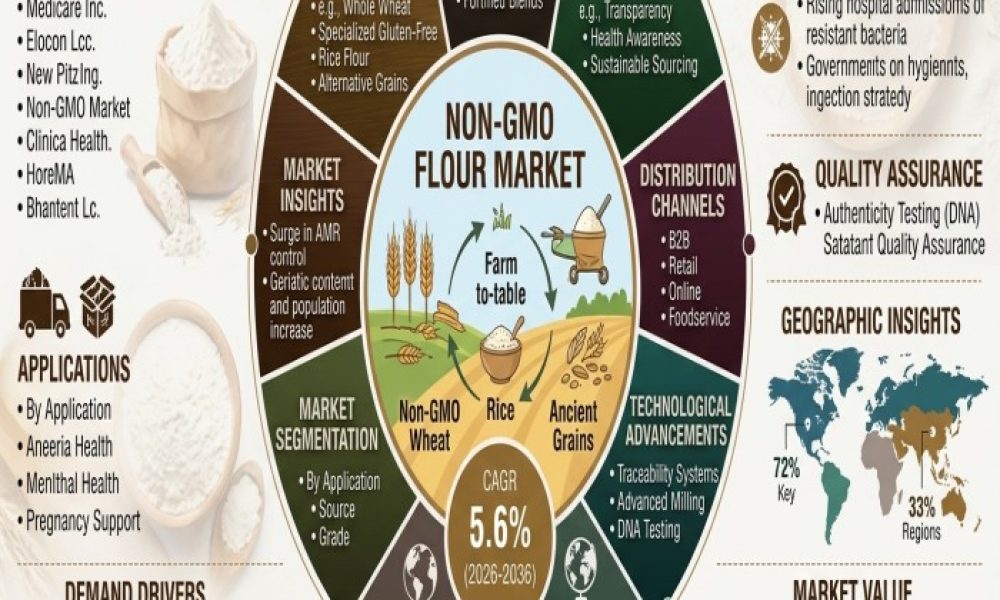
Rockville, Maryland — September 30, 2026 — The Non-GMO Flour Market is valued at USD 70.2 billion in 2026 and is projected to reach USD 121.1 billion by 2036, advancing at a 5.6% CAGR during the forecast period. Fact.MR identifies growing demand for documented ingredient sourcing, clean-label bakery products, and verified grain handling as key factors supporting market expansion across food and selected industrial applications.
Get detailed market forecasts, competitive benchmarking, and pricing trends:
Bakery manufacturers are increasingly seeking non-GMO flour inputs to maintain clear clean-label claims across bread, biscuits, cakes, cookies, and packaged baking mixes. Food processors and private-label retailers are also placing greater emphasis on ingredient evidence before products reach shelves. This is increasing the importance of crop segregation, traceable storage, documented cleaning procedures, and certification practices throughout the flour supply chain. Industrial users additionally support demand where starch performance and predictable viscosity matter in paper, textile, and adhesive formulations.
Wheat Starch remains the leading product segment, accounting for 45.9% of the market in 2026. Its broad compatibility with bakery, confectionery, and processed food formulations allows manufacturers to incorporate it without major changes to established production systems. Bakery Products and Confectionery leads the application segment with a 35.9% share, supported by strong use of familiar flour systems in breads, biscuits, cakes, cookies, and other packaged bakery products.
South Korea is expected to record the fastest country-level growth among the countries highlighted in the report, reaching a 5.9% CAGR through 2036. Imported clean-label food demand and close attention to food labeling support adoption, while inspections and documentation add compliance requirements. The USA follows at 5.8% CAGR, supported by substantial flour milling capacity and mature organic food retailing. The U.K. is projected to grow at 5.2% CAGR, with organic cereal production and supermarket visibility supporting demand for certified food ingredients. France and Germany are also covered by the report at 4.9% and 4.7% CAGR, respectively, reflecting bakery consumption, organic farmland, private-label channels, and demand for verified ingredients.
Opportunities include certified bakery mixes, rice and tapioca blends, private-label sourcing, and non-food starch grades. However, certification and audit costs, crop segregation limitations, food-price pressure, and potential confusion among non-GMO, organic, and bioengineered disclosure claims may affect purchasing decisions and supplier economics. Documentation and claim management remain relevant.
Key companies include King Arthur Baking Company, Bob’s Red Mill Natural Foods, United Natural Foods (UNFI), and Eden Foods. King Arthur Baking has direct flour-market relevance, while Bob’s Red Mill offers Non-GMO Project Verified grain and flour products. Eden Foods participates in organic flour and grain categories, and UNFI provides wholesale distribution reach.
With the market expected to add USD 50.9 billion in absolute opportunity by 2036, suppliers and buyers are evaluating sourcing, certification, formulation performance, and regional demand together. The full Fact.MR report provides detailed analysis of product segments, applications, country growth, competitive participants, and market dynamics.
For procurement teams, the report indicates that non-GMO positioning increasingly depends on evidence beyond the finished flour package. Mills need access to identity-preserved grain and controlled handling practices so sourcing claims remain consistent from intake through bagging. Bakery manufacturers can evaluate performance across high-volume recipes before broader formulation changes, particularly where texture and shelf-life characteristics matter. Retail teams can distinguish non-GMO positioning from organic claims to keep package communication clear and supported.
Country differences create varied operating conditions. South Korea’s market development is linked to imported food availability and labeling discipline, while the USA combines large-scale milling activity with established certified-food demand. In the U.K., organic cereal acreage and supermarket sales provide visibility for certified products. France benefits from its established bakery market, while Germany’s organic farming base supports ingredient availability for bakery and private-label channels. Across these markets, pricing, certification requirements, logistics, and sourcing documentation remain practical considerations for market participants.
The report covers North America, Latin America, Europe, East Asia, South Asia and Pacific, and the Middle East and Africa. Its assessment spans wheat, rice, maize, barley, potato, and tapioca-based starch sources, with applications including bakery and confectionery, pasta and noodles, non-food uses, processed foods, and animal feed. This scope helps stakeholders assess where non-GMO sourcing claims intersect with formulation and procurement needs.
Note: South Korea, the U.K., and the USA were chosen because they combine the report’s highest country CAGR, a European market with meaningful growth, and a major food-processing market.
Explore More Related Studies Published by Fact.MR Research
About Fact.MR
Fact.MR is a global market research and consulting firm, trusted by Fortune 500 companies and emerging businesses for reliable insights and strategic intelligence. With a presence across the U.S., UK, India, and Dubai, we deliver data-driven research and tailored consulting solutions across 30+ industries and 1,000+ markets. Backed by deep expertise and advanced analytics, Fact.MR helps organizations uncover opportunities, reduce risks, and make informed decisions for sustainable growth.
– Contact Us –
11140 Rockville Pike, Suite 400, Rockville,
MD 20852, United States
Tel: +1 (628) 251-1583 | [email protected]



