
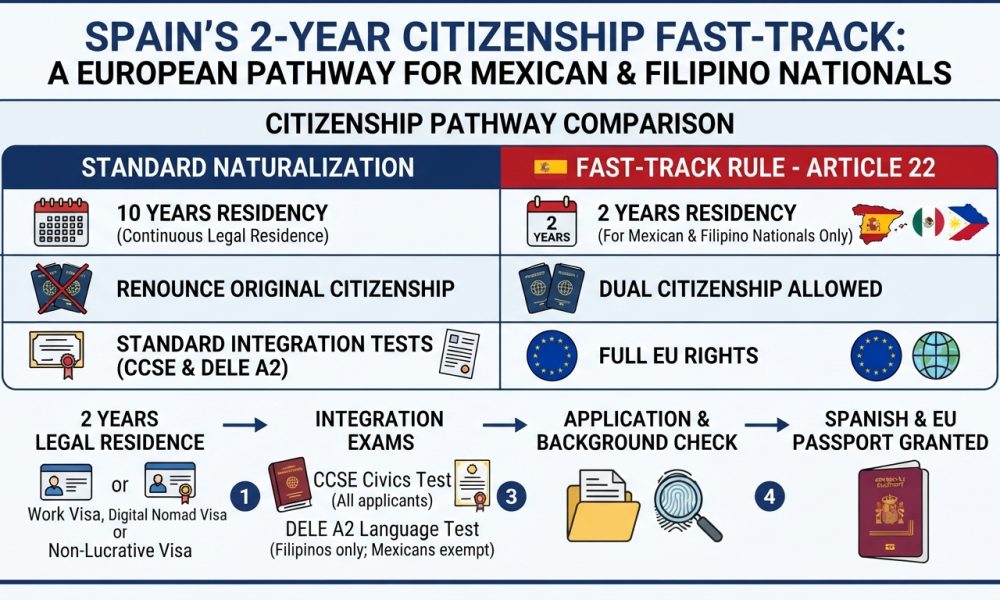
Spanish nationality law offers eligible Mexican and Filipino nationals a comparatively rapid route to applying for European Union citizenship after two years of qualifying residence. However, approval, registration, and issuance of a Spanish passport require additional steps and careful documentary review.
WASHINGTON, November 15, 2026 — Mexico-born and Philippine-born nationals considering a European future can benefit from an unusually short residence requirement under Spanish citizenship law. Still, the opportunity depends on actual lawful residence in Spain, not passport possession alone.
Article 22 of Spain’s Civil Code establishes a two-year qualifying period for nationals by origin of Ibero-American countries and the Philippines, among other specified groups, compared with the ordinary 10-year period imposed on many foreign applicants seeking citizenship through residence.
That distinction has become increasingly important for families balancing global mobility, education, retirement and business interests, because Spanish citizenship eventually confers European Union rights. At the same time, a residence permit or a pending nationality application does not, by itself, deliver those privileges.
A Historic Exception With Modern Consequences
Spain’s preferential nationality provisions reflect longstanding historical relationships with much of Latin America and the Philippines. Yet, the legal advantage is not a blanket entitlement for everyone holding Mexican or Philippine documentation or identifying with those countries through ancestry alone.
The statutory wording, which specifically refers to nationals by origin, requires attention to how an applicant acquired nationality, meaning that someone born a Mexican or Filipino citizen may have a different position from someone who acquired that citizenship later through ordinary naturalization.
A dual national who was Mexican or Filipino from birth should therefore obtain individualized legal advice and evidence of original nationality before relying on the shortened period, particularly when later naturalization, reacquisition or changes in civil status complicate the record.
The same legal provision also includes qualifying nationals from other Ibero-American countries, Andorra, Equatorial Guinea and Portugal, together with a separate category concerning Sephardic origin, illustrating that the two-year exception is established by statute rather than created through a recent promotional initiative.
As a result, eligibility questions should be resolved using the legal definition and authenticated records of nationality in the particular country, not informal descriptions such as ancestral roots, cultural identity or the possession of a recently acquired travel document.
Two Years Establishes Eligibility to Apply, Not an Approval Date
The most important practical distinction is between the residence period required to submit an application and the considerably broader process required to become Spanish, since nationality authorities still evaluate the person’s background, documentary evidence and integration before making a decision.
Spain’s Civil Code requires residence to be legal, continuous and immediately before the application, preventing an applicant from simply adding together unrelated holidays, short tourist visits or periods in the country without a qualifying immigration status.
A person who receives an appropriate residence authorization and maintains the applicable conditions may become eligible to submit a nationality application after two qualifying years. Still, the administration can continue reviewing the case beyond that date without immediately issuing a passport.
Consequently, claims that a Mexican or Filipino national can automatically receive a Spanish passport exactly 24 months after arriving should be treated cautiously, because the actual sequence includes immigration authorization, residence compliance, nationality review, and civil registration after approval.
Official Data Shows the Importance of the Citizenship Route
Spain’s National Statistics Institute reported that 299,732 foreign residents acquired Spanish nationality during 2025, a record annual total in the institute’s published series, with applicants of Latin American origin accounting for nine of the 10 most common previous nationalities.
The figures were also covered in an Agence France-Presse report on Spain’s record naturalization total, which described the enduring significance of the shortened residence pathway and the distinction between acquiring lawful status and becoming a Spanish national.
Those figures show the scale of Spanish naturalization generally, not that every successful applicant used the two-year exception, because citizenship may also arise through the ordinary residence route, family circumstances, option, or other legally recognized grounds.
For prospective applicants from Mexico and the Philippines, the annual totals provide useful context about the administrative system. Still, they cannot reliably predict personal processing times, individual approval probabilities, or how a particular residence category will be evaluated.
Legal Residence Must Come Before Nationality Planning
A Mexican or Philippine passport can establish an important nationality fact. Still, it does not itself authorize an indefinite stay in Spain, so intending residents first need an immigration category that matches their real circumstances and supports lawful residence.
Depending on eligibility, these categories may involve employment, qualifying family relationships, permitted remote work under the applicable immigration framework, or financially supported residence without employment, each governed by distinct evidence requirements and ongoing obligations.
Spain’s non-lucrative residence route may appeal to retirees and people supported by savings or passive income. Still, its restrictions on work and requirements concerning financial resources and health coverage make independent eligibility review essential before any move.
Likewise, purchasing a home, opening a bank account, or registering a local address does not, by itself, transform a visitor into a lawful resident or guarantee that the two-year nationality period has begun under Article 22.
Proof of Nationality by Origin Can Decide Eligibility
An original birth certificate, current national passport, and records showing the legal basis of citizenship can almatter whenen a person seeks tshow thatat the shorter residence period applies. However, exact documentation varies with the applicant’s circumstances.
For Mexican applicants, authorities may need to distinguish nationality held from birth under Mexican law from citizenship or nationality secured later through a separate naturalization procedure, making civil records more important than a passport’s cover or issuing date.
For Filipino applicants, the evaluation may become especially technical when a natural-born Philippine citizen later naturalizes elsewhere and then reacquires Philippine citizenship, because the interaction of national laws and documentary status calls for case-specific professional analysis.
People with multiple citizenships should avoid assuming that whichever passport they use at a border controls their legal status for Spanish naturalization, since officials examine the underlying citizenship history and the evidence submitted with the application.
Language and Integration Requirements Remain Important
Meeting the shortened residence threshold does not eliminate Spain’s integration requirements, which ordinarily involve a test covering constitutional and sociocultural knowledge and, where applicable, a separate assessment of Spanish-language ability at the prescribed level.
Applicants who are nationals of Spanish-speaking countries, including Mexico, generally benefit from an exemption from the Spanish-language examination. However, they should still verify the applicable documentation and whether the constitutional and cultural knowledge test remains required.
Philippine nationality alone does not ordinarily provide the same language-test exemption, because the exemption is tied to nationality from a country where Spanish is an official language. However, individual exemptions or accommodations may be available under governing rules.
Confirm testing arrangements, recognized qualifications,, and documentary waiverswithh the competent Spanish authorities before registration or payment,especiallyy when an applicant’s schooling, disability, previous qualification,s, or other circumstances could affect the assessment procedure.
Good Conduct and Record Consistency Are Essential
Spanish authorities examine good civic conduct as part of a nationality application, using criminal-history documentation and relevant domestic reports, so applicants should expect substantive screening rather than view the shortened period as a way to bypass ordinary scrutiny.
Inconsistent birth dates, differing names across national passports, unexplained nationality changes and incomplete residency records can introduce complications that delay review, even when a person’s underlying entitlement to the two years is otherwise well supported.
Those preparing a move should therefore preserve accurately issued civil documents, lawful name-change records, immigration approvals, and travel records, and obtain translations or legalization where required rather than relying on unverified intermediaries or improvised identity histories.
An applicant facing unresolved criminal, immigration,n or documentation issues should seek qualified advice before filing, because a second nationality neither extinguishes existing legal obligations nor grants immunity from Extradition, financial scrutiny,y or lawful investigations.
Dual Nationality Creates Opportunities, With Important Limits
Spanish law generally exempts qualifying nationals from Ibero-American countries and the Philippines from the declaration of renunciation that other applicants may face when acquiring nationality, making continued possession of an existing citizenship a central consideration for eligible families.
That Spanish exception should not be confused with a universal guarantee that every country will recognize every combination of nationalities in the same way, because the other country’s domestic law also governs retention, reacquisition and use of citizenship.
For applicants who additionally hold United States citizenship, the United States Department of State’s explanation of dual nationality provides essential context concerning multiple citizenships and the separate obligations that can follow a person across borders.
Travelers may face different passport-use requirements, consular Protection limitations, and reporting obligations depending on the jurisdiction, making a carefully documented nationality strategy more reliable than assuming a new European passport replaces every prior legal responsibility.
A Spanish Passport Opens European Union Rights After Citizenship
Once nationality is approved and properly registered, the new Spanish citizen can apply for Spanish identity documents and a passport, while also gaining the status of a European Union citizen with mobility rights under European law.
Those rights may provide a strong foundation for living, working, or studying elsewhere in the European Union, subject to applicable registration conditions and residence rules, rather than limiting a family’s long-term planning to Spain alone.
The distinction matters for multinational households because a non-European spouse or dependent does not automatically receive Spanish nationality through the principal applicant. However, lawful family residence and European free-movement rules may provide separate opportunities in appropriate circumstances.
A European Union passport can broaden options for education, careers, and long-term residence. Still, it is not a substitute for meeting local professional licensing rules, family immigration requirements or financial conditions in another member state.
Families Need to Coordinate Timelines and Documentation
Couples who both qualify for the two-year route may nonetheless hold different immigration permissions or begin their residence periods on different dates, so a household plan should identify the legally relevant start date for each adult independently.
Children may have citizenship or residence pathways connected to a parent’s Spanish status. Still, the right process depends on age, parentage, birthplace, and existing nationality, so generalized promises of automatic passports for all relatives are unreliable.
Organize education calendars, housing arrangements, medical coverage, and proof of financial support before relocating, because a sustainable two-year residence strategy requires day-to-day compliance rather than the appearance of a connection maintained on paper.
Periods spent abroad also deserve advance analysis, since extended absences can affect the continuous residence requirement even if a residence permit remains valid, and the governing assessment depends on the individual’s situation.
Tax and Banking Questions Need Their Own Examination
Citizenship, immigration residence and tax residence are distinct legal concepts, so applicants should investigate potential Spanish tax consequences, continuing duties in other countries and the location of family assets before treating nationality planning as a financial restructuring solution.
A Spanish residence permit may create practical requirements for financial Identification, insurance and proof of resources. At the same time, a change in factual living arrangements can have tax implications that do not wait until a future Spanish passport is issued.
Amicus International Consulting has addressed related distinctions in its discussion of whether a Plan B second passport changes United States tax reporting, emphasizing the need to evaluate citizenship benefits separately from continuing reporting responsibilities.
Applicants with businesses, pensions, trusts or investments spanning several countries should coordinate immigration and nationality advice with independent tax expertise, since citizenship acquisition does not automatically cancel prior liabilities or establish a preferred tax residence.
Professional Advice Should Support, Not Replace, Government Decisions
The appeal of the two-year pathway has created a market for relocation advisers and second-passport consultants. Still, responsible planning begins with an assessment of current nationality law, documentary evidence and the suitability of a real Spanish residence category.
Amicus International Consulting describes its second-passport advisory and evaluation services as a starting point for clients exploring additional citizenship options. However, Spanish nationality decisions remain exclusively within the authority of the competent Spanish institutions.
Applicants should request a written explanation of eligibility, the proposed residence basis, material costs and expected procedural stages, particularly where a commercial proposal suggests that citizenship can be obtained without qualifying residence or official government review.
No private adviser can legitimately guarantee a government nationality decision, suspend mandatory checks, or turn purchased paperwork into citizenship, and consumers should independently verify that any professional can explain applicable law and provide traceable supporting records.
From Residence Approval to Passport Issuance
An effective application plan begins with verifying original nationality and obtaining the appropriate Spanish immigration authorization, then continues with maintaining accurate civil documentation, preparing for the exam, and submitting once the statutory threshold is met.
After submission, the applicant must respond to lawful requests for additional material and await a decision, while maintaining appropriate immigration status and recognizing that administrative timelines are separate from the two years required to qualify for filing.
Following a favorable decision, the required oath or promise, applicable declarations, and entry in the Spanish Civil Register remain part of completing acquisition, after which Spanish identity documentation and passport issuance can proceed through official channels.
This sequence is less dramatic than advertising promises about instant European passports. Still, its legitimacy is precisely what makes the process valuable to applicants planning education, retirement, mobility and durable family arrangements across borders.
Applicants should also distinguish between the date their qualifying residence began, the date they became entitled to apply, the date of administrative approval, and the later completion of registration, because these milestones can fall in different years.
The European Opportunity Depends on Getting the Details Right
For qualifying Mexican and Filipino nationals, Spain’s two-year residence exception remains a key difference from the standard 10-year route, offering a potentially shorter path to citizenship without dispensing with the responsibilities of genuine residence.
The strongest prospective applications are built on verifiable nationality by origin, lawful and continuous residence, complete records, good civic conduct, and adequate integration, rather than the belief that obtaining a second passport can bypass the requirements attached to nationality.
Families who understand those boundaries can assess Spain as a serious European option while keeping realistic expectations about the processing period and final approval, preserving the central distinction between a valuable legal pathway and an assured result.




