
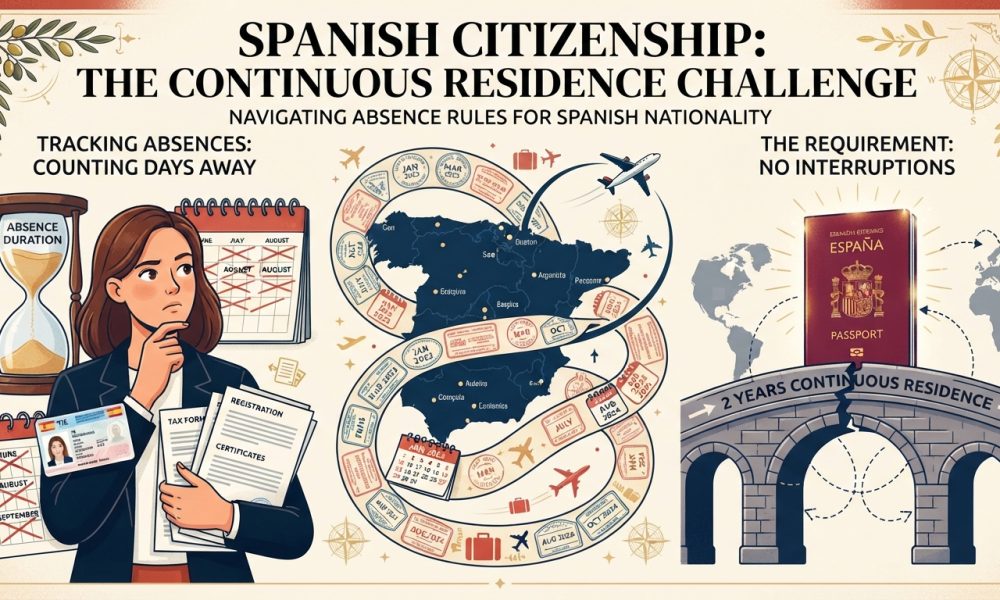
Foreign residents pursuing Spanish nationality must demonstrate legal, continuous residence, so overseas travel history and extended absences matter in government assessments, especially for applicants relying on the shortened two-year pathway available to qualifying Mexican and Filipino nationals.
WASHINGTON, November 15, 2026 — A lengthy trip abroad can put a carefully planned Spanish citizenship application under scrutiny, particularly for qualifying Mexican and Filipino nationals who expect to apply after two years of residence and discover that travel history matters as much as immigration paperwork.
Spanish nationality law offers qualifying nationals by origin from Ibero-American countries and the Philippines a shortened residence period. Still, the same provision requires residence to remain lawful, continuous and immediately before an application, leaving extended departures open to examination by authorities.
The problem is not that every overseas holiday interrupts residence, since ordinary travel can coexist with genuine settlement in Spain, but that long or repeated departures may raise doubts about whether the applicant actually maintained Spain as a meaningful home.
The Two-Year Advantage Comes With a Continuity Test
Article 22 of Spain’s Civil Code generally requires ten years of residence for nationality through naturalization, while recognizing a two-year threshold for specified groups including Mexicans and Filipinos by origin, provided every other substantive requirement is satisfied.
That shorter period creates a potentially valuable route toward Spanish and European Union citizenship. Yet, it should never be interpreted as a promise of passport issuance after exactly twenty-four months, because residence eligibility and the administrative decision are separate stages.
For applicants who regularly travel between Spain and Mexico, the Philippines, the United States,s or other countries, the critical question becomes whether the two years preceding filing still constitute genuine continuous legal residence under Spanish nationality standards.
A residence card that remains valid during a prolonged absence may demonstrate authorization to reside. Still, it does not automatically settle whether the person’s actual residence was sufficiently continuous for the separate purpose of acquiring nationality.
An Important Distinction Between Short Trips and Relocation
Brief visits for family events, holidays or work assignments are not categorically incompatible with continuous residence, because modern cross-border lives frequently require temporary departures that do not necessarily shift a person’s established center of daily life.
Nevertheless, a pattern of spending most of the year outside Spain while retaining a rented apartment and administrative registration could invite closer review, particularly if employment, household ties, and ordinary activities remain concentrated elsewhere.
A single absence can also deserve scrutiny when it occupies a substantial portion of the qualifying period, making the duration, reason and surrounding evidence important factors rather than treating an immigration card as conclusive proof of eligibility.
The safer approach is to evaluate each anticipated journey before departure and maintain a contemporaneous record, rather than reconstructing a complicated travel history months later when a ministry requests evidence of actual residence.
The Three-Month Warning Is Not a Universal Statutory Rule
Immigration advisers frequently reference a three-month warning for applicants using shortened nationality periods, a practical benchmark reflected in administrative questions and litigation, but the Civil Code does not itself prescribe an automatic three-month formula for every case.
That distinction matters because an applicant should not regard an absence of eighty-nine days as a guaranteed safe harbor, nor automatically conclude that every absence exceeding ninety days makes a favorable legal assessment impossible.
Instead, the underlying inquiry involves whether residence remained lawful, continuous and immediately before filing, with authorities and courts examining the circumstances of particular departures and the evidence establishing an enduring connection to Spain.
Rules governing long-term immigration residence have their own absence allowances. They cannot simply be transplanted into the nationality procedure, since holding or renewing a residence authorization is not legally identical to satisfying the conditions for naturalization.
A 2026 Court Decision Demonstrates the Stakes
In a July 9, 2026, decision, Spain’s National Court examined a nationality application involving an absence from September 8, 2021, until January 19, 2022, a period extending beyond three months within the applicant’s required two-year residence window.
The government had requested records explaining the departure and showing effective residence in Spain. Still, the court found that the applicant did not substantiate the general family explanation or establish the required continuous residence at the filing date.
The resulting dismissal illustrates the evidentiary risk of treating an unexplained absence as a minor administrative detail. However, the decision does not establish that all journeys of similar length must produce the same result.
The court’s reasoning also emphasized genuine personal connections to Spain. It recognized that temporary travel can be compatible with residence, making documented circumstances and continuity more informative than any simplified rule published in promotional material.
Recent News Reporting Highlights Common Application Errors
An August 2026 report by Spain’s AS newspaper on citizenship denials and withdrawn applications quoted immigration lawyer María Cardona as describing extended absences alongside premature filing, defective documents, criminal-history concerns, and unanswered government requests as recurring difficulties.
The report attributed to the lawyer cites figures indicating that 13,385 nationality applications were denied and another 3,436 cases closed during the first six months of 2026, without establishing that extended absence alone explained those totals.
These figures should be understood as context about the wider application process rather than an estimate of rejection risk for Mexican or Filipino residents, whose prospects depend on their individual status, documents, conduct and particular travel histories.
A carefully prepared applicant can learn from such warnings without treating news reports or commercial summaries as substitutes for the governing statute, current administrative guidance and case-specific advice from appropriately qualified legal professionals.
Travel Records Can Reveal More Than Applicants Expect
Passports, residence cards, boarding passes and immigration records may reveal dates that differ from a person’s recollection, so applicants should compare relevant documents before calculating how much qualifying time they believe has accumulated in Spain.
Some travel within the Schengen area may not produce routine border stamps, so residents should keep independent records of departures and returns rather than assuming their passport alone will provide a complete chronology of international movements.
Airline confirmations, rail reservations, dated accommodation receipts, and relevant work or medical records can help reconstruct a journey. Still, any evidence submitted must be authentic, consistent, and connected to the circumstances the government is actually examining.
Applicants using more than one legitimate passport should also ensure that travel disclosures are comprehensive and consistent, since changing documents does not erase a journey and discrepancies can create needless questions during formal nationality assessment.
Digital copies can make the record easier to organize. Still, residents should keep original documents whenever possible and verify that itinerary dates reflect actual journeys rather than canceled, changed, or never-taken bookings.
Reasons for Absence Matter, but Proof Still Counts
A family medical emergency, an unexpected professional obligation, or another serious event may explain why someone spent longer abroad than originally anticipated. Still, an explanation is more persuasive when supported by contemporaneous records than by a general statement.
Medical correspondence, employer instructions, travel disruptions and other reliable documentation can be relevant where appropriate. Still, none automatically guarantees that authorities will consider a prolonged absence compatible with continuous residence under the applicable nationality standard.
Residents should also avoid assuming that all travel for employment receives special treatment, because exceptions or allowances found in particular immigration categories do not necessarily decide how nationality officials assess the continuity of residence.
If a departure becomes unexpectedly prolonged, qualified local legal advice may help the resident understand the consequences for status, renewals and eventual filing, while discouraging premature assurances that the issue will disappear with time.
Where unforeseen medical or family circumstances prevent a timely return, residents should preserve a precise chronology and documents created during the event, because later statements are less helpful when their dates cannot be reconciled with objective travel records.
A Spanish Home Is More Than an Address on Paper
Evidence of ordinary life can support the broader residence picture, including a genuine housing arrangement, local healthcare activity, children’s schooling, lawful employment where permitted, and financial records reflecting the applicant’s actual daily presence in Spain.
Municipal registration may form part of that supporting documentation. Still, an address certificate does not substitute for an appropriate immigration authorization or conclusively demonstrate continuous residence when substantial time has been spent elsewhere.
Similarly, ownership of Spanish property or maintenance of a local bank account may establish economic links while revealing relatively little about where an applicant truly lived during the two years preceding the nationality request.
Officials may evaluate such material together with travel history rather than in isolation, so residents should preserve ordinary records accurately instead of assembling artificial transactions intended to create an appearance of residence that never existed.
Mexican and Filipino Families Face Practical Scheduling Choices
For a Mexican national caring for elderly relatives or managing business responsibilities in Mexico, multiple return trips can create a difficult balance between genuine family obligations and the residence continuity expected under Spain’s accelerated nationality pathway.
Filipino applicants may face comparable choices when supporting relatives in the Philippines, meeting employment obligations abroad, or coordinating children’s education, particularly when long-distance journeys encourage visits lasting several months rather than several weeks.
Neither nationality changes the underlying continuity requirement, and eligibility for the two years also depends on the applicant satisfying the statutory nationality-by-origin category rather than merely possessing a recently issued Mexican or Philippine passport.
A family considering relocation should therefore establish separate travel plans for each adult and child, recognizing that one person’s residence history cannot automatically cure another person’s extended absences or different immigration status.
United States Connections Require Additional Travel Planning
Some prospective residents also hold United States citizenship or regularly travel through American airports, creating an additional need to coordinate valid passports, international commitments and the documentation retained during a prolonged transition to Spain.
The United States Department of State’s travel guidance for Spain provides useful information on entry requirements and American consular services, although Spanish authorities alone determine whether an applicant’s residence history satisfies Spain’s nationality law.
A United States travel advisory should not be confused with a Spanish immigration ruling, because short-stay permission, border entry requirements, and the Spanish residence continuity test address different legal questions, even when they involve the same journeys.
American tax obligations may also continue independently of residence and nationality planning, which makes coordinated immigration and tax advice important for dual nationals who expect a future Spanish passport to change their wider international circumstances.
The Filing Date Is a Crucial Legal Milestone
Spanish law requires the necessary continuous residence to exist immediately before the nationality application, so an applicant cannot generally cure a shortage in qualifying time simply by remaining in Spain while an already premature application is pending.
Before submission, advisers should thoroughly review the effective immigration status, the complete travel calendar and any potentially disqualifying absence, then determine whether additional residence or a better-supported application date would be legally appropriate.
If continuity has been interrupted, the consequences require individualized analysis rather than automatically disregarding every earlier moment, since the applicable administrative and judicial assessment depends on the facts and governing legal standards.
Even after filing the application, residents should continue respecting immigration requirements and monitoring official communications, because an unresolved case does not automatically replace existing authorization or relieve applicants of the duties accompanying their lawful status.
A resident who expects to spend extended periods abroad while a nationality file is pending should also arrange dependable access to official notices and understand any deadlines, since missing a request for evidence may create a separate procedural problem.
A Second Passport Does Not Replace Genuine Residence
Amicus International Consulting discusses second-passport planning and eligibility evaluation as part of broader international mobility services. Still, any Spanish citizenship strategy remains subject to Spain’s residence rules, government screening and official decision-making authority.
The opportunity for qualifying Mexicans and Filipinos rests on Spain’s Civil Code rather than the purchase of an identity document, and no intermediary can validly convert unqualified tourist visits or undisclosed absences into continuous residence.
Applicants should ask advisers to explain the proposed immigration category, document the actual beginning of lawful residence, and identify evidence for each material absence, rather than relying on general assurances about a supposedly guaranteed European passport.
Anyone with irregular documents, conflicting identity records, or unresolved immigration difficulties should seek competent legal assistance and pursue lawful corrections, since using altered evidence or misrepresenting travel history can lead to consequences more serious than a delayed naturalization application.
Financial Residence and Citizenship Must Be Considered Separately
Spending much of the year in Spain may affect taxation, employment, banking, and household planning. Still, tax residence and the continuity requirement for nationality are distinct legal tests that should not be treated as interchangeable.
The Amicus analysis of second passports and United States tax reporting obligations provides related context about why acquiring another citizenship does not automatically eliminate financial duties created under existing national laws or individual circumstances.
Retirees receiving overseas pensions, professionals serving international clients and families managing cross-border investments should assess those arrangements before moving, because a sustainable Spanish residence plan depends on lawful finances as well as credible physical presence.
The strongest responsible planning approach preserves flexibility for necessary travel without promising that a residence card, favorable tax position,n or commercial advisory package can override the specific nationality standard established by Spanish law.
Continuous Residence Is a Matter of Evidence and Reality
Spain’s accelerated two-year nationality period remains a substantial opportunity for qualifying Mexican and Filipino nationals. Still, an applicant’s ability to use it depends on maintaining legal residence and demonstrating that overseas travel did not undermine continuity.
Short trips may be entirely consistent with a genuine Spanish home. At the same time, unexplained months abroad, contradictory travel records or a lifestyle centered primarily in another country can create questions that an otherwise valid residence permit does not resolve.
The practical lesson for future applicants is to plan international journeys deliberately, document genuine reasons for necessary absences and obtain qualified advice before filing, rather than waiting for government scrutiny to expose gaps in their travel history.
Ultimately, the same disciplined records that support nationality review can improve ordinary relocation planning, allowing families to align travel, schooling, employment, and healthcare decisions with the residence obligations they have voluntarily undertaken in Spain.
For those seeking a Spanish passport and eventual European Union citizenship, the two-year threshold should be treated as a carefully documented residence requirement, not a countdown that continues automatically whenever the passport holder is outside Spain.




