
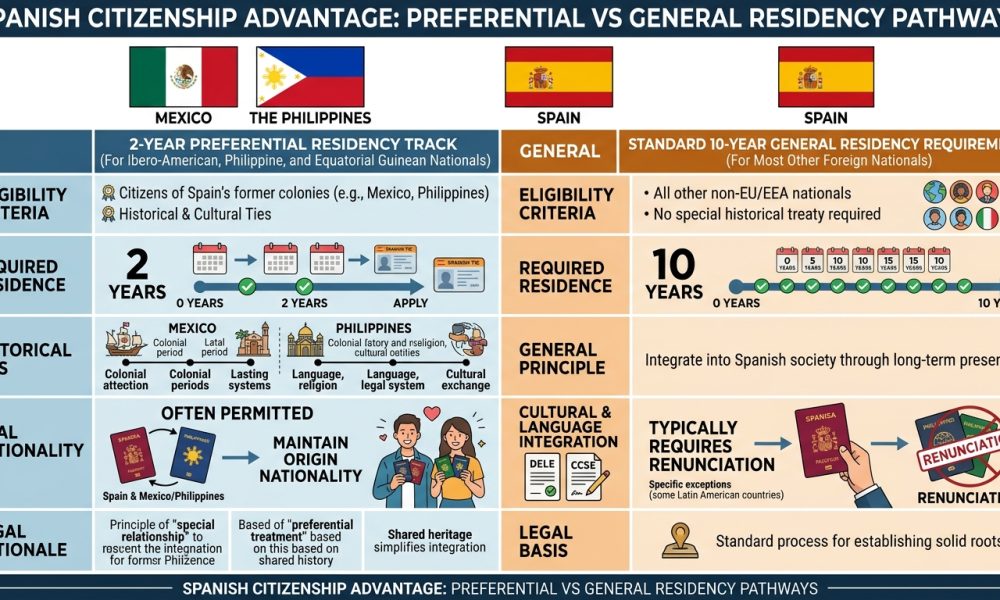
Although their immigration histories differ, both countries benefit from preferential Spanish nationality provisions unavailable to many applicants who must satisfy the ordinary 10-year residence period.
WASHINGTON, November 15, 2026
Mexican and Filipino nationals considering a permanent future in Europe occupy a distinctive position under Spanish nationality law, which allows qualifying citizens by origin to seek naturalization after two years of lawful residence rather than the ordinary ten years.
This advantage can make Spain an important long-term option for professionals, retirees, and families. However, the shorter residence requirement determines when an eligible person may apply and does not guarantee immediate approval, a passport, or unrestricted immigration benefits.
The shared exception also invites a closer comparison between two countries separated by the Pacific Ocean, because historical connections help explain their inclusion in Spanish law. At the same time, different language, documentation, and migration circumstances shape each applicant’s practical journey.
Article 22 Creates the Common Legal Advantage
Article 22 of the Spanish Civil Code generally sets a ten-year residence period for nationality by residence, while reducing that period to two years for nationals by origin of Ibero-American countries, Andorra, the Philippines, Equatorial Guinea and Portugal, among other specified beneficiaries.
The provision expressly requires residence to be legal, continuous and immediately before the citizenship application, so an eligible Mexican or Filipino national cannot replace the qualifying period with tourism, ownership of a Spanish apartment or repeated visits from abroad.
Spain also provides a five-year residence period for recognized refugees and specific one-year exceptions tied to certain family or personal circumstances, showing that the ordinary ten-year period is a default rather than an absolute rule for every foreign national.
Mexico and the Philippines therefore have a shorter statutory eligibility window within an established nationality process, not a diplomatic passport program, automatic birthright citizenship in Spain, or an exemption from government review.
Different Histories Explain a Shared Place in Spanish Law
Mexico and the Philippines emerged from different regional histories under Spanish rule, with Mexico becoming independent in the nineteenth century while Spanish colonial administration in the Philippines ended in 1898, leaving distinct linguistic and institutional legacies.
Modern Spanish nationality legislation acknowledges connections with Ibero-American countries and the Philippines through an express statutory exception, without making an applicant’s cultural Identification, surname, religion, or claimed colonial ancestry sufficient on its own to establish eligibility.
The two countries thus reach the same legal residence threshold through a shared position in the Civil Code, even though their contemporary nationality laws, principal languages, immigration patterns, and documentary traditions differ in ways that applicants must examine independently.
A history of Spanish influence may help explain why these jurisdictions appear in the legislation. Still, it does not mean that Spanish ancestry is required or that every descendant of a former Spanish subject qualifies through this particular residence exception.
Two Years Versus Ten Years Changes the Planning Horizon
An eligible applicant who maintains continuous qualifying residence for two years can generally reach the application stage substantially earlier than someone subject to the normal ten-year threshold, creating an eight-year difference in required residence before filing.
That comparison is particularly meaningful for a family evaluating whether to relocate before retirement, enroll children in Spanish schools, or establish a European base, since the nationality application may become available earlier in a genuine residence plan.
Nevertheless, the two-year threshold is not an administrative processing promise, because a government decision can arrive considerably later and further requirements, including any necessary oath or promise and civil registration, must be completed before passport issuance.
A resident subject to the ten-year standard may also qualify for another recognized exception based on personal circumstances, so responsible comparisons should describe the general statutory contrast without asserting that every non-Mexican or non-Filipino foreigner must invariably wait a decade.
Nationality by Origin Is More Important Than Passport Color
The Civil Code’s reference to nationals by origin makes the legal foundation of citizenship an essential preliminary question, particularly for people who have held several passports or acquired Mexican or Philippine nationality through procedures occurring years after birth.
A passport establishes that an issuing state recognizes a person as its national for travel purposes. Still, it does not necessarily reveal whether that nationality was held from birth or subsequently obtained through ordinary naturalization, reacquisition, or another legal mechanism.
Spanish authorities may therefore require relevant civil records and evidence of nationality. At the same time, applicants should avoid assuming that a recently issued document automatically establishes the origin-based status needed for the accelerated residence provision in an individual case.
The precise treatment of a complicated citizenship history should be determined using the applicant’s authentic records and the laws governing nationality acquisition, rather than generalized claims that any second Mexican or Philippine passport unlocks the two-year route.
For people born abroad to Mexican or Filipino parents, the facts may depend on descent rules in force at birth and subsequent registrations, reinforcing the need to establish original nationality through official records rather than birthplace assumptions alone.
Mexican Applicants Have a Distinct Language Advantage
Mexican nationals by origin generally benefit from Mexico’s recognition as a Spanish-speaking country for examination purposes, an important distinction because Spain’s Instituto Cervantes exempts qualifying nationals from such countries from the DELE A2 language examination.
That exemption can reduce testing requirements for eligible Mexican applicants. However, it does not remove the separate need to demonstrate civic integration or automatically waive the constitutional and sociocultural knowledge assessment known as the CCSE.
A Mexican applicant should still confirm the current rules, submit satisfactory nationality documentation, and investigate any individual exemption or testing accommodation before filing, because neither familiarity with Spanish nor the two-year residence exception eliminates all formalities.
The practical benefit is thus a potentially simpler language-testing component within an otherwise substantive naturalization process, not an assurance that a Mexican citizen can obtain Spanish nationality by signing a declaration after two years.
By contrast, an otherwise eligible Philippine national who already speaks Spanish fluently should not assume that conversational ability replaces the required qualification, because the government may insist on a recognized diploma unless a formal exemption applies.
Filipino Applicants Share the Timing, but Not Every Exemption
Filipino nationals by origin fall within the same two-year statutory residence category, even though the Philippines is not currently classified as a Spanish-speaking country for the ordinary nationality examination exemption available to qualifying nationals of Spanish-speaking states.
As a result, a Filipino applicant will generally need to satisfy the DELE A2 Spanish-language requirement unless a recognized personal exemption, valid diploma, or other legally accepted basis for exemption applies to the particular case.
The applicant may also need to complete the CCSE assessment and provide evidence of civic integration, making language preparation a realistic part of the relocation schedule rather than an unexpected barrier discovered shortly before filing.
Filipino citizens who previously naturalized elsewhere and later reacquired Philippine citizenship should obtain individualized advice about whether their original nationality status remains legally established for Spanish purposes, because reacquisition facts cannot safely be resolved through a simplistic passport checklist.
Legal Residence Is the Condition Both Groups Must Meet
Mexican passport holders generally enjoy different short-stay entry arrangements from Philippine passport holders under Schengen rules. Still, temporary entry privileges do not themselves constitute the legal residence required for Spanish naturalization under Article 22.
Both groups must obtain an appropriate residence authorization and maintain it in accordance with its conditions, with potential pathways depending on family circumstances, qualifying employment, permitted international telework or adequate resources for non-working residence.
A foreigner Identification number, municipal address registration, or Spanish bank account may be administratively useful. Still, none should be mistaken for conclusive proof that the two-year nationality clock began on the date that particular document appeared.
Residence decisions, renewals, travel records and evidence of genuine life in Spain can become important, especially when an applicant divides time among multiple countries or changes immigration categories before submitting a nationality request.
A family could find the same legal residence period difficult for different practical reasons, with one household balancing work and parental care in Mexico and another coordinating overseas employment and obligations to relatives in the Philippines.
The Immigration Path Must Match the Applicant’s Real Life
A retired person supported by qualifying savings or passive income may investigate non-lucrative residence. At the same time, a professional working for an overseas employer may need to examine international telework rules instead of assuming a non-working authorization permits remote employment.
A student pursuing education in Spain should pay particular attention to the distinction between permission classified as a stay and permission classified as residence, because the former does not ordinarily accumulate qualifying nationality residence merely through physical presence.
Families also need to account for spouses and children whose immigration permissions may differ, recognizing that one adult’s accelerated eligibility does not automatically confer citizenship on every household member on the same date.
Before relocating, applicants should compare visa conditions, financial evidence, healthcare arrangements, and permitted professional activities with their nationality objective to reduce the risk of choosing an appealing visa label that does not support sustainable lawful residence.
Good Conduct and Documentary Consistency Remain Essential
Spanish nationality procedures require applicants to demonstrate good civic conduct and sufficient integration, allowing authorities to review records and seek clarification when criminal-history documents, personal Identification, or other supporting materials raise legitimate questions.
Accurate birth certificates, lawful name-change records and consistent statements about existing citizenships are particularly important for dual nationals, because unexplained differences can slow review even when the underlying two-year residence period has been completed.
Applicants should obtain required translations, legalization or apostilles as appropriate and respond to official requests within applicable deadlines, rather than relying on third-party assurances that the residence advantage excuses ordinary scrutiny of identity and background.
A Record Citizenship Year Provides Wider Context
Spain recorded 299,732 acquisitions of Spanish nationality by residents during 2025, according to the National Statistics Institute, with the annual total rising from 2024 and reflecting continued demand for formal membership in the country.
An Agence France-Presse report on Spain’s record citizenship total noted that Latin American nationals account for many acquisitions and described the shorter residence period available to qualifying applicants compared with the usual ten-year requirement.
The official total includes several routes of acquiring nationality. It cannot be interpreted as a count of people qualifying specifically through the Mexican or Philippine two-year provision, nor does it establish an individual’s expected approval time.
The figures nevertheless demonstrate that the exception operates within a large administrative system where residence verification, testing and final registration remain consequential, even when a person has satisfied the minimum period required before filing.
Dual Citizenship Can Make the Route More Attractive
Spanish rules generally exempt qualifying nationals of Ibero-American countries and the Philippines from the declaration of renunciation imposed on some applicants acquiring Spanish nationality, creating an additional benefit beyond the shorter residence requirement.
The treatment of existing nationality under Mexican or Philippine law must still be examined independently, because Spain’s exemption does not override another state’s rules on acquisition, retention, reacquisition, or use of its national passport.
For people who also hold American citizenship, the United States Department of State’s dual-nationality guidance explains that multiple nationalities can coexist with continuing legal responsibilities, including the requirement that United States citizens use American passports when entering or leaving the United States.
A second or third citizenship can broaden future choices without replacing earlier legal identities, so families should keep nationality records consistent and seek professional advice before assuming consular assistance, travel documents, or ongoing obligations.
A Spanish Passport Eventually Creates European Union Rights
A successful naturalization can lead to Spanish citizenship and the ability to request a Spanish passport, offering European Union citizenship rights that may support lawful residence, employment and study opportunities across other member states under applicable rules.
Those benefits arise only after nationality is acquired, not merely because someone holds a Spanish residence card, and access to certain professions, regulated activities, or public benefits may still depend on additional local requirements.
For families seeking long-term European flexibility, the wider mobility opportunity can matter as much as the shorter Spanish filing threshold, particularly when education, retirement, and business plans may evolve over several decades.
However, a principal applicant’s eventual Spanish nationality does not mean a spouse or adult child immediately receives the same status, so separate family residence and citizenship assessments matter before any financial commitment or relocation.
Access to another European country as a Spanish citizen also involves applicable registration, professional, and family rules. So, a future passport broadens lawful options without guaranteeing employment credentials, unrestricted welfare benefits, or citizenship for relatives.
Second-Passport Advice Must Follow Government Requirements
Amicus International Consulting describes its second-passport advisory services as an option for people evaluating international mobility. Still, Spanish law and government authorities determine eligibility for Spanish citizenship, not any private provider’s commercial representations.
The distinction matters because neither a purchased document nor a remote application can replace qualifying residence under Article 22, and prospective clients should request a transparent explanation of the legal route, documentary requirements, and expected stages.
Its discussion of second passports and United States tax responsibilities also illustrates the need to separate immigration and nationality planning from taxation, since an additional passport does not automatically cancel reporting obligations associated with existing citizenship or residence.
Anyone planning a substantial move should coordinate reputable immigration, nationality,, and tax advice as needed, ensuring adviceont citizenship eligibilityiss not confused with unsupported claimsaboutg confidentiality, asset protectio,n, or exemption from legal obligations.
The Practical Choice Is a Genuine Residence Strategy
For an eligible Mexican or Filipino national, the most reliable approach begins with confirming nationality by origin, identifying a suitable Spanish residence category and establishing an authentic, documented life in Spain before calculating the earliest appropriate filing date.
The applicant should then maintain immigration compliance, preserve travel and renewal evidence, prepare for applicable examinations,s and understand that administrative processing can continue long after the two-year residence milestone has been reached in practice.
Mexico and the Philippines therefore share a notable legal advantage unavailable under the ordinary ten-year framework. Still, the value of that exception ultimately depends on verifiable eligibility, continuous lawful residence, and completion of Spain’s full nationality procedure.




