
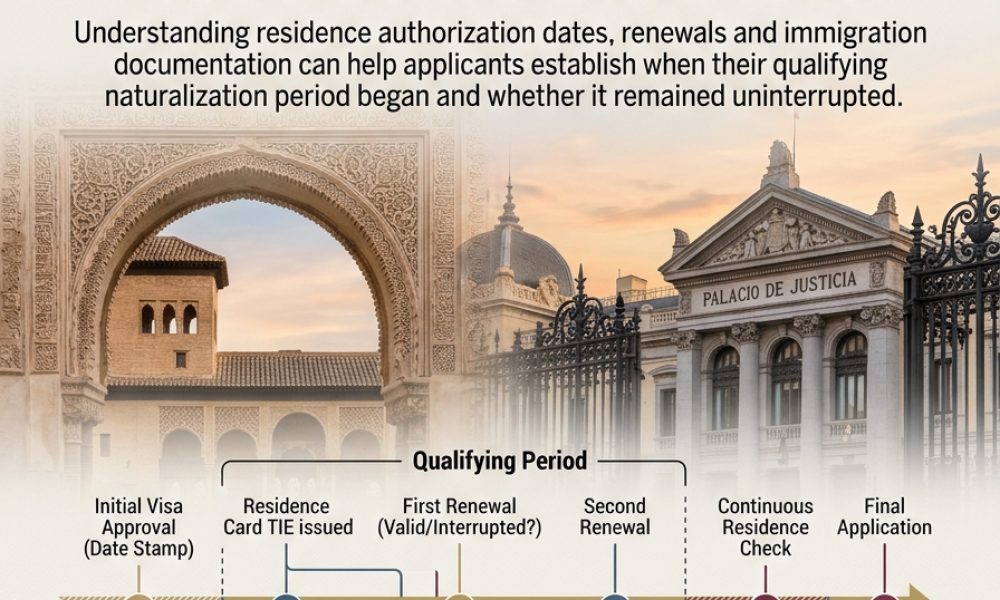
Understanding residence authorization dates, renewals, and immigration documentation can help applicants establish when their qualifying naturalization period began and whether it remained uninterrupted.
WASHINGTON, November 15, 2026 — For Mexican and Filipino nationals considering Spanish citizenship after two years, determining the start of lawful residence can be as consequential as choosing where to live, because a passport stamp or plastic identity card may not tell the full legal story.
The accelerated route under Spanish nationality law depends on an applicant’s qualifying immigration status, uninterrupted residence, and verifiable records, creating practical challenges when approvals, entry dates, identity card appointments, and renewal decisions occur at different times.
People who assume their citizenship clock started with a tourist arrival, apartment lease, or foreigner Identification number may later discover that none of those events alone established residence legally recognized for naturalization.
Article 22 Creates a Two-Year Opportunity With Conditions
Article 22 of Spain’s Civil Code provides a two-year nationality-by-origin residence threshold for nationals of Ibero-American countries and the Philippines, among other groups, while requiring legal, continuous residence immediately before the application.
This special period contrasts with the ordinary ten-year rule that applies to many other foreign nationals. Still, it reduces only the qualifying duration and does not remove screening, integration, good civic conduct, or the obligation to demonstrate actual residence.
For applicants from Mexico and the Philippines, officials must also examine evidence of nationality by origin separately from residence history, since acquiring a qualifying passport through later naturalization does not automatically establish eligibility for this statutory exception.
Officials consider the legal basis for residence, and the relevant record of authorizations rather than promotional timetables, so thorough documentary review is essential before identifying any supposedly guaranteed naturalization filing date.
A Filipino-born applicant with a clear residence decision may face a different documentary question from a Mexican citizen whose nationality history includes subsequent changes. Still, both must reconcile identity records with Spain’s official immigration chronology.
The Immigration Authorization Matters More Than Arrival
A person may lawfully enter Spain for a temporary visit without acquiring residence status, so the first arrival stamp cannot independently establish the start of the two years required for nationality through residence.
Similarly, municipal registration, rental agreements, and property ownership may help show where an individual lives. Still, none can replace the qualifying residence permission Spanish law requires for the nationality calculation.
The legal start date depends on the specific authorization, its recorded effective date, and any rules governing recognition of an earlier application, rather than a universal formula based only on airport entry or printed card issuance.
Applicants should therefore compare the official grant decision, any applicable visa activation conditions, the residence card, and the underlying immigration file before calculating eligibility, especially when approvals and travel happened weeks or months apart.
For example, someone arriving as a visitor in January and receiving a legally effective residence authorization in April should not simply mark January as the start month, because the controlling date depends on that authorization.
Application Dates and Grant Dates Can Require Legal Interpretation
A residence application receipt proves that a request was submitted. Still, it does not necessarily prove that qualifying residence began that day, because the consequences of filing depend on the legal category and subsequent administrative decision.
Conversely, applicants should not automatically assume that the day immigration authorities issued an approval is always the earliest date countable toward nationality, since particular authorizations and judicial interpretations may recognize effects connected to an earlier application.
Spanish administrative courts have considered disputes involving whether residence time should be calculated from an application date rather than a later grant date, illustrating why apparently simple chronology questions sometimes require review of the complete file.
Before using either potentially decisive date, a qualified professional should establish what immigration law and the individual decision actually recognize, avoiding unsupported assurances that every pending residence request automatically counts toward Spanish citizenship.
Judicial disputes over earlier applications also remind us that an immigration denial later overturned by a court may have consequences different from an unsuccessful application never corrected, making individual procedural history central to the calculation.
A Foreign Identity Card Is Evidence, Not the Whole Record
Spain’s foreigner identity card, commonly called the TIE, serves as physical evidence of a person’s identity and recognized immigration position. Still, the date of its production or collection is not necessarily the commencement date of the underlying authorization.
Delays in obtaining fingerprints or collecting the physical card can therefore produce dates that look inconsistent with an earlier residence decision. However, you must explain the discrepancy with official documentation rather than guesswork.
A foreigner Identification number, known as the NIE, differs from a residence permit and can exist for administrative or economic reasons, so having that number alone does not prove two years of legal residence.
Applicants who find mismatches among passport records, identity card dates, and notification letters should seek clarification through authorized channels and preserve the correspondence, rather than choosing whichever date creates the earliest convenient citizenship deadline.
Correcting a clerical discrepancy before filing for naturalization is usually more manageable than explaining contradictory dates during an advanced review, especially when missing documents must be retrieved from an old immigration office or archived digital account.
An Official Residence Certificate Can Clarify the Timeline
Spain’s National Police provides a certificado de residencia intended to establish recorded periods of legal residence, offering a formal way to examine an immigration history that may include multiple cards, permit categories, or administrative changes.
The certificate can help identify periods recognized in official records, but review its contents alongside authorization decisions and any special circumstances, rather than treating it as a substitute for the nationality authority’s final legal assessment.
Applicants can ask the designated police or immigration offices about requesting the certificate, commonly associated with the EX-15 form. They should distinguish it from a municipal registration certificate or a certificate of non-residence.
A systematic comparison of recorded periods with personal files can uncover administrative errors early, giving applicants a chance to request corrections before an incomplete history creates avoidable questions during a naturalization application.
The police describe the residence certificate as proof of recorded legal residence periods and give the certificate a three-month validity, so applicants should consider obtaining a current version when preparing important documentary submissions.
Renewal Deadlines Are Central to Continuity
Residence authorizations ordinarily have expiration dates and category-specific conditions for extension, so applicants pursuing Spanish nationality must track not only the original approval but also each renewal, modification, and official decision affecting their legal status.
Under Spain’s current immigration regulations, several commonly used temporary residence categories allow renewal requests during the two months before expiration, with a timely application extending the previous authorization’s validity while authorities consider the renewal.
The regulations also allow certain applications within three months after expiration to extend validity while pending. Still, that option can carry sanction exposure and should never be treated as a recommended substitute for timely filing.
These provisions do not necessarily apply identically to every residence category, and a temporary extension pending decision is not the same as a guaranteed approval, making category-specific confirmation indispensable for a reliable citizenship chronology.
A renewal receipt should clearly show the submission date and relevant case identifier, enabling the applicant to show the filing fell within the permitted interval if an expired card later prompts questions.
A Pending Renewal Does Not Automatically Reset Everything
An applicant whose card expires while a timely renewal remains unresolved may still have an authorization legally extended under the applicable rules, making the submission acknowledgment and official application status important documentary evidence.
Confusing the expiration date printed on a card with the end of all legal residence could produce an unnecessarily pessimistic calculation, just as ignoring a genuinely unauthorized gap could result in a premature nationality application.
The legally relevant inquiry is whether a valid authorization or legally recognized extension covered the contested interval, together with whether the person continued meeting the separate requirements of actual, continuous residence in Spain.
Where a renewal is refused, or an application is filed outside an applicable window, legal advice should address the specific procedural consequences rather than claiming that later approval will always retroactively repair every interruption
The distinction between a delayed administrative decision and a period without legally recognized status becomes particularly important when a nationality application is approaching, since the applicant must meet the required period when filing rather than afterward.
Changes From Study Status Need Special Attention
Spanish immigration law distinguishes residence authorizations from many permissions classified as stays for study, so time spent attending a university or language program does not ordinarily become qualifying residence simply because the student lived in Spain.
A student who later obtains a residence or work authorization must identify when that different legal status took effect, rather than adding educational years directly to a nationality clock without checking the governing status.
Comparable documentary care is required when moving between family, employment, and non-lucrative residence categories, because changes may preserve recognized residence periods but must be documented and reviewed according to their actual legal effects.
Residents should retain approval letters for both the earlier and later categories, since an identity card showing only the newest authorization may omit the sequence needed to understand continuous legal residence across an administrative transition.
Foreign residents should also verify whether changes in permit conditions impose new employment, insurance,e or financial requirements, because lawful residence depends on maintaining the applicable authorization rather than merely possessing paperwork from a previous category.
Administrative Change and News Coverage Add Context
Spain’s immigration framework has undergone substantial regulatory changes since May 2025, making older checklists and internet summaries potentially misleading when applicants use them to interpret current renewal procedures, category definitions or filing requirements.
A 2026 Euronews examination of Spain’s residence regularization and citizenship claims underscored that acquiring legal residence and qualifying for nationality are distinct steps, and that a newly granted permit does not itself confer Spanish citizenship.
That distinction is especially relevant where applicants have lived physically in Spain for years before securing recognized immigration status, because historical presence and later regularization should not automatically be described as identical periods for naturalization purposes.
New regulations can affect how a person obtains or renews residence without changing the separate residence durations in Article 22, requiring practitioners to read immigration rules and nationality law together.
Digital Filing and Notices Create an Evidentiary Trail
Electronic immigration submissions can generate dated receipts, registration numbers and official notifications that establish when an application reached authorities, making secure preservation of those records an important safeguard against later uncertainty over a renewal deadline.
Applicants should keep complete copies of submitted forms, proof of fees (when applicable), responses to document requests, and final decisions, because an email confirmation or appointment reservation alone may not establish that a legally effective application was filed.
Spanish nationality applications can also be submitted through the Ministry of Justice’s electronic system, where uploaded evidence and procedural notices require careful attention to avoid missing formal requests or misunderstanding the status of a pending case.
Anyone using an adviser should arrange reliable personal access to copies and official communications, reducing dependence on verbal updates and ensuring an administrative deadline is not missed because one person controls the entire file.
When an electronic portal requests more information, applicants should identify the actual notification date and lawful response period instead of assuming that a consultant’s informal summary is sufficient to protect the case from administrative closure.
Physical Residence and Travel History Remain Separate Tests
Even perfectly documented authorization dates do not eliminate the need to show continuous and genuine residence immediately before filing, since lengthy or unexplained absences may raise factual questions even if an immigration card remains valid.
Passport stamps, airline records and ordinary evidence of daily life may help explain travel patterns. Still, residents should not invent a universal absence allowance or assume that every trip shorter than a specific number of days is automatically harmless.
A family managing commitments between Madrid, Manila and Mexico City should analyze travel alongside immigration status, ensuring that the legal calendar reflects real residence rather than a nominal Spanish address maintained chiefly for citizenship purposes.
Likewise, completing two years on paper does not authorize a person to ignore residence conditions while waiting for the nationality decision, because immigration compliance and the citizenship procedure remain related but distinct responsibilities.
United States Dual Nationals Have Additional Considerations
A Mexican or Filipino national who also holds United States citizenship may face additional passport-use and travel obligations, making accurate disclosure of every nationality and consistent travel records important when Spanish authorities review a residence history.
The United States Department of State’s Spain travel information provides American travelers with relevant entry and safety guidance. Still, Spanish immigration and nationality authorities independently determine whether a person has qualifying residence.
Separate American tax responsibilities may continue while an individual lives abroad or acquires another nationality, so applicants should distinguish questions about the Spanish residence clock from their broader tax, reporting and financial obligations.
The Amicus International Consulting discussion of second passports and United States tax reporting addresses the wider planning issue. In contrast, individual cross-border tax conclusions should always be confirmed under current official requirements and qualified professional advice.
Second-Citizenship Planning Requires Verifiable Documents
Amicus International Consulting publicly describes second-passport advisory services for people evaluating additional citizenship options. Still, no commercial provider can replace Spanish immigration records or guarantee that residence history meets naturalization requirements.
Applicants should ask advisers to identify the proposed residence authorization, explain its effective date, show how renewal periods will be documented, and distinguish an eligibility-to-apply date from the later government decision on citizenship.
For Mexican and Filipino nationals, the strongest file combines verifiable nationality by origin with consistent civil Identification, an accurate authorization history, and evidence of uninterrupted genuine residence, rather than relying on promotional promises about automatically receiving a passport after twenty-four months.
Ultimately, Spain’s accelerated citizenship opportunity is most useful when the calendar is supported by official decisions, renewal receipts, and reliable records, allowing applicants to make informed relocation choices without confusing physical presence, immigration permission, and completed nationality acquisition.




