
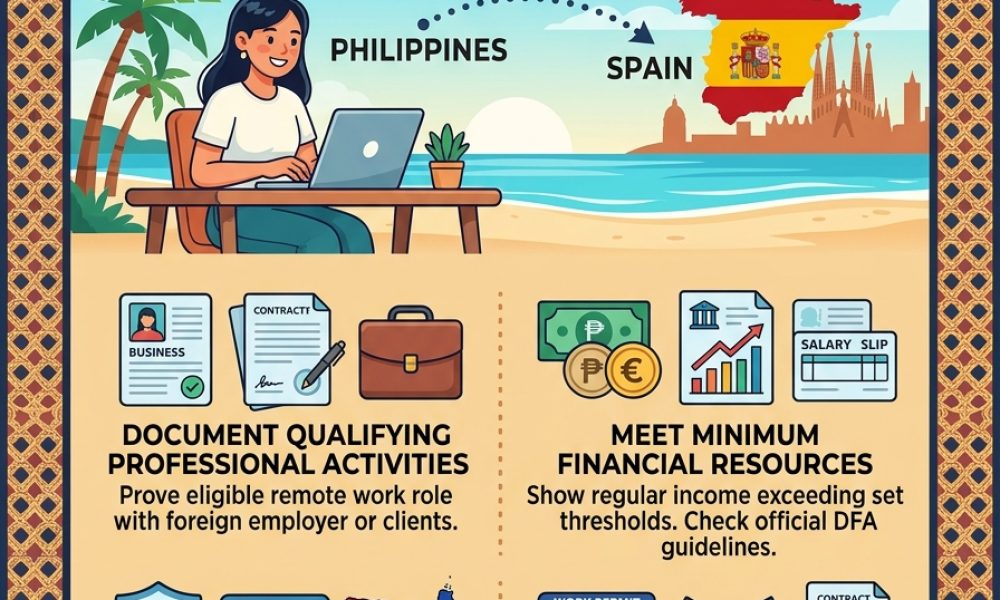
Applicants considering Spain’s teleworking residence authorization must document qualifying professional activities, financial resources, insurance, and compliance with the program’s employment restrictions.
WASHINGTON, DC, November 15, 2026: Foreign professionals hoping to relocate to Spain while keeping overseas employment face a more demanding documentary exercise in 2026, as financial thresholds, employer verification and social security obligations determine whether the country’s international telework authorization is available.
The arrangement commonly called Spain’s digital nomad visa can support a genuine residence strategy for eligible remote workers, including some Mexican and Filipino nationals who may later qualify to apply for Spanish citizenship after two years of lawful, continuous residence.
Yet the visa is not a general permission to move to Spain with a laptop, and applicants who cannot substantiate income, employment relationships, legally acceptable health coverage, and the nature of their daily duties risk delays or refusal.
The 2026 Minimum Wage Sets the Financial Framework
Spain’s government set a minimum interprofessional wage of €1,221 per month for 2026, with fourteen annual payments totaling €17,094 a year, and the international telework framework states that a principal applicant’s financial requirement is 200% of the applicable wage measure.
The Spanish consulate in Washington publishes a requirement of €2,442 per month for an applicant traveling alone, with approximately €916 added for the first accompanying family member and €306 for each additional dependent under its published guidance.
Other interpretations annualize the fourteen minimum-wage payments over twelve calendar months and calculate €2,849 per month for the principal applicant, creating a meaningful distinction for professionals whose earnings fall between the two published calculations.
A June 2026 report by The Local on stricter digital nomad visa checks used the €2,849 gross monthly figure and described increased scrutiny of work arrangements, financial proof and social security registration as administrators examined applications more closely.
Because official consular figures and annualized interpretations do not fully align, applicants should confirm the threshold with the office reviewing their case before treating either calculation as a guaranteed threshold or making irreversible relocation commitments.
Family Applications Require More Than One Income Figure
The Washington consulate’s published 2026 amounts imply about €3,358 monthly for a principal applicant and one accompanying family member, rising by roughly €306 for each additional dependent. However, applicants should confirm precise rounding and documentation directly.
Using the annualized approach instead produces a higher planning figure of approximately €3,917 for two people, with further supplements for additional family members, illustrating why household size can transform an apparently comfortable individual salary into a borderline application.
A couple relocating with children should budget beyond the minimum immigration calculation for housing, school fees where applicable, health arrangements, travel, and exchange-rate changes, because financial eligibility and an affordable family life are different questions.
When two adults both earn income, an adviser should confirm what evidence the reviewing authority accepts from the principal worker and accompanying relative, rather than assuming that every household salary automatically combines into a qualifying total under the same rules.
Applicants paid in dollars, pesos, or another currency should prepare consistent exchange-rate evidence and distinguish regular gross earnings from occasional bonuses, speculative future commissions, or transfers between personal accounts that do not establish continuing professional income.
The Program Is Built Around Actual Overseas Work
Spain’s international telework provisions principally cover non-European nationals performing employment or professional services remotely for businesses established outside the country, using computer, telecommunications and related digital systems rather than work requiring ordinary attendance at a physical workplace.
For salaried employees, the employer must be outside Spain, and the applicant needs documents showing the existing job can genuinely be performed from Spanish territory, including an express authorization that matches the employee’s actual responsibilities.
Independent professionals may be eligible through overseas commercial relationships. They can undertake limited professional activity for Spanish clients, but that local activity must remain within the statutory 20% ceiling and cannot be disguised salaried employment for a Spanish company.
A prospective applicant whose main role involves visiting customers, supervising production, regularly attending an overseas office or physically delivering services should not assume that occasional video meetings turn the underlying occupation into qualifying international telework.
Company History and Contracts Must Stand Up to Review
The foreign company or corporate group generally needs evidence of at least one year of genuine, continuous activity, so a business newly incorporated solely to sponsor a visa may lack the operating history the program requires.
Employees must generally establish at least three months of preceding employment with the foreign company. At the same time, freelancers need an equivalent documented commercial relationship with one or more overseas clients before filing the application.
Useful records include company registration certificates, dated contracts, employer letters, invoices, and paymentproof of payment, documents should clearly state the employer’s location, the nature of services, the period of engagement, and permission to work from Spain.
The relevant professional relationship must also be expected to continue under the visa’s rules, so it’s important to disclose a short remaining contract term or a planned change in employer rather than presenting a temporary engagement as permanent work.
For freelancers with several clients, separate contracts and invoices can demonstrate how income is distributed across engagements, while written explanations should resolve any apparent inconsistencies between the application, the professional registration record and the actual source of recurring payments.
Professional Qualifications Are Another Essential Test
Applicants generally must demonstrate recognized graduate or postgraduate education, qualifying professional training, or at least three years of relevant professional experience, adding a substantive career-history requirement that a high salary cannot automatically replace.
A software developer without a university degree may still have a viable application if they meet the professional experience requirement and document it properly. contrast, an applicant with impressive academic credentials still needs qualifying work and adequate resources.
Employers and clients should provide records that accurately describe the responsibilities performed, because an employment title alone may not establish that duties can be carried out exclusively through the information and communications technology contemplated by Spain’s rules.
Foreign public documents may require apostilles or other legalization and Spanish translations, so applicants should start preparing documents early instead of assuming informal English-language scans will satisfy every consular or immigration requirement.
Social Security Compliance Is a Core Obligation
Workers residing and working in Spain generally need a legally appropriate social security arrangement, and the required solution differs substantially between a foreign company’s employee and a self-employed professional operating under commercial contracts.
For employees, the overseas employer may need to register as a nonresident employer in Spain and arrange Spanish social security coverage, unless a relevant international agreement permits formally documented coverage under another participating country’s system.
The United States Social Security Administration’s agreement with Spain describes how to coordinate contribution obligations and certificates of coverage. Still, the treaty does not automatically exempt every American remote worker or foreign employer from Spanish registration requirements.
Applicants relying on treaty coverage should confirm that the competent authority will issue a certificate specific to their work arrangement, since paying payroll contributions abroad alone does not replace the required official evidence.
The certificate question is especially important for companies unfamiliar with international assignments, because a human resources department may approve relocation in principle without having investigated whether its payroll registration or contribution arrangements will meet Spanish administrative requirements.
Self-employed international teleworkers ordinarily must register in Spain’s special social security regime for self-employed workers, known as RETA. They should not assume that a foreign contribution record satisfies this obligation under current administrative guidance.
Health Insurance Must Match the Actual Coverage Position
Spain requires an acceptable basis for healthcare coverage, which may arise through appropriate access to its public system following social security registration or through a qualifying private health insurance policy issued by an insurer authorized to operate in Spain.
Where private coverage is necessary, applicants should confirm whether the policy provides the required scope and continuity, because a short-term travel insurance product designed for holiday emergencies is generally not an adequate substitute for residence coverage.
An employer’s international benefits package may be valuable for medical care yet still needs review against Spanish immigration criteria, especially when the policy excludes ordinary treatment, imposes material cost sharing or terminates shortly after relocation.
Family applications require separate attention to each dependent’s healthcare position, rather than presuming that the principal worker’s membership card necessarily establishes adequate entitlement for a spouse, partner or child throughout the proposed residence period.
Insurance documentation should also clearly identify the policyholder, insured relatives, coverage dates, and geographic limits, since a product that sounds comprehensive in an advertising brochure may prove unsuitable when its actual terms are examined during an immigration assessment.
Proof of Income Must Be Verifiable and Sustainable
A well-prepared income file connects professional contracts and employer certifications to actual salary deposits, invoices, or other acceptable evidence, allowing the reviewing authority to understand both the amount of earnings and their continuing source.
Irregular freelance receipts may require additional explanation because a strong quarter does not necessarily show stable income throughout the intended stay, especially if the applicant depends on a small number of customers or seasonal projects.
Bank balances may help explain available resources and financial resilience, but applicants should not assume savings alone satisfy a program intended for people performing qualifying international employment or professional activity.
The applicant should also distinguish gross earnings from take-home pay and identify any withholding or social security deductions, since different official calculations and evidence standards can matter when income sits close to a published threshold.
Changing Jobs After Approval Can Affect Residence
The digital nomad authorization is tied to the type of work and eligibility established in the approved application, so later changes in employer, contract structure, or client location affect ongoing compliance and future renewal decisions.
A foreign employee who leaves a qualifying employer for a Spanish business should not presume that the original remote work residence authorization automatically permits that change, because its salaried employment restrictions remain legally significant.
Similarly, a freelancer whose Spanish clients begin accounting for more than the permitted share of professional activity should reassess the arrangement before that shift becomes a compliance problem, rather than relying on an outdated application description.
Renewal planning should begin well before the authorization expires, with updated contracts, financial records and social security evidence available to demonstrate convincingly that the conditions supporting the initial residence permission continue to be met throughout the entire relevant period.
Visa Approval Is Not the Same as Citizenship Eligibility
The international telework framework offers qualifying residence, but a Mexican or Filipino applicant considering Spain’s accelerated naturalization route must separately establish nationality by origin and legal, continuous residence immediately preceding the eventual citizenship application.
A person whose original nationality qualifies under Article 22 of Spain’s Civil Code may generally seek naturalization after two years of qualifying residence, compared with the ordinary ten-year requirement for many other foreign nationals.
That two-year period establishes eligibility to apply rather than automatic nationality, and applicants must still satisfy applicable documentary, integration, and good-conduct requirements before Spanish authorities decide whether to grant citizenship through the ordinary administrative review process.
Maintaining a residence card while spending extended periods outside Spain may not settle whether the residence was sufficiently continuous for nationality purposes, so travel records and actual settlement deserve the same care as professional income documents.
Taxes and Banking Require a Separate Assessment
A long-term move to Spain can create tax residence questions and obligations involving foreign earnings, investments and financial accounts, even though immigration approval does not by itself determine every tax consequence or establish eligibility for preferential treatment.
Workers considering a special expatriate tax regime should investigate separate qualification and filing deadlines before assuming that holding a digital nomad residence authorization guarantees a favorable tax election, because the immigration and tax processes operate under different rules.
For individuals with American citizenship or substantial United States connections, the distinction matters because tax responsibilities can continue across borders despite acquiring foreign residence or another nationality under applicable rules.
Amicus International Consulting has examined related considerations in its discussion of second passports and United States tax obligations, which underscores why immigration permission should not be presented as an automatic solution to existing cross-border financial reporting duties.
Professionals weighing a move should coordinate immigration, payroll, and tax advice before selecting a residence date, ensuring their contract structure, salary arrangements, and anticipated family expenses are workable under the applicable rules.
Independent Review Can Prevent Costly Filing Errors
Prospective applicants should request a clear explanation of the appropriate application channel, whether filing will occur through a consulate or from within Spain, and which official authority will assess income, employer documents and social security coverage.
Amicus International Consulting’s second-passport advisory information addresses broader international mobility planning. However, a digital nomad visa is an immigration authorization, not a purchased citizenship document or a guarantee of future Spanish naturalization.
No commercial adviser can legitimately waive income requirements, invent overseas work history, or promise a favorable government decision, and applicants should confirm key conditions independently before paying substantial fees or signing a long-term lease.
A carefully organized application with genuine contracts, consistent income evidence, valid healthcare arrangements, and lawful social security treatment offers a more defensible foundation than a rushed submission built around minimum numbers from an outdated online checklist.
Applicants whose monthly earnings fall between the competing 2026 calculations should request written guidance and preserve the response with their other evidence, since choosing a financial target without confirming the assessing authority’s approach can expose an otherwise eligible worker to avoidable uncertainty.
The 2026 Opportunity Depends on Documentation
For qualifying remote workers, Spain offers a structured way to combine overseas professional activity with a European residence plan. Still, the advantages depend on meeting current financial standards and maintaining a lawful basis to work from Spanish territory.
Competing published income calculations make individualized confirmation especially important in 2026, while the employer’s history, professional relationship, social security arrangements, and healthcare documentation remain independent eligibility questions even for applicants with ample earnings.
For Mexican and Filipino nationals who eventually hope to pursue citizenship, the most realistic strategy is first to establish verifiable international telework residence, maintain the authorization, and build a genuine continuous residence record before considering the separate nationality application.




