
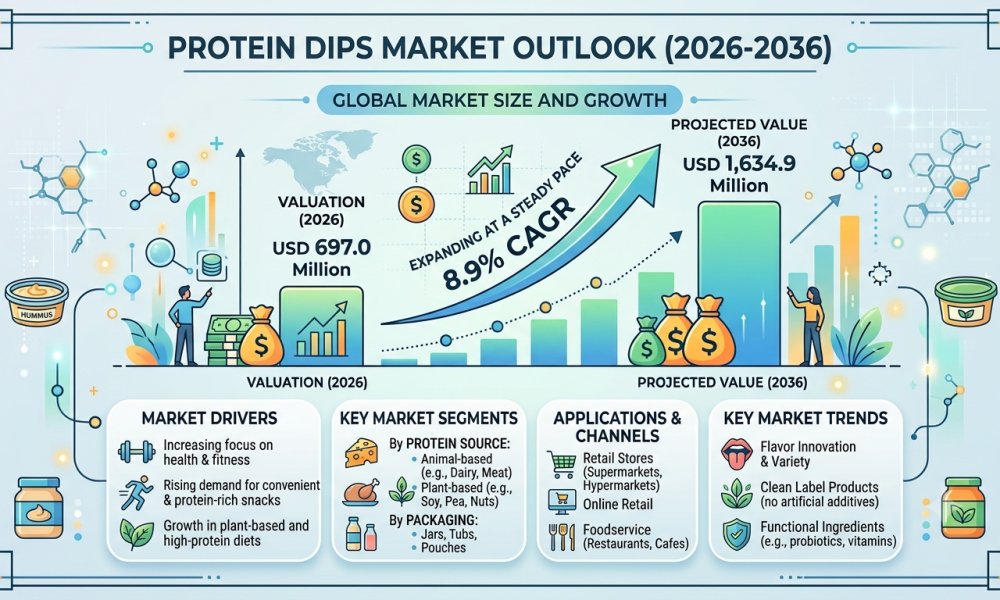
The global protein dips market is projected to grow from USD 697.0 million in 2026 to USD 1,634.9 million by 2036, registering an 8.9% CAGR during the forecast period. Demand is supported by growing interest in protein-forward eating, familiar chilled snacking occasions, and the use of dairy, legumes, nuts, seeds, and other protein-rich ingredients in convenient dip formats. Consumers are increasingly seeking products that combine nutrition, taste, convenience, and versatility across snacks and meal components.
Protein dips benefit from their ability to add a visible nutrition proposition to an established eating occasion. Greek yogurt, hummus, beans, dairy cheese, and nut-based formulations provide multiple routes for product development, while single-serve cups and differentiated recipes create opportunities for portable snacking. At the same time, manufacturers need to manage texture, flavor, refrigerated shelf life, nutrition-profile requirements, and pricing to support repeat purchases.
Get detailed market forecasts, competitive benchmarking, and industry insights: https://www.futuremarketinsights.com/reports/sample/rep-gb-34852
Global Segment Leaders
- Product Type – Greek Yogurt Dips: 40.5% in 2026. Greek yogurt provides a creamy chilled base and a familiar dairy-protein platform that works across savory flavors.
• Protein Source – Dairy: 26.7% in 2026. Yogurt and cheese offer recognizable protein sources with broad compatibility across savory dip profiles.
• Claim – High-Protein: 30.3% in 2026. The claim directly communicates the category’s nutritional proposition while maintaining the familiar dip use case.
• Packaging – Tubs: 29.8% in 2026. Tubs support shared refrigerated use, resealing, and sufficient front-of-pack space for flavor and nutrition communication.
• Sales Channel – Supermarkets & Hypermarkets: 37.0% in 2026. These channels provide refrigerated infrastructure, shopper traffic, product comparison, and opportunities for trial and repeat purchase.
Country-Level Performance
South Korea is projected to record the fastest growth among the profiled countries, with a 9.3% CAGR through 2036. Convenient portions and clear nutrition labeling are relevant to packaged-food adoption, while protein is included among mandatory nutrients for covered processed foods.
The United States is forecast to expand at an 8.5% CAGR, supported by established refrigerated merchandising and growing emphasis on protein foods and nutrient-dense eating. The 2025-2030 Dietary Guidelines for Americans provide a current nutrition context for dairy, legume, nut, and seed-based formulations.
The United Kingdom is projected to grow at an 8.2% CAGR. Changes to food promotion and advertising rules increase the commercial relevance of balanced nutrition profiles for qualifying products, creating opportunities for protein dips positioned around clear nutritional value.
Germany is expected to expand at a 7.6% CAGR, supported by dietary guidance that gives attention to both legumes and nuts while retaining daily dairy, creating multiple formulation pathways for protein-dip manufacturers.
Japan is forecast to register a 7.0% CAGR through 2036. Nutrition communication and packaging requirements remain important considerations as manufacturers develop products for the Japanese retail environment.
Regional Context
South Korea, the United States, and the United Kingdom represent key country markets within the protein dips landscape, with projected CAGRs of 9.3%, 8.5%, and 8.2%, respectively. Growth is linked to protein-forward eating, established refrigerated retail infrastructure, convenient portion formats, and consumer interest in nutrition-oriented snack and meal options.
Germany and Japan are also expected to record sustained growth, with CAGRs of 7.6% and 7.0%, respectively. Across these markets, manufacturers are exploring both dairy and plant-protein pathways, while adapting flavor profiles, packaging, labeling, and nutrition communication to local conditions.
The full report covers North America, Latin America, Western Europe, Eastern Europe, East Asia, South Asia and Pacific, and the Middle East and Africa, with country-level analysis including the USA, UK, Germany, Japan, and South Korea.
Access full Report in PDF Format@ https://www.futuremarketinsights.com/reports/brochure/rep-gb-34852
Competitive Landscape
The competitive landscape includes Good Foods, Sabra, Bolthouse Farms, Ithaca Hummus, Litehouse, Lantana Foods, Fresh Cravings, Cedar’s Mediterranean Foods, and Boar’s Head. Competition spans refrigerated dairy dips, hummus specialists, and brands with broader grocery or deli access. Companies differentiate through protein source, pack architecture, ingredient profiles, claim positioning, and refrigerated availability.
Good Foods, Bolthouse Farms, and Litehouse serve dairy or yogurt-based refrigerated dip occasions, while Ithaca Hummus, Lantana Foods, and Fresh Cravings focus on refrigerated hummus and plant-oriented dips. Sabra, Cedar’s Mediterranean Foods, and Boar’s Head serve hummus and Mediterranean dip occasions through established grocery and deli channels.
Key Market Opportunities
Protein dips offer manufacturers multiple routes for product differentiation. Single-serve cups can address portable snacking and lunch occasions, while family-sized tubs support sharing. Plant-based variants can appeal to consumers seeking legume, nut, or seed-based protein sources.
However, protein enrichment can affect texture and flavor, while refrigerated shelf-life requirements and nutrition-profile rules can increase formulation and commercialization challenges. The commercial opportunity therefore depends on delivering a clear protein proposition without compromising taste, convenience, or product economics.
Analyst Perspective
“Protein dips have a workable route to repeat purchase when the protein source improves the product story without making texture, portion economics or refrigerated handling harder. Retail teams should judge the full eating experience before treating protein grams as a stand-alone reason for shelf space.”
— Nandini Roy Choudhury, Principal Consultant, Future Market Insights
Explore More Insights from the Food and Beverage Industry Analysis
Future Market Insights provides research across food and beverage categories, covering market size, segment performance, country-level growth, competitive landscapes, and emerging product opportunities.
Read the complete Protein Dips Market analysis: Future Market Insights – Protein Dips Market
About Future Market Insights (FMI)
Future Market Insights, Inc. (ESOMAR certified, recipient of the Stevie Award, and a member of the Greater New York Chamber of Commerce) offers profound insights into the driving factors that are boosting demand in the market. FMI stands as the leading global provider of market intelligence, advisory services, consulting, and events for the Packaging, Food and Beverage, Consumer Technology, Healthcare, Industrial, and Chemicals markets. With a vast team of over 400 analysts worldwide, FMI provides global, regional, and local expertise on diverse domains and industry trends across more than 110 countries.



