
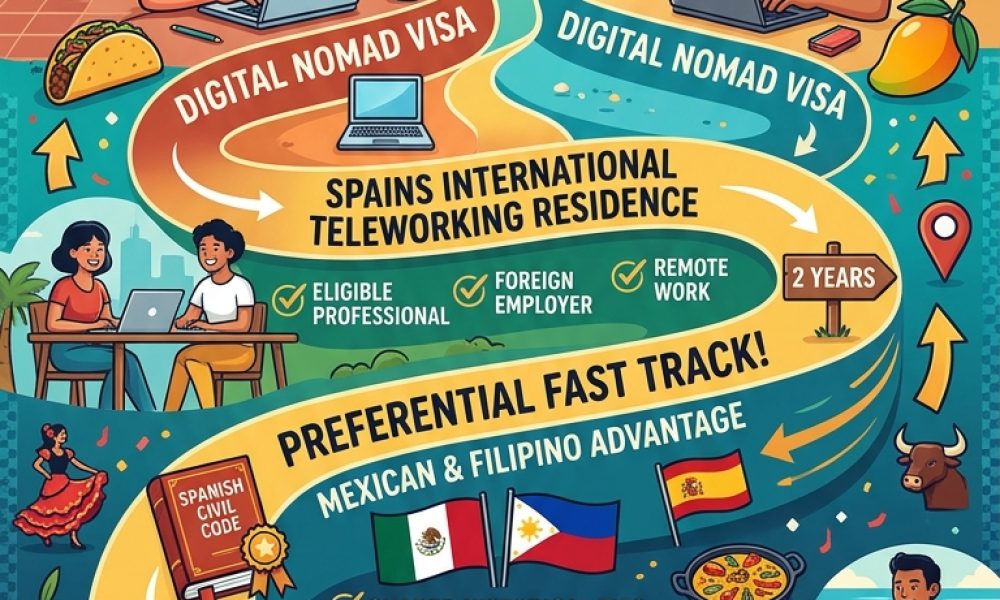
Eligible Mexican and Filipino professionals working remotely for foreign employers may use Spain’s international teleworking residence framework as part of a longer-term path to nationality.
WASHINGTON, November 15, 2026: Spain’s international telework residence program is attracting attention among remote professionals considering a European future, particularly Mexican and Filipino nationals who may qualify for Spanish citizenship after two years of lawful residence.
The arrangement offers a possible way to combine continuing foreign employment with a genuine move to Spain. However, the immigration authorization, income requirements, and nationality application remain distinct processes governed by separate legal tests.
For applicants thinking beyond their next overseas assignment, the essential question is whether their specific remote working circumstances meet Spain’s immigration rules and can support continuous residence, rather than merely allowing an extended period of travel.
A Remote Work Permit With a Defined Legal Purpose
Spain introduced its international teleworker provisions through legislation adopted in 2022, creating a residence framework for eligible non-European professionals who can perform their work remotely for businesses established outside Spanish territory using digital communications systems.
The framework is commonly called the digital nomad visa, but its formal legal classification matters because Spanish citizenship rules distinguish genuine authorized residence from tourist visits and certain other forms of temporary permission that do not count.
An employee ordinarily must work for an employer based outside Spain. At the same time, a self-employed professional may undertake limited work for Spanish clients provided it does not exceed 20% of the individual’s total professional activity.
That distinction means a foreign employee cannot automatically take a Spanish side job simply because another applicant operating as an independent contractor is permitted a restricted amount of domestic professional work under different statutory conditions.
Mexican and Filipino Nationals Have an Additional Opportunity
Article 22 of Spain’s Civil Code provides a two-year residence period for qualifying nationals by origin from Ibero-American countries and the Philippines, compared with the ordinary ten-year period applicable to many applicants seeking nationality through residence.
For an eligible Mexican software developer or Filipino financial technology professional, a properly maintained international telework residence authorization could therefore form part of the qualifying history needed to apply for Spanish nationality after the statutory period.
The two-year rule does not mean citizenship is awarded automatically after twenty-four months, because applicants must still demonstrate legal, continuous residence immediately before filing, good civic conduct, satisfactory integration and compliance with applicable documentary requirements.
Applicants who acquired Mexican or Philippine citizenship through later naturalization should also investigate whether they meet the nationality-by-origin condition, since holding one of those passports is not necessarily sufficient to claim accelerated treatment.
The Employer and Professional Relationship Must Be Documented
Spain’s legislation requires evidence that the overseas company or corporate group has operated genuinely and continuously for at least one year, guarding against applications built around newly invented employers or unsupported remote working arrangements.
Employees must establish an existing relationship with their foreign employer for at least three months before the application and provide documentation confirming that their duties can lawfully be performed remotely from Spain.
Independent professionals similarly need proof of a commercial relationship with one or more overseas companies for at least three preceding months, together with contracts explaining the nature and conditions of their remote services.
The applicant must also demonstrate recognized qualifications or at least three years of relevant professional experience, meaning that receiving online payments alone does not establish eligibility under the international teleworking framework established by Spanish law.
Remote Work Must Genuinely Be Possible From Spain
The law targets work performed through computer, telecommunications and comparable electronic systems, not positions that require regular on-site supervision, physical production or business travel that cannot realistically be reconciled with genuine remote performance.
A software engineer delivering projects electronically may present a different eligibility profile from a regional sales executive whose routine responsibilities require frequent in-person customer visits and supervision at an employer’s overseas premises.
Companies should confirm the arrangement in writing and examine confidentiality, cybersecurity, employment law and payroll obligations before authorizing relocation, since an informal promise from a manager may not satisfy immigration or corporate compliance requirements.
Freelancers should similarly retain contracts, invoices and evidence of ongoing client relationships, while ensuring that any Spanish customer work stays within the specific statutory limit applicable to eligible independent professionals rather than foreign employees.
Financial Requirements Change With Spain’s Minimum Wage
Spain connects financial eligibility to its statutory minimum wage, and the Spanish Embassy’s Washington consular guidance lists a 2026 requirement of €2,442 per month for an international telework applicant traveling without accompanying family members.
The published amount corresponds to 200% of the applicable monthly minimum wage. It increases when qualifying relatives accompany the principal applicant, making household size a substantive consideration rather than a minor administrative detail.
Evidence may include employment agreements, salary records, company certifications and other accepted financial documentation, but applicants should confirm the exact proof currently required by their responsible consulate or immigration office before submitting any paperwork.
Because the statutory wage and implementing guidance can change, a financial calculation copied from an older article should not substitute for official verification of the threshold in force when an actual application is lodged.
Consular Visas and In-Country Residence Permits Differ
Applicants living outside Spain generally pursue an international teleworker visa through the responsible Spanish consulate, which may issue residence authorization for up to one year depending on the employment arrangement and applicable immigration conditions.
A foreign national already lawfully present in Spain may instead qualify to request an international teleworker residence authorization through the designated immigration procedure, a separate avenue whose initial validity can reach three years.
The law allows later renewals of residence authorization for two-year periods when the underlying eligibility conditions remain satisfied. However, any applicant approaching expiry should review the relevant deadlines and ongoing documentation requirements.
Neither a tourism visit nor an appointment confirmation should be mistaken for a residence authorization, and the date from which nationality residence can be counted must be assessed through legally effective immigration records.
Spain’s Digital Nomad Appeal Has Received International Coverage
An October 2025 Euronews report on leading digital nomad destinations described Spain’s attraction to remote workers. It noted the particularly short citizenship residence period available to qualifying nationals from Ibero-American countries and the Philippines.
The report drew on a comparative assessment of countries offering remote work options. Still, those rankings should not be treated as government eligibility decisions or evidence that every participant in Spain’s program will eventually obtain citizenship.
For people comparing Spain with other European destinations, the key consideration is the interaction between a legally recognized remote-work residence route and the accelerated nationality advantage attached to certain applicants’ original citizenship.
A favorable ranking can encourage further research, but the decisive facts for any individual remain nationality history, the overseas employer’s status, income, social security arrangements, and the ability to reside continuously in Spain.
Social Security Compliance Is More Than an Afterthought
Spanish guidance requires international teleworkers to address social security coverage, and employees may need to register through their foreign employer unless an applicable international agreement provides formally recognized coverage from another country’s social security system.
A valid international coverage arrangement generally requires documentary evidence from the responsible social security authority, not an unsupported claim that contributions paid abroad automatically exempt the worker from Spanish statutory requirements.
For self-employed applicants, Spanish administrative guidance emphasizes registering under the applicable self-employment social security system, an obligation to evaluate before assuming an overseas freelance business can operate without local registration.
Because these issues involve labor classification and potentially complex international coordination agreements, both employees and contractors should obtain case-specific advice rather than selecting whichever administrative treatment appears to produce the lowest contributions.
Tax Residence and Visa Eligibility Remain Separate Questions
Moving to Spain for a sustained period may trigger Spanish tax residence and reporting questions. Still, immigration approval does not automatically establish that every applicant qualifies for a special tax regime or a particular reduced income tax rate.
Certain incoming workers may be eligible to apply for special tax treatment if they meet independent statutory requirements. Still, the outcome depends on timing, working arrangements, personal circumstances, and properly filing tax elections.
A remote professional who continues receiving income from Mexico, the Philippines or the United States should review the relevant tax treaty provisions and applicable reporting rules, rather than assuming offshore payment automatically avoids Spanish taxation.
Amicus International Consulting has explored the separation between nationality and continuing obligations in its analysis of second passports and United States tax reporting, a useful reminder that a future Spanish passport does not cancel liabilities established elsewhere.
Continuous Residence Is Essential to the Citizenship Plan
Even after an international telework residence authorization is granted, an applicant relying on Article 22 must maintain legal, continuous residence immediately before applying, so prolonged foreign assignments or frequent extended departures can complicate the case.
A valid identity card or Spanish bank account cannot, on its own, establish that someone genuinely lived in Spain, especially when travel records show that much of the proposed qualifying period was spent working or residing overseas.
Residents should keep immigration approvals, renewal receipts, relevant travel evidence, and ordinary documentation of their Spanish lives, and seek qualified advice before planning potentially disruptive lengthy absences or changing their professional arrangements.
An employer’s permission to work anywhere does not override applicable Spanish immigration requirements, making it important to reconcile business travel schedules with the actual residence history that Spanish nationality authorities may later examine.
Language Testing Creates Different Practical Requirements
Qualifying Mexican citizens generally qualify for the Spanish-language examination exemption available to nationals of countries where Spanish is an official language. Still, that exemption does not automatically remove every integration or knowledge-testing requirement.
Philippine nationality alone ordinarily does not provide the same language examination exemption, so Filipino applicants should review the applicable Spanish proficiency rules, accepted diplomas, and possible individual exemptions before scheduling their nationality application.
Both groups may face the constitutional and sociocultural knowledge assessment where required, as well as the separate official examination of good civic conduct and the authenticity of documents submitted during the citizenship procedure.
For professionals with demanding overseas work schedules, early preparation can make the eventual application more orderly. However, successful examination results cannot replace the need for a complete and lawful residence history.
Family Members Need Individual Immigration Planning
Spain’s international teleworker framework can accommodate qualifying spouses, partners, children, and certain dependent relatives. Still, family applications require appropriate documentation and sufficient resources, not just a principal worker’s employment contract.
Authorized family members can benefit from residence and employment rights under the applicable framework. However, their future nationality eligibility must be assessed separately based on individual citizenship history, family relationships, and legal residence periods.
A Mexican professional with a Philippine spouse, for example, should not assume both qualify through identical nationality documentation, even if each may independently hold a citizenship status that could support the shorter Spanish residence threshold.
Families should also consider schooling, healthcare, housing, and income changes before relocating, because a long-term residence strategy depends on a sustainable household arrangement rather than merely obtaining initial administrative permission.
American Dual Nationals Have Additional Travel Considerations
Some Mexican and Filipino nationals also hold American citizenship, and the United States Department of State’s Spain travel advisory offers relevant safety and travel information for American citizens considering a move or extended stay abroad.
American travel guidance does not determine Spanish visa eligibility or nationality treatment, however, and applicants should distinguish the obligations associated with United States citizenship from Spain’s separate tests for original nationality and qualifying residence.
A dual citizen should identify every citizenship accurately in official applications and consider the rules governing passport use, financial reporting and consular assistance, rather than assuming a change in residence erases existing legal responsibilities.
When a family includes citizens of several countries, coordinated legal planning can reduce administrative surprises and clarify how each relative’s rights differ before and after any eventual acquisition of Spanish nationality.
A Second Passport Is the Possible Outcome, Not the Starting Document
Amicus International Consulting provides information aonsecond-passport planning and advisory services. Still, the Spanish digital nomad framework is a residence pathway administered by Spanish authorities, not a passport purchase or guaranteed nationality program.
Prospective applicants should require clear explanations of the applicable immigration category, the evidence supporting foreign employment, the expected cost of relocation, and the difference between eligibility to apply for nationality and eventual government approval.
No commercial representative can substitute fabricated employment records, a nominal Spanish address, or altered nationality documents for the requirements established in Spanish law, and material misstatements can jeopardize both immigration permission and later citizenship review.
The strongest planning approach therefore begins with verifiable professional qualifications and genuine remote work, followed by documented residence, regulatory compliance and a carefully timed application once the nationality requirements have actually been satisfied.
The European Opportunity Depends on a Genuine Move
For eligible Mexican and Filipino professionals, Spain’s international teleworker authorization can make continued employment compatible with residence abroad, potentially bringing the citizenship application threshold within reach after two years of uninterrupted qualifying residence.
That advantage matters only when an applicant meets separate immigration, financial, social security, and nationality rules, because remote-work flexibility does not turn tourist visits into residence or convert a residence card into citizenship.
The practical lesson for workers and families is to verify eligibility before relocating, keep accurate records throughout their time in Spain, and view a future European Union passport as a possible legal outcome rather than an automatic benefit.
A professional whose contracts change during the first year should reassess the authorization conditions before accepting a substantially different position, because continued compliance may depend on the overseas employer and duties.
Similarly, applying for citizenship should not be confused with receiving a permanent European residence right, since the telework authorization has its own renewal rules and nationality remains a separate decision requiring official approval.
Spain’s framework offers a potentially consequential route for those prepared to build an authentic life while working remotely. Still, its long-term value rests on sustained compliance, credible documentation,n and official decisions at every stage.




