
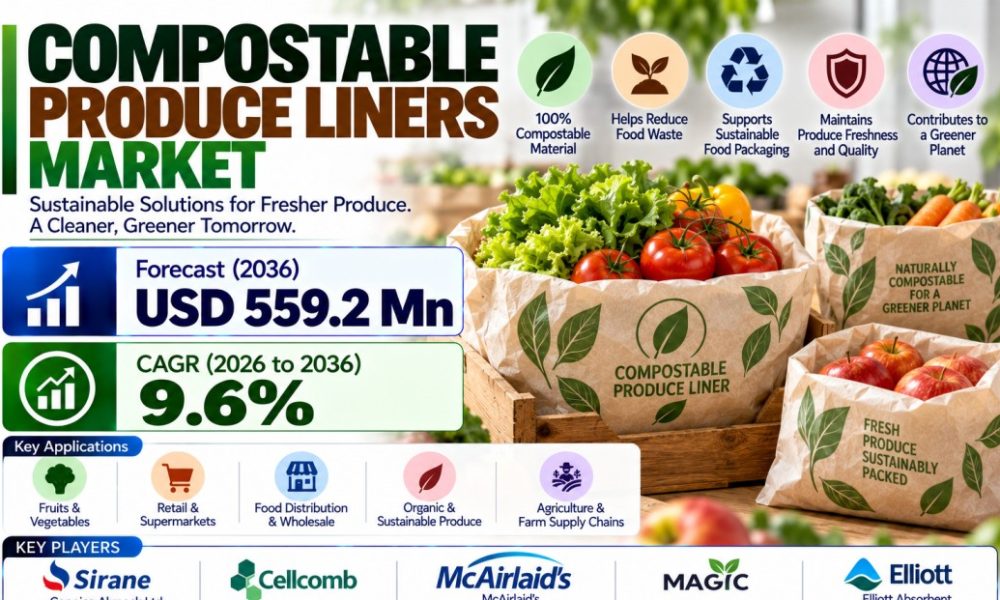
The global compostable produce liners market is projected to grow from USD 223.6 million in 2026 to USD 559.2 million by 2036, expanding at a 9.6% CAGR during the forecast period, according to Future Market Insights. The market is being shaped by the need to manage condensation and free liquid inside fresh-produce packs while maintaining ventilation, filling-line performance, food-contact compliance, and accurate disposal instructions.
Produce respiration and cooling changes can leave free water inside packs. Compostable liners are therefore being evaluated not only as material alternatives but also for their ability to control moisture without blocking vents or changing established tray and filling-line configurations. The market is also being influenced by packaging and waste-management requirements that require documentation across material classes and destination markets.
>> Get Detailed Market Forecasts, Competitive Benchmarking, and Pricing Trends: https://www.futuremarketinsights.com/reports/sample/rep-gb-34600
Certified Compostable Absorbent Pads Lead the Product Category
Certified compostable absorbent pads are projected to account for 30.0% of the market in 2026, making them a key product category. Their familiar placement beneath moisture-sensitive produce allows packhouses to evaluate liquid retention and surface behavior without changing the outer tray.
Berries are forecast to represent 26.0% of the market in 2026. Their sensitivity to free moisture and pressure points creates demand for liners that manage localized liquid while preserving airflow and presentation inside shallow retail packs.
Airlaid Cellulose Gains Attention for Lightweight Absorbency
By material, airlaid cellulose is estimated to hold a 31.0% share in 2026. Its low component weight, adjustable thickness, and liquid-uptake properties allow converters to tune liner density for different moisture loads.
For automated operations, rolls and die-cut pads can also support placement processes without requiring changes to the outer pack. However, food-contact records, cover layers, edge sealing, and crop-specific performance remain important parts of commercial qualification.
Industrial Compostability Holds a 54.0% Share
Industrial compostable certification is expected to account for 54.0% of the certification category in 2026. Controlled standards provide packaging teams with a defined testing and documentation route.
However, certification alone does not guarantee that a used liner will enter the intended waste stream. Collection infrastructure varies between countries, creating additional qualification work for multinational produce programs. Germany, for example, has restrictions affecting biodegradable plastic packaging in biowaste collection.
FMI Principal Consultant Nandini Roy Choudhury explains:
“Packhouses should compare liquid retention and pad movement under the cooling profile used for each crop. Commercial value comes from stable seasonal supply plus disposal instructions that remain accurate in every destination market.”
Country Markets Show Varied Growth Profiles
The report profiles five key country markets with Brazil recording the highest projected CAGR at 10.1%, followed by the UK at 9.7%, Germany at 9.4%, the USA at 8.9%, and Japan at 8.1%. These growth rates reflect different certification practices, collection systems, retail structures, and qualification requirements rather than a direct ranking of current market size.
Brazil’s market is influenced by packaging reverse-logistics requirements and long domestic and export produce routes. In the UK, separate food-waste collection is increasing attention on disposal instructions. Germany combines established recovery infrastructure with restrictions around biodegradable plastics in organic-waste systems.
In the USA, large retail programs provide opportunities for crop-specific trials, although facility acceptance and state-level labeling requirements vary. Japan’s established packaging collection infrastructure is paired with more conservative qualification requirements for new food-contact structures.
Qualification Is Becoming Central to Commercial Adoption
The key commercial challenge is connecting compostability claims with actual operating conditions. Packhouses need to assess absorbency, pad movement, ventilation, food-contact documentation, line performance, and the disposal route available in each destination market.
The market also presents an opportunity for crop-specific formats. Manufacturers can adjust pad density, dimensions, and surface characteristics for individual crops and production lines while providing destination-specific disposal guidance.
👉 Access the Complete Report in PDF Format: https://www.futuremarketinsights.com/reports/brochure/rep-gb-34600
Competitive Landscape
The market includes absorbent-pad specialists and compostable-film platforms. Notable companies profiled by FMI include Coppice Alupack Ltd. (Sirane), Cellcomb AB, McAirlaid’s Vliesstoffe GmbH, MAGIC S.p.A., Elliott Absorbent Products Ltd., Futamura Chemical Co., Ltd., and TIPA Corp.
Sirane, Cellcomb, McAirlaid’s, MAGIC, and Elliott compete in absorbent pads designed for condensation control and soft-fruit protection. Futamura and TIPA provide compostable film platforms for produce-adjacent labeling and flexible packaging applications.
Recent developments include TIPA’s September 2025 launch of four high-barrier compostable film and laminate products, Cellcomb’s June 2025 acquisition of Fatex, and Elliott’s Echo recyclable and compostable pad launched in October 2024 and later featured at Fruit Logistica in February 2025.
About the Compostable Produce Liners Market
The FMI report covers the market by product type, material, certification, produce type, end use, sales channel, and region. Product categories include certified compostable absorbent pads, compostable paper liners, PLA-biopolymer film liners, and cellulose net liners.
The report covers North America, Latin America, Europe, East Asia, South Asia and Pacific, and the Middle East and Africa, with country-level analysis across more than 20 countries.
To explore how FMI Custom Research can support your strategic priorities, connect with our team at – [email protected]
About Future Market Insights (FMI)
Future Market Insights, Inc. is an ESOMAR-certified, ISO 9001:2015 market research and consulting organization trusted by Fortune 500 companies. With a global presence across the U.S., UK, India, and Dubai, FMI delivers data-driven insights across 30+ industries and 1200 markets worldwide.



