
Crime

Tony Ye’s Guilty Plea Marks a Separate Outcome in Chen Case
Jianyun “Tony” Ye pleaded guilty in 2021 and completed a twelve-month federal prison sentence in an EB-5 immigration fraud prosecution, creating a separate legal outcome
Jianyun “Tony” Ye pleaded guilty in 2021 and completed a twelve-month federal prison sentence in an EB-5 immigration fraud prosecution, creating a separate legal outcome

The allegations surrounding immigration attorney Danhong “Jean” Chen’s practice, followed by her federal criminal convictions, highlight the risks investors face when legal representation, undisclosed referral

According to the U.S. Justice Department’s March 2025 announcement, Danhong “Jean” Chen was returned from the Kyrgyz Republic to face federal immigration fraud charges; subsequent

According to the U.S. Justice Department’s March 2025 announcement, Danhong “Jean” Chen was returned from the Kyrgyz Republic to face federal immigration fraud charges, with

Le Monde’s 2023 reporting examined citizenship recipients linked to criminal cases, raising questions about applicant checks while requiring distinctions between allegations, convictions, and legitimate citizenship
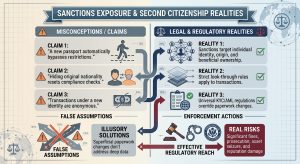
Executives should question suggestions that another nationality automatically resolves sanctions exposure, with any proposed business or financial activity requiring assessment under the rules that apply.

A contribution-based nationality application should be evaluated independently from tax residence and reporting questions, particularly when applicants expect financial consequences from obtaining another passport. WASHINGTON,

Applicants seeking financial flexibility should review institutional requirements separately, rather than assuming another nationality will establish account eligibility or eliminate questions about their circumstances. WASHINGTON,

Assess the value of a citizenship decision with the understanding that destination entry policies can change, affecting the benefits emphasized when an application was first
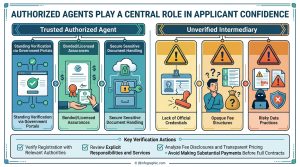
Prospective second citizenship applicants should verify official licensing, understand the differences between advisers and authorized filing agents, and establish clear protections for personal documents, payments,
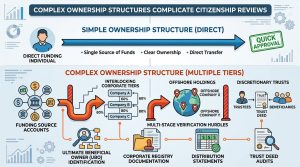
Second citizenship applicants with holding companies, family trusts, partnerships, and international investments may need to establish who controls assets, who benefits from them, and how
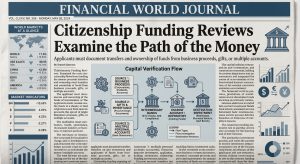
Government screening increasingly focuses on how qualifying contributions move from legitimate earnings, business proceeds, family gifts, and investment accounts into authorized citizenship programs, with reliable

Entrepreneurs applying for second citizenship must explain how businesses, investments, and transactions built their wealth, while separately documenting the legitimate origin of the precise funds
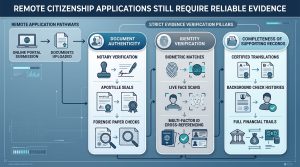
Digital interviews and agent-managed submissions can simplify second citizenship applications. Still, genuine civil records, verified financial histories, accurate family information, and independent government assessment remain
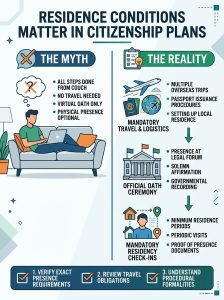
Applicants attracted by citizenship programs advertising little or no physical presence must distinguish residence obligations from mandatory interviews, sworn declarations, biometric enrollment, passport issuance, and

Citizenship-by-investment programs may permit qualifying spouses, newborn children, parents, and other relatives to obtain nationality after the principal applicant’s approval. Still, separate eligibility rules, additional

Spouses, children, parents, grandparents, and siblings may qualify differently across investment citizenship programs, making documentary proof, financial dependency, government screening, and the timing of family

Families comparing second citizenship contributions must calculate screening charges, dependent eligibility, professional assistance, official documents, passport issuance, and settlement expenses before treating an advertised minimum

New citizenship-by-contribution pathways in Africa and the Pacific are expanding international options. Still, changing legislation, document-issuance delays, government oversight, and foreign visa policies make long-term
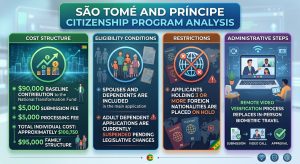
The African island nation’s emerging citizenship-by-investment program offers a contribution-based route through its National Transformation Fund. Still, applicants must examine government authorization, family eligibility, administrative

Short processing estimates for Vanuatu citizenship-by-investment applications warrant scrutiny because document preparation, financial screening, official decisions, citizenship certification, passport issuance, and changes to international

St. Kitts and Nevis maintains a US$250,000 minimum contribution under its principal citizenship funding route. Still, applicants comparing Caribbean second passports must assess family eligibility,

Entrepreneurs considering Grenada’s citizenship-by-investment program should distinguish acquiring Caribbean nationality from eligibility for an American E-2 treaty investor visa, especially because U.S. law imposes additional
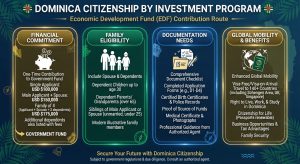
Dominica’s Economic Diversification Fund offers a contribution-based citizenship pathway. Still, prospective applicants must examine nonrefundable payments, dependent eligibility, identity screening, government approval, and changing international
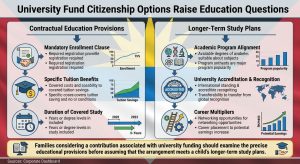
An education-linked citizenship contribution may help finance university development while offering a limited tuition benefit. Still, families must examine eligibility, admissions, living expenses, and