
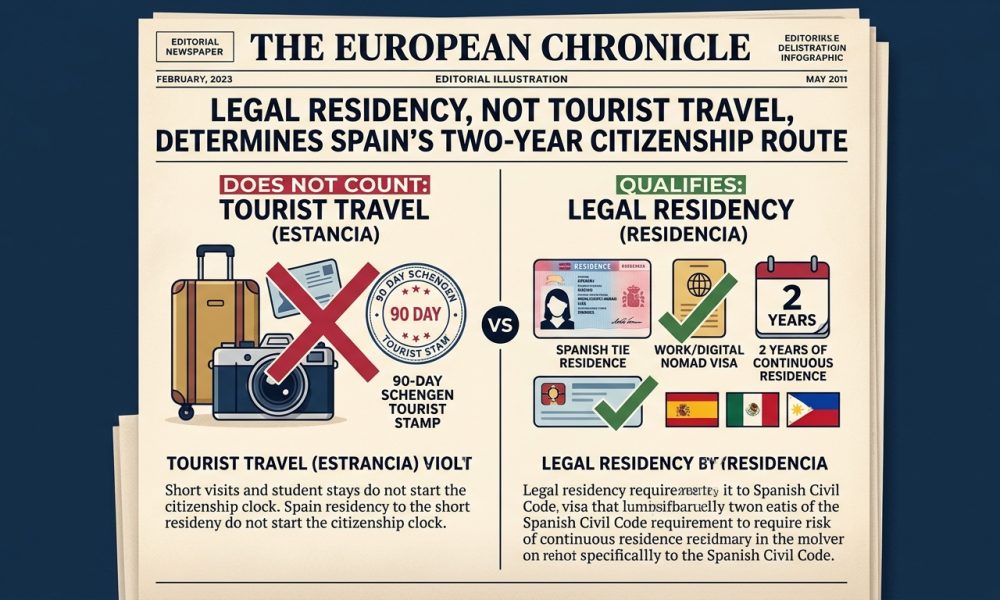
Mexican and Filipino travelers considering naturalization must distinguish authorized residence from short-term visits, because tourist stays do not satisfy the qualifying residency requirement.
WASHINGTON, D.C., November 15, 2026 — Mexican and Filipino nationals exploring Spanish citizenship face an essential legal distinction: repeatedly visiting Spain, renting an apartment, or taking extended vacations there does not establish the lawful residence required for an accelerated nationality application.
Spain offers qualifying nationals by origin from Ibero-American countries and the Philippines an opportunity to apply after two years of eligible residence, rather than the ordinary ten-year period. Still, the shortened timetable does not convert tourism into immigration status.
The practical consequences extend beyond planning a move, since applicants who confuse entry permission with residence authorization can miscalculate their filing dates, disrupt family arrangements and incur substantial expenses before discovering that their citizenship clock never started.
Spanish Law Requires More Than Physical Presence
Article 22 of Spain’s Civil Code establishes the two-year exception for qualifying nationals by origin and expressly requires legal, continuous residence immediately before the application, regardless of how often someone has entered the country.
That three-part standard means a person’s nationality may determine the minimum period. In contrast,e the immigration authorization and actual living circumstances determine whether a particular period can count toward the residence requirement in the first place.
A traveler who spends several summers in Madrid, signs a residential lease or maintains a Spanish bank account may have substantial personal connections to Spain. Yet, those facts alone cannot replace the residence authorization recognized under immigration law.
The distinction is also reflected in Euronews reporting on Spain’s citizenship eligibility rules, which explains that obtaining legal residence and meeting the relevant nationality period are separate from ultimately receiving citizenship or national voting rights.
Tourist Entry and the Schengen Travel Limit
Short visits generally fall under Schengen rules allowing qualifying travelers to spend no more than 90 days within a rolling 180-day period, a framework intended for temporary travel rather than an indefinite European relocation.
Mexican passport holders ordinarily benefit from short-stay visa exemption. In contrast,e Philippine passport holders generally require an appropriate Schengen visa unless another applicable exemption exists, but neither arrangement by itself creates residence for Spanish nationality purposes.
The United States Department of State’s guidance for travelers in Europe also describes the 90-days-in-180 rule for American passport holders, an important additional consideration when a Mexican or Filipino national simultaneously holds United States citizenship.
Accumulating tourist visits across several years cannot be transformed into two years of Spanish residence through arithmetic, because the relevant legal test concerns qualifying residence status and continuity rather than the total number of stamps in a passport.
Time spent visiting other Schengen countries can also affect the short-stay allowance, so a person cannot automatically restart the travel clock by crossing from Spain into France or Portugal and then returning for another holiday.
A Visa, Residence Permit and Address Are Different Things
A Schengen visitor visa authorizes a limited visit under its conditions. In contrast, a qualifying residence visa or authorization can support a longer lawful stay, making the document’s legal category more consequential than its duration alone.
Registering at a municipal address, often called empadronamiento, can provide useful evidence of where a person lives. Still, registration is not an independent immigration permission and cannot retroactively legalize time spent merely as a tourist.
Likewise, obtaining a foreigner Identification number, opening a local bank account, or buying property may help with administrative arrangements, but none automatically establishes the residence status needed to begin the nationality eligibility period.
Applicants therefore need to retain the actual authorization decision and verify its effective dates, rather than relying exclusively on invoices, property deeds, accommodation contracts or local registration certificates as evidence that their citizenship clock has started.
Student Permission Can Be a Separate Legal Category
A particularly consequential distinction affects international students, whose permission to remain for education may be classified under Spanish immigration law as an authorized stay, or estancia, rather than the legal residence required for nationality through residence.
A person could complete an extended university program in Spain, learn the language, and develop strong local ties without automatically accumulating the two qualifying years for citizenship if their immigration status remained an educational stay throughout. Some students may later qualify to change their status to residence and work authorization. Still, they should review the exact transition date and effect of the new permission before calculating eligibility under Article 22.
Consequently, prospective students who regard education as an eventual citizenship pathway should plan both stages separately, recognizing that a successful study experience and a qualifying residence history are related objectives rather than interchangeable legal achievements.
A student who later secures an appropriate residence authorization may begin accumulating qualifying time under that new status, making it especially important to distinguish the date of academic enrollment from the legally relevant date of residence.
Choosing the Right Residence Pathway Matters
Appropriate immigration options may include non-working residence, employment-based authorization, family-related residence, or international telework arrangements, with each category imposing different requirements for sufficient income, permitted activities, supporting documentation, medical insurance, and the applicant’s actual relationship to Spain.
A residence route suitable for a retired Mexican national supported by investment income may not fit a Filipino professional seeking to continue full-time online employment, even when both individuals eventually hope to apply for Spanish nationality.
Applicants should examine whether the relevant authorization counts as residence for nationality purposes and whether they can meet its ongoing conditions, rather than choosing a visa solely because promotional descriptions emphasize speed or convenience.
Immigration rules and consular practices can also change, so it’s important to check the requirements in effect when an application is submitted rather than treating a previously published checklist or third-party commercial estimate as permanently reliable guidance.
Non-Lucrative Residence Is Not Permission to Work Remotely
Spain’s non-lucrative residence pathway can accommodate qualified applicants with sufficient financial means who genuinely intend to live in Spain without engaging in employment or professional activity, subject to health coverage and other statutory conditions.
The category does not authorize online employment simply because an employer or client is located abroad, a restriction that can make the non-lucrative route inappropriate for people whose relocation budget depends on active remote income.
A prospective applicant should distinguish passive dividends, investment returns, or other qualifying resources from professional earnings, and seek individualized advice on whether specific financial arrangements meet the applicable means-of-support test and documentation standards.
The residence strategy must also remain sustainable after arrival, since an applicant who enters under one set of conditions but works contrary to the permission could create immigration problems that undermine the longer citizenship objective.
International Telework Requires Its Own Authorization
Spain separately provides a framework for eligible international teleworkers, sometimes described as digital nomads, allowing certain non-European nationals to work remotely under an immigration authorization designed for that activity rather than under tourist entry.
Eligibility depends on conditions including the nature of the foreign employment or professional relationship, qualifying experience, financial capacity, and supporting records, so a remote job by itself does not guarantee the required permission will be granted.
Some applicants who are lawfully present in Spain may be able to pursue an international telework residence authorization through the designated procedure. Still, an application opportunity should never be confused with permission to overstay a visitor allowance.
For nationality planning, the decisive issue remains the period of qualifying legal residence actually obtained and maintained, not the marketing label attached to a visa or the simple fact that someone worked online from Spain.
Records must support the Starting Date.
A careful application timeline identifies the legally effective start of residence using official immigration records, then checks whether the applicant continuously maintained the required status during the full period immediately before the intended filing.
An arrival stamp can confirm when someone crossed the border. Still, it may not establish the date on which a separate residence authorization took legal effect, especially when tourist travel preceded an approved change of immigration status.
Applicants should organize residence approvals, renewals, foreigner identity documentation (where applicable), and relevant official notices chronologically, preserving consistent personal details so any future nationality review can follow their legal history without speculation.
When a renewal is pending, or an authorization changes categories, examine the effect on continuity under the governing rules and specific dates, rather than assuming a paperwork delay or a new card necessarily resets everything.
People who move between Spanish provinces or change addresses should also keep administrative records updated as required, because discrepancies across local registration, immigration files and application forms can trigger avoidable questions during subsequent nationality review.
Travel Abroad Can Affect Continuous Residence
The continuous residence requirement does not mean every brief trip outside Spain automatically destroys eligibility. Still, extensive or poorly explained absences can raise questions about whether the applicant maintained genuine residence throughout the qualifying period.
Family emergencies, professional obligations, or necessary travel may have understandable explanations. Still, an applicant should keep departure records and supporting evidence rather than relying on an internet claim that every absence under a particular number of days is safe.
Spanish authorities assess continuity in light of the applicable rules and facts, including where the person actually lives and maintains meaningful connections, making rigid commercial promises about permitted time abroad an unreliable basis for major decisions.
Those splitting their lives between Manila, Mexico City and Spain should therefore reconcile travel schedules with the residence requirement before planning long overseas periods, especially when school terms, family responsibilities or employment demand repeated international journeys.
Nationality by Origin Must Also Be Verified
Even a fully documented two-year residence period cannot secure the shortened treatment unless the applicant qualifies under the nationality categories identified in Spanish law, including the specific reference to nationals by origin of qualifying countries.
For Mexican applicants, proof may involve a birth certificate and evidence of Mexican nationality from birth. In contrast,e Filipino applicants may need additional records if naturalization abroad and subsequent reacquisition created a more complicated citizenship history.
A recently issued Mexican or Philippine passport does not, by itself, resolve how citizenship was acquired, so advisers should avoid assuming that everyone with one of those documents automatically receives the same accelerated naturalization treatment.
Applicants with several nationalities should establish their legal position through authentic civil records and qualified professional review, ensuring that the claimed citizenship basis and the immigration information submitted in Spain are accurate and mutually consistent.
Two Years Is an Application Threshold, Not a Passport Guarantee
Once an applicant completes the minimum qualifying residence period, they can pursue nationality through the prescribed process, which involves reviewing good civic conduct, integration, and supporting documents before authorities decide whether to grant citizenship.
Spanish-language testing requirements depend partly on nationality and other legally recognized circumstances. At the same time, applicants from countries where Spanish is an official language may still be required to take an examination on constitutional and sociocultural knowledge.
Approval can occur after the minimum residence threshold has passed, and further formalities involving the required oath or promise and civil registration are ordinarily necessary before someone can seek Spanish Identification and a passport.
The eventual European Union citizenship benefits are significant for eligible families. Still, they arise from properly completed Spanish nationality acquisition rather than from tourist travel, an approved residence card, or an application still awaiting decision.
Family, Tax and Financial Planning Cannot Be Ignored.
Relocation plans involving spouses or children must account for each family member’s nationality, residence authorization and timing, because relatives do not necessarily acquire Spanish citizenship simultaneously simply because one principal applicant qualifies after two years.
A household should also consider housing, schools, health coverage, and sustainable finances as practical elements of genuine residence, rather than trying to satisfy immigration rules through a nominal address while living primarily elsewhere.
Where spouses hold different passports or children have separate citizenship claims, each family member may require a distinct analysis of visa eligibility, educational arrangements and later nationality procedures instead of relying on one applicant’s legal position.
Amicus International Consulting’s discussion of second passports and continuing tax responsibilities shows why nationality, immigration residence, and tax residence require separate analysis, rather than assuming one new document automatically changes every cross-border obligation.
For people maintaining business interests or financial accounts outside Spain, advance coordination with immigration counsel and qualified tax professionals can help prevent unexpected reporting problems while ensuring that relocation decisions remain compatible with their actual activities.
Independent Verification Protects the Applicant
Prospective clients should request a written explanation of which residence authorization is proposed, why it qualifies for the nationality pathway, and what official records will prove the relevant start date, rather than accepting assurances based on ordinary tourism.
The second-passport advisory information published by Amicus International Consulting provides a commercial starting point for evaluating international citizenship goals. Still, any Spain-specific residence and nationality strategy must comply with government requirements and official decisions.
Be wary if an intermediary suggests that repeated tourist entries, purchased property, a municipal address, or an unverified passport can substitute for qualifying legal residence, since none removes the independent requirements imposed by Spanish law.
Responsible preparation also means checking original identity documents, reviewing criminal-history requirements and distinguishing estimated administrative timelines from guaranteed results, because even an eligible applicant must complete a substantive nationality review before becoming Spanish.
A Real Move, Not Repeated Vacations, Creates the Opportunity
For eligible Mexican and Filipino nationals, the two-year rule can make Spain a consequential European option. Still, its practical value depends on securing an appropriate residence authorization and building a genuine, well-documented period of life in the country.
Tourist visits remain useful for exploring neighborhoods, evaluating schools, and deciding whether to relocate. Yet, they should be understood as preliminary research rather than qualifying months that can be added toward an eventual citizenship application.
A durable plan connects original nationality, lawful immigration status, continuity of residence, family arrangements and later naturalization requirements, allowing applicants to pursue the benefits of Spanish citizenship without confusing a travel privilege with a residence right.
The central message is straightforward despite the complexities surrounding different visa categories: Spain’s accelerated citizenship pathway rewards qualifying legal residence, and the calendar cannot be advanced merely by crossing the border more often.




