
Overview
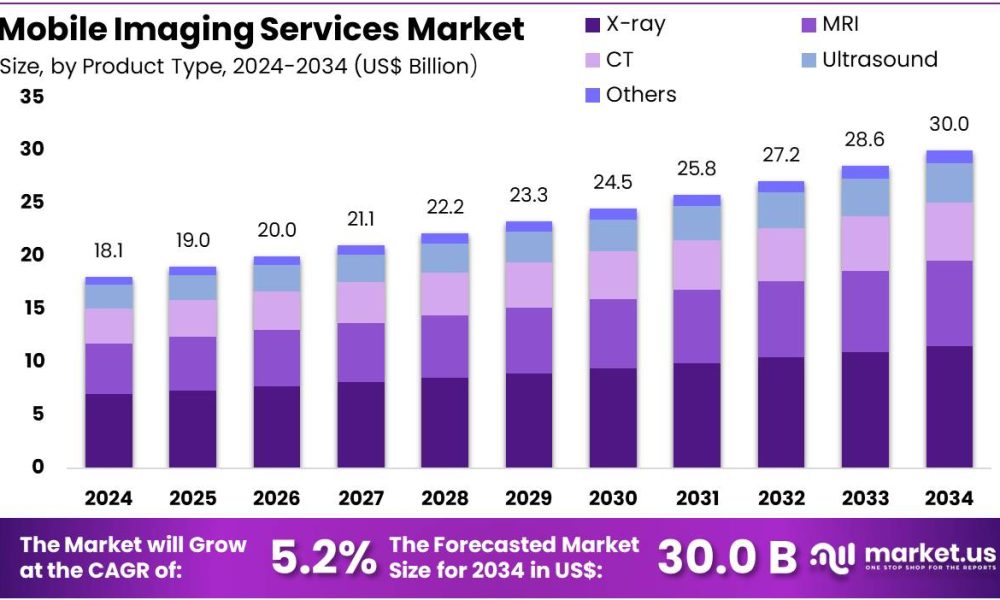
The Global Mobile Imaging Services Market is projected to grow from USD 18.1 billion in 2024 to USD 30 billion by 2034, registering a CAGR of 5.2%. This growth is driven by increasing demand for accessible and cost-effective diagnostic solutions. Mobile imaging services deliver on-site diagnostics such as X-rays, CT scans, MRIs, and ultrasounds. These services benefit hospitals, outpatient centers, and remote healthcare settings. The convenience offered by mobile imaging helps reduce patient travel time and supports faster diagnosis and treatment decisions, contributing to improved patient care.
Mobile imaging services are particularly valuable in emergency cases, home healthcare, and rural settings. These environments often lack access to fixed imaging infrastructure. Mobile diagnostics help bridge this gap by providing real-time results and supporting timely medical decisions. The rising prevalence of chronic conditions like cancer, heart disease, and neurological disorders is further increasing demand for such services. According to the NCBI, the U.S. recorded nearly 2 million new cancer cases in 2023. This underscores the growing need for accessible, high-quality diagnostic solutions available closer to patients.
Technological advancements are significantly enhancing the capabilities of mobile imaging units. Innovations such as portable MRI systems and digital X-ray machines are improving image quality and diagnostic accuracy. These technologies reduce patient wait times and streamline workflows within healthcare settings. As mobile units become more efficient and reliable, healthcare providers are more inclined to integrate them into their diagnostic services. This trend is expected to support market growth through better resource utilization and broader patient coverage.
One of the major drivers of market expansion is the increasing prevalence of chronic diseases. As per CDC data released in May 2023, 60% of U.S. adults were living with at least one chronic condition, and 40% had two or more. These conditions require regular imaging for effective monitoring and treatment evaluation. Mobile imaging offers a practical solution by delivering services directly to patients. This eliminates the need for transportation to centralized facilities, improving accessibility, especially in underserved or rural areas.
Despite promising growth, the mobile imaging services market faces notable challenges due to high operational costs. These include equipment purchase and maintenance, fuel expenses, and technician salaries. Mobile CT and MRI units require significant investment, often limiting entry for small-scale providers. Moreover, insurance reimbursement limitations in some regions restrict patient access to mobile imaging services. Logistical hurdles in reaching remote locations further complicate operations. Overcoming these barriers will require policy support and cost-efficient innovations to ensure sustainability and wider adoption.

Key Takeaways
- In 2024, mobile imaging services generated US$ 18.1 billion in revenue and are projected to reach US$ 30.0 billion by 2033, growing at 5.2% CAGR.
- Among product types, X-ray imaging dominated in 2023, capturing a 38.5% market share due to its wide usage in rapid and portable diagnostics.
- Orthopedics emerged as the top application area, holding a 35.6% market share, reflecting strong demand for mobility-focused diagnostic tools in bone and joint care.
- Diagnostic imaging centers led the end-user segment, accounting for 41.7% of total revenue, driven by their specialization and higher patient throughput in mobile setups.
- North America commanded the largest regional share in 2024, securing 39.3%, supported by advanced infrastructure and high adoption of portable diagnostic technologies.
Get Sample: https://market.us/report/mobile-imaging-services-market/request-sample/
Regional Analysis
North America currently dominates the global mobile imaging services market, holding the highest revenue share of 39.3%. The region’s growth is driven by increasing demand for accessible diagnostic services, especially among elderly populations and individuals with mobility issues. In May 2023, the government of New Brunswick, Canada, invested US$ 1.1 million to expand mobile X-ray services in long-term care facilities. Advancements in portable imaging technologies have significantly improved diagnostic accuracy, leading to broader adoption across various healthcare settings in the U.S. and Canada.
Chronic disease prevalence, including cancer and cardiovascular conditions, has further accelerated the demand for on-site imaging solutions. Improved healthcare coverage and favorable reimbursement policies have supported the expansion of mobile imaging services. Strategic partnerships between healthcare providers and mobile imaging companies have enhanced service accessibility in remote and underserved regions. Additionally, the integration of mobile diagnostics with telemedicine platforms is enabling efficient remote consultations. Increased awareness of early diagnosis and preventive healthcare is encouraging both providers and patients to opt for mobile imaging as a reliable diagnostic tool.
The Asia Pacific region is projected to witness the highest CAGR during the forecast period. Countries like India and China are rapidly expanding their healthcare infrastructure to meet rising medical demands. The growing burden of chronic and age-related diseases is expected to drive adoption of mobile diagnostics, especially in rural and semi-urban areas. Government initiatives aimed at improving affordability and access to care are boosting market potential. Moreover, increasing collaborations between local and international companies, coupled with rising medical tourism and technological advancements, are anticipated to further accelerate regional market growth.
Segmentation Analysis
In 2024, the X-ray segment dominated the mobile imaging services market, accounting for a 38.5% share. Its widespread use in diagnosing fractures, lung diseases, and structural abnormalities has made it a core imaging method. The portability of X-ray systems allows for effective use in emergency and remote settings. Growing demand for fast and non-invasive diagnostics is a key driver of this segment. Technological advancements such as digital X-ray systems offer improved image quality and lower radiation exposure, enhancing safety and efficiency for both patients and healthcare providers.
The orthopedics application segment captured a significant 35.6% market share. This growth is driven by the rising number of musculoskeletal disorders and the increased need for bone and joint disease imaging. Mobile imaging, especially X-ray and ultrasound, plays a vital role in rapid orthopedic assessments. These services support the diagnosis of fractures, arthritis, and dislocations. The aging population and growing interest in physical fitness contribute to demand. Additionally, mobile imaging is increasingly used in orthopedic surgeries and post-operative care due to its convenience and timely access to diagnostic information.
Diagnostic imaging centers held the largest end-user market share at 41.7% in 2024. This growth reflects the rising demand for diagnostic services in outpatient and specialized healthcare settings. These centers utilize mobile imaging for procedures like X-rays, ultrasounds, and CT scans. Mobile solutions are crucial for serving patients who face barriers accessing traditional healthcare facilities. With outpatient care on the rise and decentralization of services, demand is set to increase further. Advancements in mobile imaging technology are improving portability and image resolution, supporting the continued expansion of this segment.
By Product Type
- X-ray
- MRI
- CT
- Ultrasound
- Others
By Application
- Oncology
- Cardiology
- Gynecology
- Orthopedics
- Others
By End-User
- Hospitals & ASCs
- Diagnostic Imaging Centers
- Specialty Clinics
- Homecare Settings
- Others
Key Players Analysis
Key players in the mobile imaging services market are expanding their fleets of portable diagnostic equipment to meet growing demand. These include digital X-rays, portable ultrasound machines, and mobile CT scanners. The goal is to offer on-site diagnostic solutions for hospitals, nursing homes, and outpatient clinics. Companies are investing in advanced technologies to improve image quality and operational efficiency. Strategic partnerships with healthcare providers also help extend services to underserved areas. Many market participants focus on affordability, speed, and service reliability to boost patient satisfaction and increase adoption.
Geographic expansion into regions with limited healthcare infrastructure is further supporting market growth. Players are targeting areas where remote healthcare services are in high demand. Alliance HealthCare Services is a prominent provider in this space. It offers a wide range of mobile imaging services, including MRI, PET/CT, and X-ray diagnostics. The company delivers services directly to healthcare settings, reducing patient travel and wait times. With a focus on high-quality diagnostics and operational excellence, Alliance HealthCare Services has built a strong reputation. Its ongoing investment in innovation positions it well in the evolving landscape of mobile diagnostic imaging.
- Siemens Healthineers
- Philips Healthcare
- Johns Hopkins Medicine
- Jefferson Abington Hospital
- GE Healthcare
- DispatchHealth
- Carestream Health
- Canon Medical Systems
Conclusion
Get in Touch with Us:
Market.us (Powered By Prudour Pvt. Ltd.)
Address: 420 Lexington Avenue, Suite 300, New York City, NY 10170, United States.
Contact No: +1 718 874 1545 (International), +91 78878 22626 (Asia).
Email: [email protected]
View More
Personal Health Record Software Market
Healthcare Internet of Things (IoT) Security Market



