

Overview
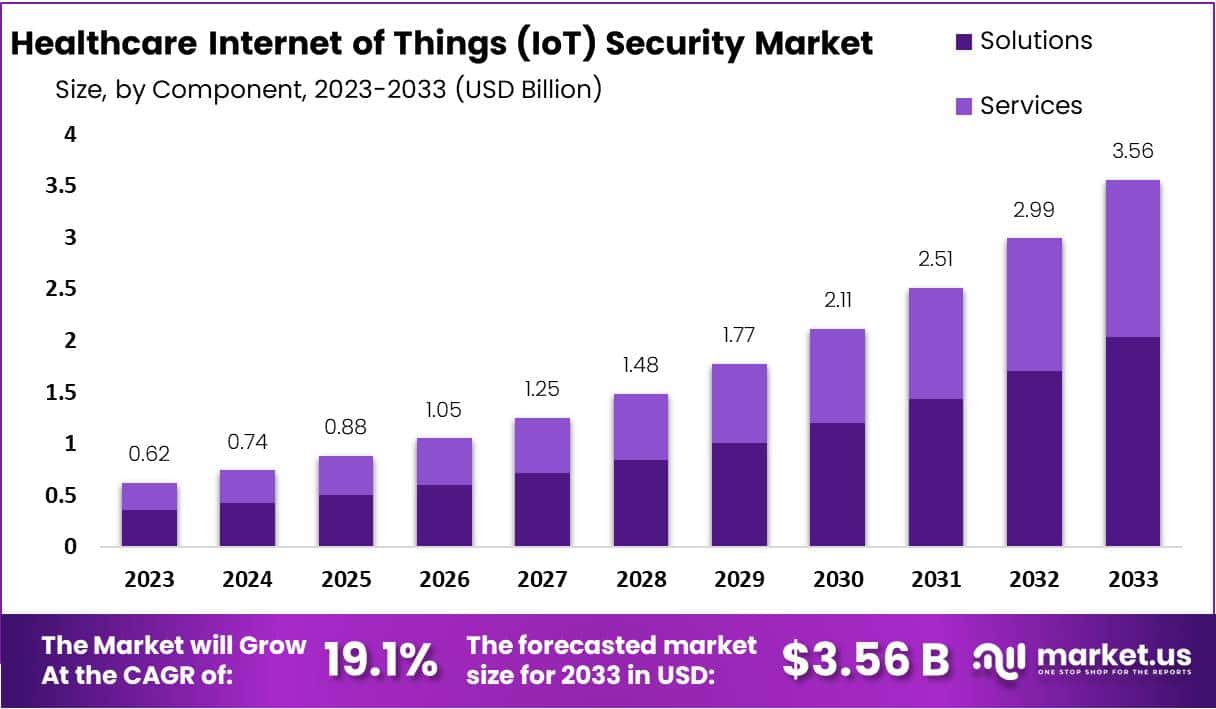
The Healthcare Internet of Things (IoT) Security Market is projected to reach approximately USD 3.56 Billion by 2033. This represents substantial growth from its 2023 value of USD 0.62 Billion. The market is expected to grow at a compound annual growth rate (CAGR) of 19.1% from 2024 to 2033. The increasing use of IoT devices in healthcare settings has raised security concerns. The market focuses on solutions that secure interconnected devices handling sensitive health data, ensuring patient privacy and system integrity.
Healthcare IoT Security refers to security measures applied to medical IoT systems. These include wearable devices, remote patient monitoring tools, and smart diagnostic systems. All of these exchange and store patient health information (PHI). Protecting such data is critical. Security systems prevent breaches, unauthorized access, and malware threats. With cyberattacks rising, maintaining the confidentiality and integrity of healthcare data is vital. The need for secure IoT networks is now recognized as a critical requirement across healthcare organizations globally.
The Healthcare IoT Security Market includes software, hardware, and services developed for this specific need. Hardware security ensures physical protection of devices, while cloud security safeguards data transmitted across cloud platforms. Vendors offer a range of services including encryption tools, compliance software, risk assessments, and device monitoring. Compliance with regulations such as HIPAA and GDPR remains central. The market is witnessing rising demand for solutions that both protect patient data and help organizations avoid legal consequences from breaches.
Rising cybersecurity threats are a primary driver for this market’s expansion. As more connected devices are used in hospitals and clinics, cyberattacks have increased. According to the HIMSS Cybersecurity Survey, there was a 45% increase in threats compared to the previous year. These statistics highlight the urgent need for robust IoT security solutions. Healthcare organizations are increasingly aware of the risks and are investing in cybersecurity infrastructure to mitigate these vulnerabilities and secure their digital environments.
Regulatory mandates also contribute significantly to market growth. As compliance requirements become more stringent, healthcare providers must align with standards to protect patient data. HIPAA and GDPR enforce strict data handling policies. Around 64% of healthcare institutions cite compliance as a top reason for cybersecurity adoption. Secure device management, regular software updates, and patching are essential. Studies from Deloitte reveal that ~56% of organizations face device management challenges, making continuous investment in IoT security a top priority for future-ready healthcare systems.
Key Takeaways
- The Healthcare IoT Security Market is projected to reach USD 3.56 billion by 2033, growing steadily at a CAGR of 19.1% from 2024.
- In 2023, the Solutions segment led the market, accounting for more than 57.1%, highlighting the sector’s reliance on robust security technologies.
- Cloud Security emerged as a key focus in 2023, capturing a 35.8% share due to its vital role in protecting sensitive healthcare data.
- Hospitals and Clinics dominated end-user adoption in 2023, holding 61.8% market share, reflecting their pressing need for stronger data protection frameworks.
- Limited IT budgets remain a barrier, as healthcare institutions allocate only 3–4% of total spending to IT security enhancements.
- The rising use of telehealth presents a major opportunity, with the segment expected to grow at a CAGR of 17.3% through 2033.
- The rollout of 5G technology is expanding connected care, prompting increased demand for secure IoT systems across healthcare environments.
- Blockchain integration is gaining momentum, offering greater data integrity, transparency, and protection for patient health records.
- North America led the global market in 2023 with a 46.2% share and a valuation of USD 0.28 billion, backed by regulatory rigor.
- Europe and Asia-Pacific are showing strong potential for future growth, driven by cybersecurity initiatives and expanding healthcare IT capabilities.
Regional Analysis
In 2023, North America held a dominant position in the global Healthcare Internet of Things (IoT) Security market, accounting for 46.2% of the total share, with a valuation of USD 0.28 billion. This leadership was supported by the region’s advanced technological infrastructure, particularly within hospitals and digital health systems. The presence of modern healthcare IT ecosystems enabled widespread adoption of security solutions tailored to connected medical devices, hospital networks, and data flow. These developments created a foundation for sustained IoT security growth across North American healthcare institutions.
The region’s stringent data protection regulations, including HIPAA in the United States, have further boosted the adoption of IoT-specific security technologies. Healthcare organizations across North America are required to comply with strict privacy laws, pushing them to invest in high-grade cybersecurity systems. As cyber-attacks increasingly target healthcare institutions, providers have intensified efforts to secure networks and protect patient records. These developments have positioned North America as a proactive and security-conscious region, significantly driving demand for advanced IoT security frameworks within healthcare environments.
In addition to compliance, North America’s strong focus on innovation and R&D continues to shape its market leadership. Institutions and private companies are investing heavily in creating next-generation IoT security solutions, customized for the unique needs of the healthcare sector. Meanwhile, regions such as Europe and Asia-Pacific are also showing rising demand due to expanding healthcare IT infrastructure, growing awareness about data protection, and increased use of connected healthcare devices. These regions offer promising opportunities for future market expansion.
Segmentation Analysis
In 2023, the Healthcare Internet of Things (IoT) Security Market showed strong momentum in its component segmentation. The solutions segment led the market, capturing over 57.1% of the share. This dominance was driven by the increasing need to secure healthcare IoT environments. These solutions included advanced software and tools designed for data encryption, device authentication, and network protection. As hospitals and health systems rapidly adopted IoT devices, the demand for these tailored security frameworks rose significantly, strengthening the role of the solutions segment across the healthcare landscape.
Services also held a notable position in the Healthcare IoT Security Market in 2023. These services included consulting, implementation, and ongoing support, helping healthcare providers deploy and manage security infrastructure effectively. The growth of the services segment reflected the industry’s demand for expert guidance amid rising cybersecurity concerns. As the digital health ecosystem expanded, services providers ensured that security systems remained functional and compliant with health data protection standards. Together, both solutions and services created a dynamic framework for navigating the complex IoT security environment in healthcare.
In terms of security types, cloud security led the market with over 35.8% share in 2023, driven by widespread cloud adoption in healthcare. Application security supported the safe performance of medical software, while network security focused on protecting data transmission and network access. Endpoint security ensured device-level protection, especially for connected medical equipment. On the end-user side, hospitals and clinics dominated with more than 61.8% share, driven by rising needs for patient data security. Ambulatory centers and labs followed with growing interest in securing IoT-enabled workflows.
Component
- Solutions
- Services
Security Type
- Application Security
- Network Security
- End-point Security
- Cloud Security
End-Use
- Hospitals and Clinics
- Ambulatory Surgical Centres
- Research and Diagnostic Laboratories
Key Players Analysis
The healthcare IoT security market is witnessing rapid development, led by key global players that are investing in secure, scalable, and intelligent technologies. Microsoft is at the forefront with its strong technological infrastructure. It delivers innovative encryption protocols and robust authentication systems to protect sensitive health data. IBM, with its expertise in artificial intelligence and analytics, focuses on real-time threat detection. Its AI-powered tools help healthcare organizations prevent data breaches and secure their interconnected devices effectively, contributing significantly to the evolution of the healthcare IoT security landscape.
Oracle plays a vital role by offering secure cloud-based platforms that enhance data protection and scalability in IoT environments. The company focuses on encrypted data storage and stringent access control mechanisms. Intel Corporation brings hardware-level protection to the market. It offers secure device authentication and encrypted communication, which are essential for safeguarding critical patient information. These companies are not only fortifying infrastructure but also promoting standards that improve overall IoT security resilience in healthcare.
Other influential contributors include AO Kaspersky Lab, Cisco Systems, and Deutsche Telekom AG. These companies support the ecosystem through advanced cybersecurity tools and network protection. Additionally, emerging firms such as Waracle, ICtera, and iTechAtt specialize in niche areas like mobile IoT security and secure application development. Their presence adds innovation and flexibility to the market, encouraging collaboration across sectors. This collective effort is essential to meet rising cyber threats and ensure the long-term safety of healthcare IoT systems.
Conclusion
In conclusion, the Healthcare Internet of Things (IoT) Security market is gaining strong momentum due to the rapid rise in connected healthcare technologies. Hospitals, clinics, and research centers are increasingly relying on IoT-enabled systems, which makes securing patient data more important than ever. The growing risks of cyberattacks, along with strict healthcare data regulations, are pushing providers to invest in advanced security solutions. Key players in the market are developing tools that protect devices, networks, and cloud platforms. As digital health adoption continues to grow, the demand for IoT security will remain a top priority for healthcare institutions looking to protect privacy, maintain trust, and ensure safe patient care.
Get in Touch with Us:
Market.us (Powered By Prudour Pvt. Ltd.)
Address: 420 Lexington Avenue, Suite 300, New York City, NY 10170, United States.
Contact No: +1 718 874 1545 (International), +91 78878 22626 (Asia).
Email: [email protected]
View More
Clinical Perinatal Software Market
Personal Health Record Software Market



