
Overview
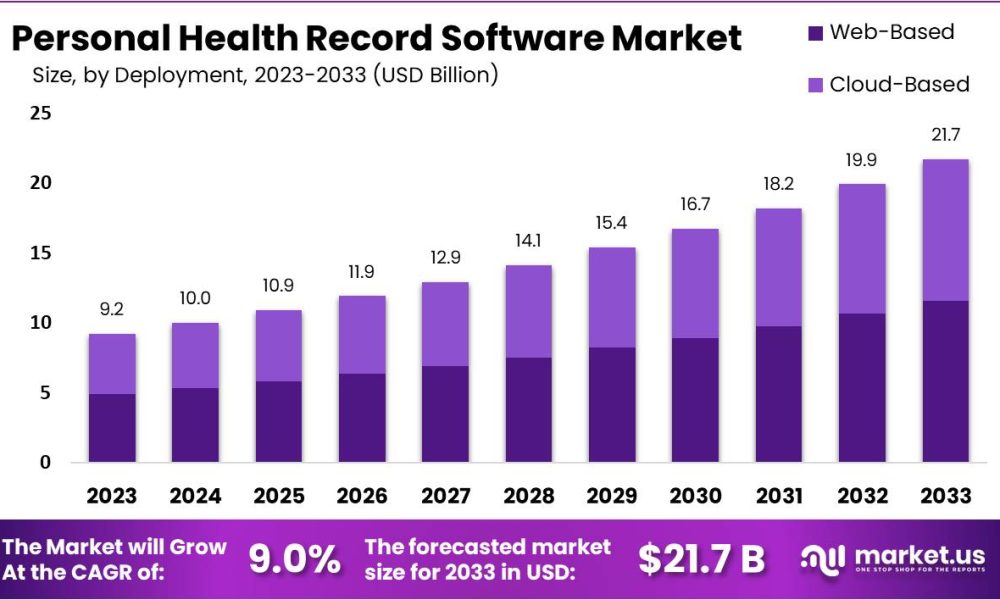
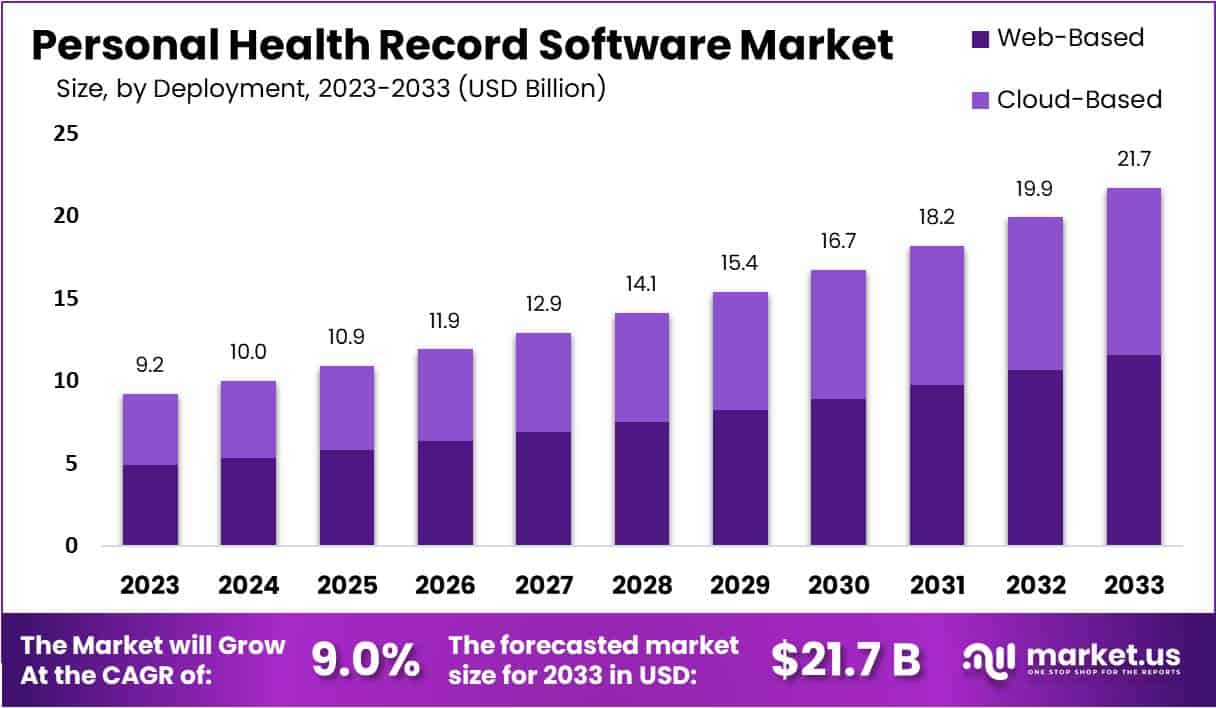
The Global Personal Health Record (PHR) Software Market is projected to reach approximately USD 9.2 billion by 2033, rising from USD 2.17 billion in 2023. This growth is expected at a CAGR of 9% from 2024 to 2033. PHR software allows individuals to manage their health records digitally. It enables users to store and update their medical history, track medications, record allergies and immunizations, and maintain essential health metrics. The system also ensures secure access, allowing only authorized users to view or share information with healthcare providers when needed.
The growing awareness among individuals about managing their health data is a major factor supporting market growth. People are increasingly seeking tools to monitor their medical conditions, which drives demand for PHR software. Digital transformation across the healthcare sector has further accelerated this trend. PHR platforms improve patient engagement and enhance coordination between patients and providers. Additionally, user-friendly features make it easier to organize appointments, monitor vital signs, and share health updates with clinicians.
Government initiatives also play a vital role in supporting the market. Programs such as the HITECH Act in the U.S. offer incentives for adopting electronic health records. These policies promote the adoption of PHR solutions. Governments across several regions support digital healthcare systems to improve patient outcomes and reduce operational costs. This support creates a favorable environment for the growth of PHR software.
Another key driver is the integration of wearable technology. Devices like smartwatches and fitness bands generate valuable health data. This data can be synchronized with PHR software, allowing users to maintain continuous records. The rise in chronic conditions has also increased demand for better personal health monitoring tools. As per IDC, wearable device usage is expected to grow significantly, indirectly boosting the adoption of PHR software globally. This trend aligns with the shift toward personalized and preventive healthcare.
Key Takeaways
- The Personal Health Record Software Market is projected to reach US$ 21.7 Billion by 2033, registering a steady CAGR of 9% from 2024–2033.
- PHR software helps users manage medical history, medications, and vital signs, enhancing care coordination and overall health data organization effectively.
- Demand for PHR tools is rising due to digital healthcare transformation, increased awareness, and supportive government efforts encouraging secure digital health solutions.
- Cloud-based deployment led with 53.4% share in 2023, favored for its remote accessibility, seamless updates, and real-time data synchronization capabilities.
- Software and mobile applications dominated the component segment in 2023, capturing 52.7% share by offering intuitive, user-friendly platforms for health management.
- Standalone PHR solutions held a 40.1% share in 2023, giving users full control to independently manage their personal health information without external integration.
- Growth is being fueled by expanding digital infrastructure, patient-focused care models, wearable device integration, and proactive government engagement across health sectors.
- However, privacy concerns, high initial investment, limited digital literacy, and resistance from traditional healthcare practices present major adoption challenges.
- Growth opportunities lie in AI and ML enhancements, entry into emerging markets, insurer partnerships, and rising demand for telemedicine-compatible PHR platforms.
- North America led regionally in 2023 with a 50.2% market share, worth US$ 4.6 Billion, due to advanced healthcare IT and strong policy backing.
Get Sample: https://market.us/report/personal-health-record-softwaremarket/request-sample/
Regional Analysis
In 2023, North America led the global Personal Health Record (PHR) Software Market. It held over 50.2% of the total market share, reaching a value of USD 4.6 billion. The region’s dominance was supported by strong healthcare infrastructure and advanced technology adoption. Government policies promoting digital health played a vital role. Leading companies in the region have developed innovative PHR solutions tailored to both providers and patients. High awareness of digital health tools also encouraged adoption. These factors together secured North America’s top position in the global market.
Asia-Pacific is expected to show the fastest growth in the coming years. Factors such as rising healthcare spending and efforts to modernize healthcare systems are driving the market. Countries like China, India, and Japan are investing heavily in digital health. Increased smartphone usage and internet penetration are also helping PHR software adoption. Public and private partnerships in healthcare are further boosting development. As a result, the region is projected to see significant expansion across both urban and rural areas.
Europe is likely to register steady growth due to its established healthcare system. Nations such as Germany, the UK, and France are focusing on patient-centered care. The region benefits from structured data privacy laws and high digital literacy. Efforts to improve interoperability between systems are ongoing. Patient demand for transparency and access to medical records supports further adoption. While growth is moderate, the region remains important for long-term market development.
Segmentation Analysis
Deployment Analysis
In 2023, the Cloud-Based segment led the Personal Health Record (PHR) Software Market with over 53.4% market share. This dominance reflects rising demand for flexible and accessible healthcare tools. Cloud-based solutions allow users to access records anytime and from any device. This ease of access supports real-time updates and better health management. Web-Based solutions also contributed significantly, offering access through browsers with simple interfaces. Though smaller in share, this segment remained relevant. The growing need for integration across devices is pushing adoption of both deployment types.
Component Analysis
The Software & Mobile Applications segment secured a strong lead in 2023, accounting for over 52.7% market share. Its growth was driven by user-friendly digital platforms and rising mobile usage. These applications enable people to manage health data conveniently on-the-go. Users prefer intuitive features that make personal health tracking easy. Meanwhile, the Services segment also played a key role. It included support functions such as training and implementation. Together, software and services offer a complete solution. Their balance helps deliver a better user experience and supports continued market expansion.
Architecture Analysis
The Standalone segment dominated the architecture landscape in 2023 with a 40.1% share. Users preferred it for its self-management features and independence from external systems. Provider-Tethered systems followed closely. These solutions integrate patient data with healthcare providers for improved coordination. The Payer-Tethered segment also gained traction. It linked users directly with insurance platforms for smoother processing. As demand for personalization grows, standalone tools may lead. However, integrated models will see continued growth. This mix is shaping a competitive and evolving architecture segment in the PHR Software Market.
Key Players Analysis
The Personal Health Record (PHR) Software Market is characterized by a strong competitive landscape led by key players like Epic Systems Corporation. Epic is widely recognized for its user-friendly interface and seamless integration with healthcare systems. These features enhance provider-patient interactions and streamline workflows. Its widespread adoption across major institutions further solidifies its leadership. Cerner Corporation also plays a major role by focusing on interoperability and advanced data analytics, enabling actionable insights for healthcare professionals and improving patient engagement through easy-to-use, efficient systems.
Allscripts Healthcare Solutions Inc. offers a flexible approach to PHR software. Their adaptable solutions support both large hospitals and small clinics. Allscripts’ customizable software allows healthcare providers to tailor patient experiences effectively. Athenahealth Inc. contributes with its cloud-based PHR system, known for its scalability and ease of use. The company focuses on efficient workflows and improved care coordination. These solutions are popular among providers seeking accessible and reliable digital health platforms that enhance patient outcomes and system efficiency.
In addition to leading players, the market includes a range of contributors such as McKesson Corporation, eClinicalWorks LLC, and MEDITECH. Other notable participants include GE Healthcare, CareCloud Corporation, Greenway Health LLC, and Amazing Charts LLC. These players—ranging from established firms to innovative startups—add dynamism to the PHR market. Their collaborative efforts and healthy competition continue to foster rapid innovation and diversification across the global PHR software landscape.
Conclusion
Get in Touch with Us:
Market.us (Powered By Prudour Pvt. Ltd.)
Address: 420 Lexington Avenue, Suite 300, New York City, NY 10170, United States.
Contact No: +1 718 874 1545 (International), +91 78878 22626 (Asia).
Email: [email protected]
View More
Healthcare Information Systems Market
Materiovigilance Market



