
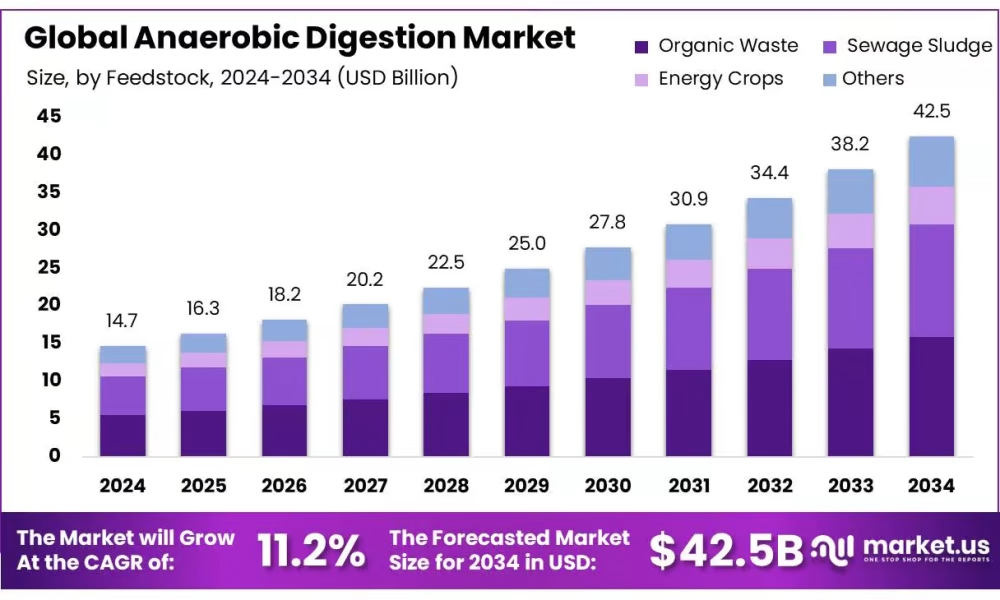
According to market.us, The Global Anaerobic Digestion Market size is expected to be worth around USD 42.5 billion by 2034, from USD 14.7 billion in 2024, growing at a CAGR of 11.20% during the forecast period from 2025 to 2034.
The anaerobic digestion (AD) market is experiencing robust growth due to the increasing global demand for sustainable waste management solutions and renewable energy generation. Anaerobic digestion is widely recognized for its ability to convert organic waste into biogas and biofertilizers, contributing significantly to the circular economy and reducing greenhouse gas emissions.
In countries such as the United States, the adoption of AD systems in large-scale livestock operations is gaining momentum. With nearly 44% of dairy cows on farms housing over 1,000 animals, and 90% of hog farms exceeding 2,000 pigs, the integration of AD technology offers substantial economic and environmental benefits.
In India, supportive government policies are accelerating market development. The SATAT initiative, led by the Ministry of Petroleum and Natural Gas, targets the creation of 5,000 BioCNG plants and 15 MMT of BioCNG production, aligning with national goals to reduce dependence on natural gas imports.
Similarly, Europe remains a key market, with Germany alone operating over 10,971 digesters and contributing significantly to the region’s 10.5 GW biogas-based electricity capacity. Anaerobic digestion projects, such as those in Russia’s Sverdlovsk region, further highlight the technology’s potential in reducing CO₂ emissions while generating both electricity and heat.
Key Takeaways
- The global anaerobic digestion market was valued at USD 14.7 billion in 2024.
- The global anaerobic digestion market is projected to grow at a CAGR of 11.20% and is estimated to reach USD 42.5 billion by 2034.
- Among feedstock, organic waste accounted for the largest market share of 37.5%.
- Among product types, Upflow Anaerobic Sludge Blanket (UASB) accounted for the majority of the market share at 43.3%.
- By process, Wet AD accounted for the largest market share of 65.3%.
- By end use, waste management and treatment accounted for the majority of the market share at 38.4%.
- North America is estimated as the largest market for anaerobic digestion with a share of 43.7% of the market share.
Access a Complimentary Sample of This Premium Report: https://market.us/report/global-anaerobic-digestion-market/request-sample/
Factors Affecting the Growth of the Anaerobic Digestion Market
Rising Demand for Renewable and Sustainable Energy: The global push toward clean energy solutions has significantly increased interest in anaerobic digestion as a means of producing biogas and biomethane. Governments and industries are prioritizing low-emission technologies, which is encouraging investment in anaerobic digestion facilities for electricity, heat, and fuel generation.
Government Policies and Incentives: Supportive government initiatives, such as renewable energy targets, feed-in tariffs, and subsidies for biogas production, play a critical role in driving the adoption of anaerobic digestion technology. National programs promoting waste-to-energy conversion and energy self-reliance are boosting market growth, particularly in developing economies.
Agricultural and Livestock Industry Expansion: The growth of large-scale livestock farms and intensified agricultural activity is contributing to increased organic waste generation. This provides an abundant and consistent feedstock for anaerobic digesters, making them a practical and profitable solution for waste management and energy recovery.
Waste Management Challenges and Regulations: Stringent environmental regulations on landfill use and organic waste disposal are prompting industries and municipalities to adopt anaerobic digestion. The technology offers a viable alternative to conventional waste treatment methods, enabling compliance with sustainability targets and waste reduction goals.
Technological Advancements and Infrastructure Development: Continuous improvements in digester design, process optimization, and biogas upgrading technologies are enhancing the efficiency and scalability of anaerobic digestion systems. Additionally, the development of supportive infrastructure—such as gas pipelines, storage facilities, and distribution networks—is facilitating broader implementation across sectors.
Key Market Segmentation
By Feedstock Analysis
In 2024, the Organic Waste segment accounted for a substantial 37.5% share of the global anaerobic digestion market revenue. This dominance is driven by the rising emphasis on sustainable waste management and the growing availability of feedstock such as food scraps, agricultural residues, and yard trimmings. Increasing awareness about landfill diversion and greenhouse gas reduction has encouraged the use of organic waste in anaerobic digestion systems.
Governments and industries are actively promoting circular economy practices by redirecting organic waste away from landfills. Additionally, utilizing organic waste offers economic advantages by lowering disposal costs and generating renewable biogas for energy use. The resulting digestate also serves as a valuable fertilizer, reinforcing the segment’s contribution to sustainable agriculture. These environmental and economic benefits have positioned organic waste as a key driver of growth in the anaerobic digestion market.
By Product Type Analysis
In 2024, the Up-flow Anaerobic Sludge Blanket (UASB) segment dominated the anaerobic digestion market, accounting for a notable 43.3% share. This leadership is attributed to the system’s high efficiency and cost-effectiveness in treating high-strength wastewater. UASB reactors are favored for their capacity to process large volumes of organic waste with relatively low energy input, making them ideal for industries such as food processing, dairy, and municipal wastewater treatment.
Their design, which allows wastewater to flow upward through a sludge blanket, enhances microbial breakdown of organic matter. Additionally, the lower capital and operational costs, along with a compact footprint, make UASB systems highly suitable for facilities with space constraints. These combined advantages have supported the widespread adoption of UASB technology, solidifying its dominant role in the global anaerobic digestion market.
By Process Analysis
In 2024, the Wet Anaerobic Digestion (Wet AD) segment held a dominant 65.3% share of the global anaerobic digestion market. This strong position is driven by its effectiveness in processing a wide range of organic waste, especially liquid feedstocks like sewage sludge and food waste. Wet AD operates by digesting materials in a liquid slurry, enhancing microbial interaction and boosting biogas output.
It is widely implemented in municipal wastewater treatment plants and large-scale organic waste facilities where liquid waste is prevalent. The technology’s scalability, proven performance, and adaptability to diverse feedstocks have made it a preferred option for industrial and municipal applications. The rising focus on renewable energy generation and efficient waste management has further reinforced the adoption of Wet AD systems globally.
By End-Use Analysis
In 2024, the waste management and treatment segment accounted for a leading 38.4% share of the global anaerobic digestion market. This dominance is driven by the increasing demand for sustainable waste disposal methods and efforts to reduce landfill usage and environmental pollution. Anaerobic digestion plays a crucial role by transforming organic waste—such as food scraps, sewage sludge, and agricultural residues—into biogas and digestate, thereby reducing methane emissions and supporting climate goals.
The U.S. Environmental Protection Agency and the Department of Agriculture’s target to cut food waste by 50% by 2030 reflects such global policy momentum. Furthermore, stringent environmental regulations and the growing shift towards waste-to-energy solutions have accelerated the adoption of AD systems. With the added advantage of renewable energy generation and nutrient recovery, anaerobic digestion has become a key technology in modern waste management strategies.
Key Market Segments
By Feedstock
- Organic Waste
- Sewage Sludge
- Energy Crops
- Others
By Product Type
- Upflow Anaerobic Sludge Blanket (UASB)
- Internal Circulation Reactor (IC Reactor)
- Expanded Granular Sludge Bed Digestion (EGSB)
By Process
- Wet AD
- Dry AD
By End-Use
- Waste Management and Treatment
- Energy Generation
- Agriculture
- Others
Geopolitical Impact Analysis
Geopolitical tensions have highlighted the need for energy security, prompting nations to seek local and renewable energy alternatives. Anaerobic digestion offers a strategic solution by producing biogas from domestic organic waste, reducing reliance on imported fossil fuels. As global conflicts and trade disruptions persist, the adoption of AD technologies is gaining importance for achieving energy independence.
Governments are supporting this shift through incentives, subsidies, and policies, especially in regions like the EU and China, where AD is integrated into broader renewable energy and environmental goals. However, changes in political leadership and international relations can impact the consistency of these supportive frameworks.
The following are some of the major players in the industry
- Adnams plc
- Clarke Energy
- WELTEC BIOPOWER GMBH
- Schneider Electric
- EnviTec Biogas AG
- Northern Biogas
- Bioenergy Devco
- AAT Abwasser- und Abfalltechnik GmbH
- Viessmann Climate Solutions SE
- Agrinz Technologies GmbH
- PlanET Biogastechnik GmbH
- Agraferm GmbH
- Scandinavian Biogas Fuels International AB
- BDI-BioEnergy International GmbH
- Gasum Oy
- Nature Energy
- ENGIE Group
- AB HOLDING SPA
- Capstone Green Energy Corporation
- Compact Membrane System
- Others
Get in Touch with Us:
Market.us (Powered By Prudour Pvt. Ltd.)
Address: 420 Lexington Avenue, Suite 300 New York City, NY 10170, United States
Send Email: [email protected]
Refer More Related Reports:
- Europe Food Safety Testing Market
- Europe Fructose for Food & Beverage Market
- Rotational Molding Materials Market
- Tea Capsules Market
- The Europe & Middle East Tomatoes Market
- Latin America Labels Market
- Asia Pacific and Middle East & Africa Frozen Pizza Market
- Alcohol Free Beer Market
- Beer Processing Market
- Enzymes Market



