
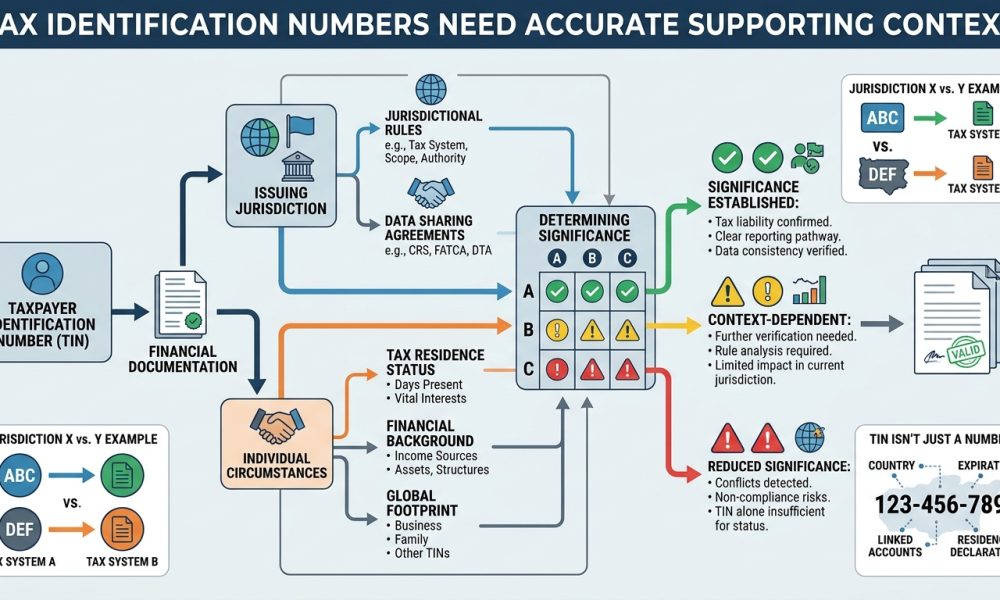
A tax number forms part of a person’s financial documentation, but its significance depends on the issuing jurisdiction and the individual’s actual circumstances.
Washington, DC, October 26, 2026 — A tax Identification number can help authorities and financial institutions connect records with a taxpayer. Still, the number alone does not establish citizenship, immigration permission, tax residence, or a history of meeting financial obligations.
The distinction matters when individuals assemble documents for international banking, relocation or citizenship applications, because a valid identifier may answer a specific administrative question without proving the broader claims sometimes attached to it in commercial proposals.
Official guidance illustrates the different purposes these numbers serve, with issuing systems applying their own eligibility, documentation, and usage rules rather than treating every tax identifier as an equivalent form of general Identification across national borders.
A reliable assessment therefore asks which Authority issued the number, whom it identifies, and what the receiving institution needs to establish, ensuring supporting documents accurately explain its significance rather than letting assumptions replace relevant evidence.
Start With the Issuing Jurisdiction
The term tax Identification number describes a broad category of identifiers, so examine the particular jurisdiction’s rules before assuming a number issued in one country serves the same function as one issued elsewhere.
The OECD’s directory of tax Identification numbers organizes Information on domestic issuance, structure, use, and validity, distinguishes identifiers for individuals from those assigned to entities, and provides a starting point for understanding the relevant national system.
Applicants should establish the identifier’s official name and issuing Authority, then obtain current instructions about its use rather than relying on an informal comparison with a familiar number from their home country’s administrative or tax system.
When a bank or other organization requests a tax number, clarification should identify the jurisdiction and taxpayer the request concerns, especially when the applicant holds multiple nationalities or maintains financial connections with more than one country.
A Tax Number Identifies a Taxpayer or Record
An identifier helps associate Information with the person or entity to whom it belongs. Still, it should be distinguished from the separate facts recorded under that number, including registration details, returns, assessments, or payments.
A recipient examining the number should therefore ask what proposition the accompanying document supports, rather than assume that a registration record establishes every aspect of the taxpayer’s financial position or history within the jurisdiction concerned today.
For applicants, the practical task is to present the identifier together with the records appropriate to the request, ensuring that explanations remain limited to what those records actually demonstrate and do not imply unsupported conclusions about earlier activity.
This distinction becomes especially important when a service proposal describes a number as providing an established financial profile, since the applicant should ask which genuine records support that description and whether they relate to the correct person.
The American ITIN Illustrates Important Limits
The Internal Revenue Service explains that an Individual Taxpayer Identification Number serves federal tax purposes for eligible people who need a taxpayer number but are not eligible for a Social Security number under the applicable rules.
The IRS expressly states that an ITIN does not provide or change immigration status, authorize employment in the United States, or establish eligibility for Social Security benefits, and that these matters are separate from the allocation of the number.
That example demonstrates why a tax identifier should not be presented as evidence of lawful work permission or citizenship, even when the person has a genuine tax obligation and has properly obtained the number needed to address it.
Applicants should identify the purpose for which an identifier was issued and seek advice about any separate status question, rather than assume that participation in a tax system confers rights administered by another government Authority.
Tax Filing and Immigration Status Are Separate Questions
In February 2025, Reuters examined how undocumented immigrants can file tax returns using ITINs, highlighting the distinction between participation in the federal tax system and the separate immigration circumstances of people using that system to meet their obligations.
The existence of a tax record should therefore be interpreted according to its actual purpose, with immigration eligibility assessed through the relevant legal process rather than inferred solely from evidence that a tax number has been assigned.
Similarly, a person should not assume that an identifier reveals another individual’s complete immigration history, because the issuing framework and eligibility conditions must be understood before concluding the circumstances behind the registration or related filing.
Where tax and immigration issues arise together, coordinated advice can clarify the separate obligations involved, allowing the applicant to provide accurate Information to each Authority without claiming that one administrative process resolves every question addressed by the other.
Registration Does Not Settle Tax Residence
A person may need a tax identifier because of a particular filing or transaction without that fact alone determining where the person is tax resident, making residence a separate issue requiring analysis under the applicable rules.
OECD guidance explains that citizenship or a right to reside in a jurisdiction does not automatically establish tax residence there or extinguish residence elsewhere, reinforcing the need to examine actual circumstances rather than rely on a document label.
An applicant should therefore distinguish the country issuing a tax number from the countries whose residence rules may apply, and seek qualified advice where employment, accommodation, family connections, or time spent across borders make the position uncertain.
When financial forms request tax residence and Identification numbers together, the answers should reflect that analysis, rather than treating possession of a foreign number as permission to omit another jurisdiction that remains relevant to the person’s circumstances.
Registration Certificates Have Defined Evidential Value
Mexico’s tax Authority describes its Constancia de Situación Fiscal as a document that contains taxpayer Information and allows verification of registration in the Registro Federal de Contribuyentes, illustrating how an official certificate can establish a specific administrative fact.
Read registration evidence based on its contents, and request separate documentation when an institution needs to establish income, specific payments, or compliance during a defined period rather than merely confirm registration.
Applicants should avoid presenting a certificate containing identifying and fiscal details as automatic proof of an entire tax history, particularly when therecipient’ss question concerns activities or obligations not addressed by the Information shown on the document.
A clear explanation should identify what the certificate confirms and what additional records remain necessary, allowing the receiving professional or institution to evaluate the relevant facts without assuming that every official tax document serves an identical purpose.
Historical Claims Need Historical Evidence
A tax number assigned today should not be described as proof that the holder filed returns or paid taxes in earlier years, because those claims require records relating to the periods and activities actually being asserted.
Where a proposal includes a claimed history of tax compliance, the applicant should ask which returns, payment confirmations or official records support that history and whether the Information accurately reflects genuine events involving the individual concerned.
The applicant should also explain the dates on supporting documents carefully, distinguishing the date a document was issued from the period it describes, rather than treating a recently generated record as automatically historical or automatically insufficient evidence.
If earlier records contain an error or are incomplete, the appropriate response is to identify the Authority’s correction or retrieval procedure, ensuring that gaps are addressed through legitimate records rather than a narrative created to satisfy an Application requirement.
Multiple Numbers Require Accurate Classification
An individual with cross-border connections may encounter several identifiers serving different purposes, so it’s important to distinguish personal tax numbers from business numbers, social insurance identifiers, and other administrative references used by the relevant national authorities. Do not substitute a company identifier for an individual’s number simply because the person owns or manages the business, since the receiving institution may be asking about a different taxpayer and a different legal relationship.
Applicants should keep a clear record of each identifier’s issuing jurisdiction, holder, and intended purpose, so advisers can complete forms consistently without confusing numbers that appear together in a broader package of financial or corporate documents. If a form requests a number that has not been issued or is not required under the relevant system, the applicant should follow the form’s instructions and seek clarification rather than invent a number or select an unrelated identifier.
Changes in Circumstances May Require Record Updates
Review tax records when relevant personal circumstances change, including a lawful name change or another development affecting the Information the issuing Authority holds, and update them through the procedures applicable to that system.
The IRS provides a specific example for ITIN holders who later receive a Social Security number, instructing them to stop using the ITIN and notify the agency so it can handle their tax records appropriately.
That procedure illustrates the importance of preserving continuity between identifiers rather than treating a replacement number as a separate financial identity, especially when earlier filings remain relevant to the same taxpayer’s administrative record and continuing obligations.
Applicants should also ask financial institutions what updates they require after an official change, ensure current Information is supported by legitimate evidence, and keep older records explainable so reviewers can understand the transition.
Banks Consider the Supporting Circumstances
A tax number may be part of a bank’s Identification and reporting documentation. Still, applicants should distinguish providing that number from meeting the institution’s broader requirements for identity, residence, account purpose, and the proposed financial relationship.
The bank’s instructions should establish which supporting evidence is required and whether the Information must be certified or submitted through a particular channel, rather than leaving the applicant to assume that an assignment notice alone completes onboarding.
When the number and other records show different names or addresses, the applicant should clearly explain the discrepancy and confirm whether an update is needed, avoiding inconsistent answers from different intermediaries during the same Application process.
An adviser can help organize documents, but check any claim that a particular identifier guarantees account approval directly with the institution, whose assessment may involve questions the number itself does not resolve.
Family Documents Should Be Interpreted by Purpose
Family financial planning can involve records for spouses, children, or other dependent relatives, so it’s important to establish which person each identifier belongs to and what Authority another family member has to submit Information or act on their behalf.
Amicus International Consulting’s article on parental photographs in Mexico’s children’s passports explains how travel documents can include Information about several family members, showing why documents should be examined for their actual contents and purpose rather than treated as interchangeable evidence.
A child’s passport, a parent’s tax registration, and a guardianship document address different questions, so a family should ask which records the receiving Authority needs instead of assuming one document proves all relevant relationships and permissions.
Transmit sensitive Information only through verified channels and for a clear purpose, and have the family verify the recipient’s identity before sharing complete tax records or Identification documents that include details about several individuals.
Verification Should Focus on the Claim Being Made
A useful review should identify the precise claim attached to a tax number, whether registration, a filing obligation, or a particular financial history, and then determine which official Information and supporting records are needed to assess that claim accurately. Checking a number’s apparent form can differ from confirming its allocation or the accuracy of the Information associated with it, so it’s important to understand the limits of any verification service offered.
Before paying for assistance, applicants should request a written explanation of the lawful service, the issuing process, and the expected documents, ensuring the proposal does not describe unsupported residence, tax payment, or banking outcomes as automatic consequences An
AA tax Identification number becomes useful evidence when applicants and institutions understand its jurisdiction, holder, and purpose. With accurate records, applicants can address relevant financial questions without assigning the number a significance it does not establish.




