
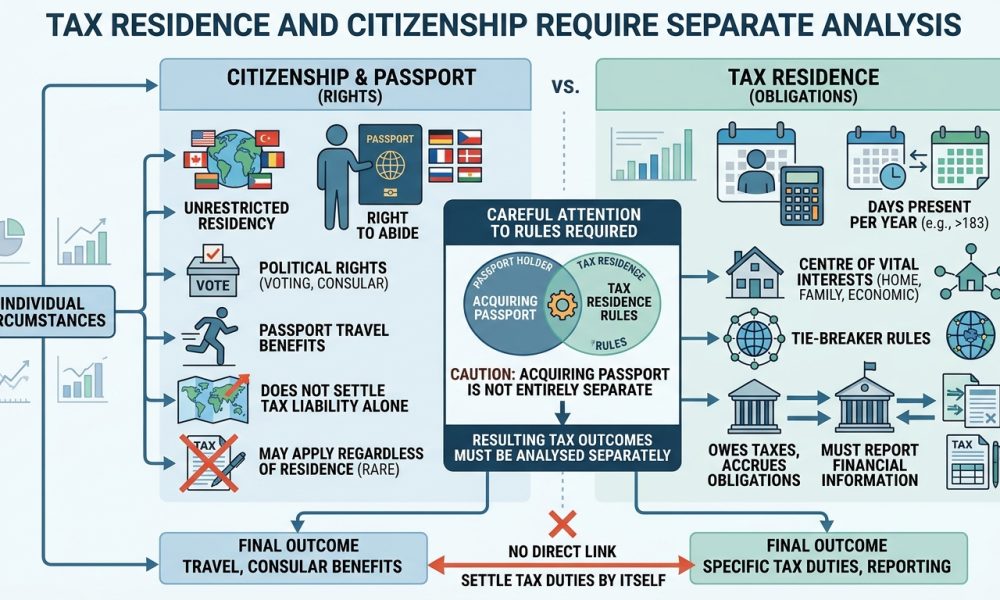
Getting a passport does not, by itself, determine where someone owes tax or must report financial Information, so it requires careful attention to applicable rules.
Washington, DC, October 26, 2026 — Acquiring another citizenship can change a person’s nationality and mobility rights, but it does not, by itself, establish tax residency, end existing tax responsibilities, or resolve obligations to report overseas financial accounts.
The distinction matters for individuals considering relocation, investment migration, or international banking because nationality, immigration permission, and tax residence answer different legal questions, even when they arise during the same period of personal and financial planning.
Official guidance shows why those questions need separate treatment: tax authorities examine factors such as residential connections, physical presence, and income, while citizenship can remain independently relevant under the rules of particular countries, including the United States.
A useful assessment therefore identifies the countries concerned, the relevant tax periods and the individual’s actual circumstances, allowing advisers to distinguish confirmed obligations from assumptions based on a passport, residence card or proposed move abroad.
Nationality and Tax Residence Establish Different Relationships
Citizenship establishes a legal relationship with a country. At the same time, tax residence concerns the Application of a jurisdiction’s tax rules to an individual, so the two classifications can overlap without being interchangeable in every purpose or situation.
The OECD’s guidance on tax residence explains that acquiring citizenship or a right of residence does not automatically make someone tax resident there or extinguish tax residence in another jurisdiction where the individual previously had relevant connections.
A residence permit may allow a person to live in a country without clarifying how its tax law applies, so examine immigration approval alongside the separate requirements governing the individual’s actual presence and activities.
Applicants should therefore ask advisers to identify which question each document answers, distinguishing proof of nationality, permission to reside and evidence relevant to taxation rather than treating several official documents as confirmation of one unified legal status.
The Analysis Begins With Facts and Dates
A tax-residence review should establish where the person lived and worked, the timing of arrivals and departures, and the connections maintained in each country, creating a factual foundation before applying any jurisdiction’s legal tests.
The relevant period also needs Identification, because tax systems can use different annual calendars and rules for changes during a year, making a general statement that someone moved abroad insufficient to determine every filing or payment consequence.
Applicants should keep reliable records of their circumstances rather than rely solely on passport stamps, which may not show where work occurred, how accommodation was used, or which personal connections continued after an international journey ended.
A dated chronology can help advisers reconcile these facts across jurisdictions, particularly when a citizenship Application, new residence permission, and physical relocation occur at different times and should not be treated as a single legal event.
Canadian Guidance Emphasizes Residential Connections
The Canada Revenue Agency explains that determining tax residence requires considering the relevant facts, including residential ties and the length, purpose, intention, and continuity of stays inside and outside Canada, rather than nationality alone.
Its guidance recognizes that a person working temporarily abroad may remain a factual Canadian resident because of continuing connections, illustrating why departure from the country should not automatically be described as the end of Canadian tax residence.
For someone planning a move, the assessment should examine household circumstances and the connections that will remain, allowing the adviser to apply the relevant rules rather than infer the outcome from a foreign passport or address.
The CRA also identifies circumstances involving treaty-based residence determinations, reinforcing the importance of examining the applicable legal framework when connections exist in more than one country, rather than assuming domestic residence rules alone provide the final answer.
Day Counts Are Important but Not Universally Decisive
The United Kingdom’s Statutory Residence Test illustrates why physical presence must be considered within a wider legal framework, with official guidance identifying automatic overseas tests, automatic United Kingdom tests and a sufficient-ties test for determining residence.
Although spending 183 days in the United Kingdom can establish residence under an automatic test, staying below that number does not automatically establish non-residence, because other parts of the framework can still apply.
Applicants should avoid relying on a universal day-count rule borrowed from another jurisdiction, particularly when online summaries omit conditions involving homes, employment, family connections or the person’s residence history during earlier tax years under the applicable legislation.
When travel plans change during the year, update the analysis to reflect actual circumstances so the advice stays relevant, rather than relying on an itinerary prepared before work commitments, family needs, or other events changed the expected pattern.
American Citizenship Can Remain Independently Relevant
The Internal Revenue Service explains that United States citizens and resident aliens abroad generally remain subject to American rules on worldwide income, showing that living abroad does not necessarily sever the existing American tax connection.
For an American who acquires another nationality, the additional passport does not terminate United States citizenship or settle the associated tax position. Hence, the nationality decision is separate from assessing continuing filing and payment requirements.
Available relief, including foreign tax credits or qualifying exclusions, has its own conditions, so a person should not assume overseas income is automatically excluded merely because it was earned abroad or paid into a foreign account.
The practical review should identify the income involved, the applicable filing requirements and any relief that may be claimed, giving the taxpayer a clear explanation of the position rather than equating continued reporting with an unavoidable duplicate tax payment.
Two Countries May Apply Residence Rules Simultaneously
An individual can satisfy domestic tax-residence rules in more than one jurisdiction, so you must examine both systems before assuming a residence certificate or other document from one country resolves the position everywhere else.
Where a tax treaty applies, its provisions may help determine how overlapping residence claims are treated. Still, the analysis depends on the specific treaty and facts, not a general promise that international agreements always eliminate competing obligations.
Treaty residence should also be distinguished from citizenship, immigration status, and the continuing relevance of domestic law, allowing the adviser to explain what the treaty changes and which questions still require consideration under the countries’ respective rules.
A written assessment should identify the treaty provisions relied upon and any procedural requirements for claiming their effect, helping the taxpayer understand the basis of the conclusion instead of treating a favorable interpretation as automatic recognition by every Authority.
Treaty Relief Does Not Remove Every Responsibility
The IRS explains that many American tax treaties include a saving clause that preserves taxation of citizens and treaty residents, subject to specified exceptions, illustrating why a treaty alone cannot establish that American obligations disappear.
An adviser should therefore examine the relevant provision, the type of income and the taxpayer’s status, rather than assume that a general treaty benefit available to one person necessarily applies to another person with different citizenship or residence circumstances.
Relief from double taxation can also involve claims, supporting records, or coordination between tax systems. Hence, it’s important to distinguish the substantive benefit from the steps required to obtain it through the applicable return or other procedure.
Taxpayers should retain evidence supporting those claims and review the position when circumstances change, particularly if income sources, residence patterns or family arrangements develop in ways that affect assumptions underlying advice received in an earlier tax year.
Non-Residence Does Not Answer Every Income Question
Even after a person establishes non-residence in a country, income connected to that jurisdiction requires separate consideration, so it’s important to identify the source and character of each relevant receipt rather than stop at residence classification.
A review should address continuing employment income, property-related receipts, investment returns and other relevant amounts under the applicable rules, with advisers explaining which obligations depend on residence and which may arise from connections with the income itself.
In October 2026, the Financial Times examined tax complications associated with moving abroad, highlighting how relocation can leave continuing obligations and create unexpected consequences, reinforcing the value of obtaining advice before major personal and financial decisions are implemented.
For planning purposes, assess the proposed move alongside the assets and income that will remain, so the taxpayer understands the continuing position rather than assuming departure resolves every tax question.
Leaving a Country Can Trigger Additional Issues
Assess the financial consequences of ceasing tax residence before the move, particularly where the applicable system requires consideration of assets, unrealized gains, or reporting connected with the change in status during the relevant year.
Canadian guidance explains that emigration can trigger a deemed disposition of certain property and a resulting capital gain, commonly called departure tax, showing why leaving a jurisdiction can create a tax issue without an actual sale.
That example should not be applied indiscriminately to every asset or individual. Still, it shows why a departure review needs a sufficiently detailed account of holdings and circumstances before advisers can explain which rules or exceptions matter.
Where property, businesses or other significant assets are involved, obtaining advice before transactions are completed can help identify valuation and recordkeeping needs, reducing the risk that essential Information must be reconstructed after the relevant dates have passed.
Financial Reporting Is Separate From Tax Payment
A person may have information-reporting duties even when no additional income tax is payable, so it is necessary to distinguish tax calculations from obligations regarding foreign accounts, assets, or other financial interests under the applicable rules.
The IRS explains that Form 8938 and the Foreign Bank Account Report have separate requirements. Filing one does not replace the other when both apply, illustrating why a single disclosure may not satisfy every obligation.
Applicants should ask which reports apply to their assets, accounts, Authority,ity and circumstances, rather than assume that Information supplied to a bank or included in an income tax return automatically covers every separate reporting requirement that may arise.
The compliance plan should identify the responsible person, required records and applicable deadlines for each filing, allowing the taxpayer to maintain oversight even when accountants or other professionals assist with different parts of the international reporting process.
Family Circumstances Need Individual and Coordinated Review
A household moving together should not assume every member has an identical tax position, because citizenship, income, residence history, and legal interests can differ even when relatives share a home and participate in the same relocation plan.
At the same time, family connections affect a residence assessment, so advisors should understand where spouses and children actually live rather than examine each person’s passpoin rt isolation.
Amicus International Consulting’s article on parental photographs in Mexico’s children’s passports discusses family Identification features in travel documents, illustrating the Information those documents can contain without suggesting they determine the family’s separate tax-residence or financial-reporting obligations.
A coordinated family review should therefore explain each person’s position while identifying shared facts that matter, allowing citizenship applications, housing arrangements and financial decisions to proceed with an understanding of their distinct legal and tax consequences.
Advice Should Reflect the Full Cross-Border Position
Before acquiring another citizenship or relocating, individuals should seek an assessment covering the relevant jurisdictions and proposed actions, ensuring the professional scope includes the tax questions involved rather than assuming immigration advice automatically addresses them.
The resulting advice should identify the facts relied upon, the relevant periods, and the obligations requiring action, and clearly explain uncertainty where the outcome depends on future events, additional evidence, or interpretation of the applicable legal provisions.
Update records when the plan changes, including developments affecting residence, work, or significant transactions, so later filings and financial certifications reflect the actual circumstances rather than an outdated description prepared before the move.
A passport can document nationality and support international mobility. Still, tax residence, income taxation, and financial reporting require separate analysis, so careful factual preparation and coordinated professional advice play a central role in responsible cross-border planning.




