
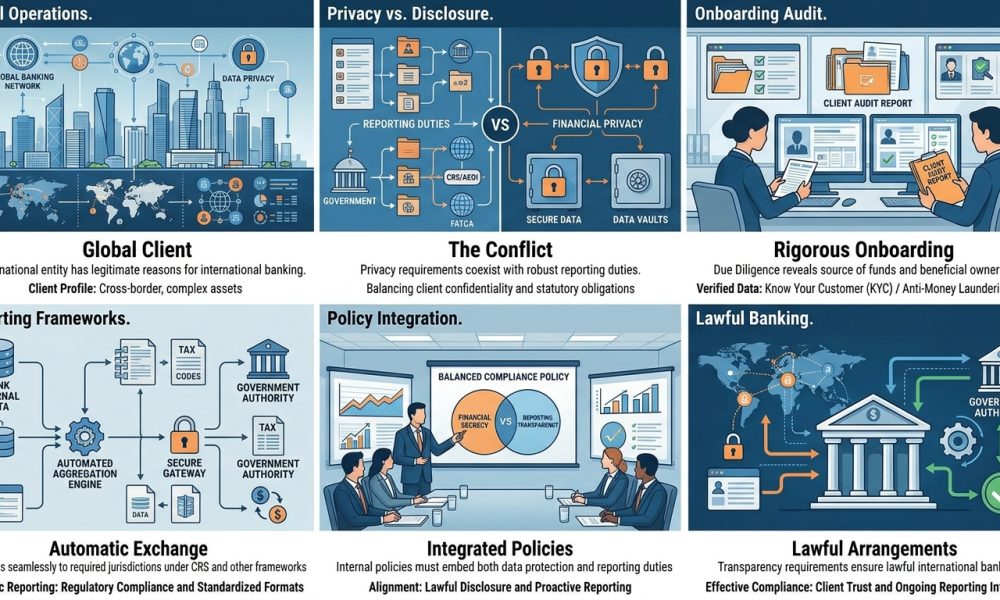
Protecting personal Information does not eliminate disclosure obligations, making transparency requirements essential to lawful international banking arrangements.
Washington, DC, October 26, 2026 — Financial privacy can protect individuals against unnecessary exposure of sensitive Information. Still, it does not remove obligations to provide accurate details to banks, tax authorities, or other recipients entitled to receive Information under applicable law.
The distinction matters when people consider overseas accounts, additional citizenships, or international financial arrangements, because limiting public access to personal records raises different questions than determining what regulated banking and reporting processes must disclose.
Official guidance recognizes both concerns, combining requirements for financial transparency with protections governing confidentiality and Information security, rather than treating privacy and lawful disclosure as objectives that cannot operate together within the same financial relationship.
A dependable plan therefore identifies who needs specific Information, the legal purpose of the disclosure, and the safeguards around it, allowing individuals to reduce unnecessary exposure while maintaining accurate records and meeting obligations relevant to their circumstances.
Identify the Information and the Intended Recipient
Financial privacy planning should begin with the Information concerned and the audience from which Protection is sought, because restricting public access, limiting commercial sharing, and responding to an authorized reporting requirement involve different legal and practical considerations.
An individual may reasonably want to prevent unnecessary circulation of account statements or Identification documents, while still providing complete Information through the secure process a bank uses to establish and maintain the customer relationship being requested.
The assessment should distinguish disclosure to the institution from disclosure to an intermediary, a government Authority, or the public, ensuring that a general promise of confidentiality does not obscure the different purposes and rules governing each recipient.
A useful explanation should describe those channels separately. Hence, the customer understands which Information is needed for account administration and which additional uses may be optional, restricted, or required under the applicable legal framework.
Privacy Choices Do Not Cover Every Disclosure
American consumer guidance illustrates that financial privacy rights can include choices about certain Information sharing. Still, those choices operate within a legal framework containing exceptions and should not be interpreted as a universal right to prevent disclosure.
The Federal Deposit Insurance Corporation explains that federal privacy protections let consumers opt out of some sharing of personal financial Information, making the institution’s privacy notice an important document for understanding the choices available to the customer.
Federal law also provides exceptions for specified circumstances, including certain disclosures permitted or required by law, demonstrating why a marketing preference or privacy election does not necessarily prevent Information from reaching an authorized recipient through another lawful process.
Customers should read the notice and ask the institution to explain unclear provisions, distinguish optional sharing from disclosures governed by separate legal duties, and avoid assuming one privacy setting controls every use of their financial Information.
International Reporting Has a Defined Legal Framework
The Common Reporting Standard provides a framework for participating jurisdictions to obtain specified financial account Information from institutions and exchange it with relevant partner jurisdictions, subject to domestic implementation and the applicable exchange arrangements governing those relationships.
Applicants should not assume every country exchanges every account detail with every other country, since the relevant jurisdiction, account classification, and activated reporting relationship require examination before a professional can explain a particular customer’s position.
The OECD publishes Information about activated exchange relationships, illustrating why current official arrangements matter more than a jurisdiction’s historical reputation for banking secrecy or a provider’s general description of how confidential its financial sector is considered to be.
A review should identify which reporting framework applies to the proposed account. What Information may be reportable, so the individual can understand the actual obligations without relying on exaggerated claims of secrecy or universal disclosure.
Confidentiality Safeguards Accompany Information Exchange
The OECD’s guidance on confidentiality and data safeguards explains that information-exchange standards require legal protections for confidential data and information-security arrangements within tax authorities, recognizing that lawful transparency must be accompanied by safeguards for the Information being exchanged.
Those protections should not be described as a guarantee that no security incident can occur. Still, they show that reporting frameworks set expectations for how sensitive Information is handled rather than simply requiring unrestricted circulation of customer records.
For account holders, the practical question is how the institution and relevant authorities protect Information within the applicable framework, with requests for clarification directed toward verified sources rather than answered through broad assurances supplied by an unrelated intermediary.
When a person faces a specific privacy or personal-safety concern, qualified advice can help identify available protections and appropriate handling arrangements, while preserving the distinction between seeking lawful safeguards and withholding Information that must be provided accurately.
Tax Residence Must Be Described Accurately
Tax-reporting Information should reflect the person’s actual circumstances, because a passport, residence permit, or mailing address alone does not determine the complete tax position that may need to be recorded during financial account opening or review.
OECD guidance explains that citizenship or a right of residence does not automatically establish tax residence in that jurisdiction or terminate tax residence elsewhere, making an individualized assessment important when the person has connections with several countries.
Where an individual qualifies as a tax resident in more than one jurisdiction, examine the relevant self-certification requirements carefully, and seek professional advice where domestic rules or treaty provisions make the position difficult to determine accurately.
The objective should be a consistent, supportable account of the circumstances, rather than selecting a jurisdiction because it appears to offer greater confidentiality or because a service provider supplied documentation associated with that country.
Bank Reporting Does Not Replace Personal Filings
Information a bank supplies and Information an individual must file directly can arise under different obligations, so you must identify both rather than assume the institution’s reporting automatically completes the customer’s own compliance requirements.
The Internal Revenue Service explains that Form 8938 and the Foreign Bank Account Report have separate requirements. Filing one does not replace the other when both apply, illustrating why foreign financial reporting needs careful classification.
Taxpayers should assess the relevant thresholds, assets, and account relationships for each obligation, and avoid assuming that a small tax bill or an account producing no income resolves every separate question about whether Information must be reported.
A practical reporting plan should identify who prepares each filing and which records support it, allowing the account holder to maintain oversight even when several professionals assist with tax returns, financial statements and other cross-border administrative responsibilities.
Confidential Banking Does Not Excuse False Records
In May 2025, Reuters reported Credit Suisse Services AG’s guilty plea in an American tax case, showing the legal consequences that can arise when offshore financial arrangements conceal Information from tax authorities.
The United States Department of Justice separately described conduct involving hidden assets and income, emphasizing that the case concerned unlawful practices rather than establishing that holding an overseas account is itself improper or incompatible with legitimate financial privacy.
For individuals evaluating financial services, the relevant lesson is to check whether a proposal depends on accurate records and lawful reporting, rather than accept assurance that an account’s location makes the underlying obligations irrelevant.
Any suggestion that documents should misstate ownership, residence or financial activity should be addressed before the arrangement proceeds, with independent advice sought to establish the correct position instead of relying on the provider responsible for the proposed description.
Legal Structures Need Their Own Disclosure Assessment
Companies, trusts and other arrangements can serve legitimate financial and family purposes. Still, their use does not, by itself, answer which people or interests must be disclosed to a bank, regulator, or tax Authority under the relevant rules.
The assessment should identify the actual ownership, control and legal roles involved, allowing advisers to determine what Information the institution requires rather than assume that a person’s absence from the account title eliminates every reporting connection.
Different frameworks can ask different questions about the same arrangement, so it’s important to distinguish account-signing Authority from ownership, beneficial interests, or other relationships that may affect disclosure under the applicable jurisdiction’s rules and reporting procedures.
Written advice should explain the basis for any reporting conclusion, identify the relevant facts and obligations, and clarify the recipients to whom information can lawfully remain private, rather than describing the structure as anonymous or confidential.
Advisory Confidentiality Should Have Clear Boundaries
Before sharing sensitive financial records with an adviser, individuals should understand the purpose of the engagement and how Information will be handled, including who can access the file and whether work will involve other organizations or professionals.
Read a confidentiality agreement alongside the adviser’s regulatory and legal responsibilities, because an undertaking to protect client Information should not be interpreted as a promise to disregard lawful disclosure obligations arising during the professional relationship.
The agreement should also identify the services provided and the limits of the advice, allowing the client to establish whether tax reporting, banking documentation and privacy questions are covered or require separate assistance from another qualified professional.
If a provider promises complete secrecy, the client should ask for a precise explanation of what that means and which exceptions apply, ensuring the engagement rests on realistic protections rather than language that obscures necessary legal qualifications.
Family Information Requires Careful Handling
Family banking and wealth arrangements can include records about spouses, children, and other relatives, so it’s important to identify whose Information is required and whether the person submitting it has the appropriate Authority.
Amicus International Consulting’s article on parental photographs in Mexico’s children’s passports explains that these documents contain family Identification Information, showing why sharing a passport copy may disclose details about several people, not just the child named as the holder.
Families should ask which pages and records are necessary, use verified submission channels, and seek instructions before redacting Information the receiving institution may need to examine as part of an authorized verification or reporting process.
A coordinated approach should also distinguish a relative’s Identification from evidence of Authority to act for them, ensuring that privacy concerns are addressed through appropriate handling arrangements without creating uncertainty about the relationships described in the Application.
Changes and Errors Should Be Addressed Promptly
Review financial information when relevant circumstances change, including residence, citizenship, or account Authority, so the bank’s records and any required filings reflect the current position rather than an outdated description.
If a submitted record contains an error, the appropriate response is to identify the correction procedure and seek advice when needed, so the individual can distinguish a routine update from an issue that requires an amended filing or additional explanation.
For example, the IRS provides instructions for amending an FBAR, showing that correcting a financial report follows a defined process rather than assuming that notifying the bank automatically changes a previously submitted government filing on the customer’s behalf.
When earlier omissions or inaccuracies may have legal consequences, qualified counsel should assess the facts and available procedures to help the person address the issue accurately, rather than trying to resolve it through inconsistent statements or undocumented changes.
Build Privacy Around Accurate Compliance
A lawful financial privacy plan should identify what Information should be disclosed, who is entitled to receive it, nd the protections available for handling it, giving the individual a clear account of both responsibilities and safeguards.
Practical measures can include verified communication channels, restricted access to records and careful review of optional sharing choices, provided that these arrangements support accurate disclosure rather than interfere with the Information required for the banking relationship or applicable filings.
Before committing to an international arrangement, individuals should obtain advice covering the relevant jurisdictions and their actual circumstances, ensuring that promises about confidentiality are assessed alongside tax residence, account reporting and the responsibilities attached to any proposed legal structure.
Protecting financial Information and meeting reporting duties can operate together when the plan distinguishes unnecessary exposure from authorized disclosure, allowing individuals to maintain meaningful privacy while keeping their banking records and legal obligations accurate, current, and properly documented.




