
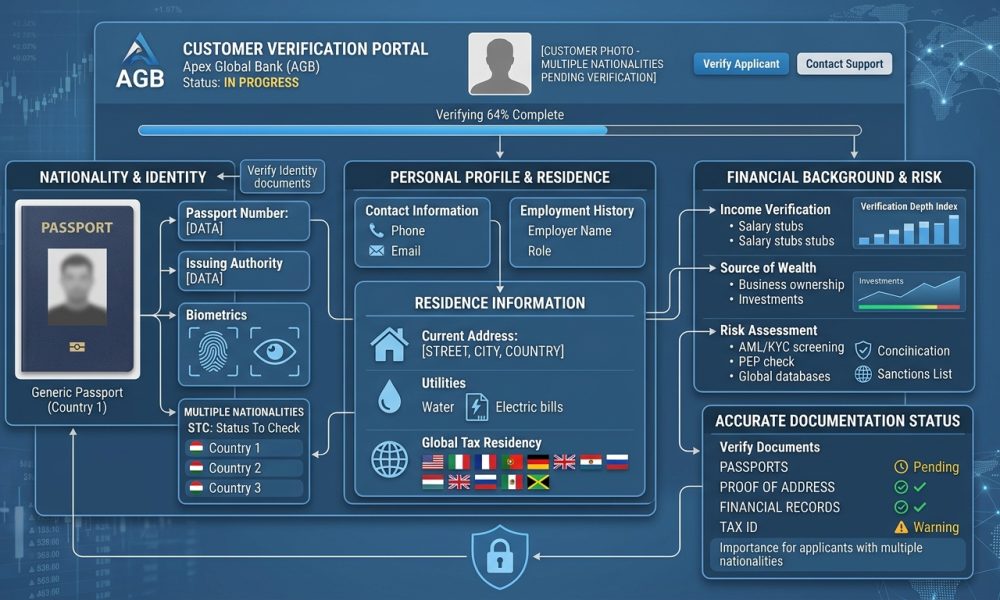
Customer verification can involve personal details, residence Information, and financial Background, making accurate documentation important for applicants with multiple nationalities.
Washington, DC, October 26, 2026 — A passport photograph can help link a person to a travel document. Still, bank identity checks ask broader questions about who the applicant is, whether supporting Information is reliable, and how the proposed account will operate.
For applicants with multiple nationalities, that distinction matters because different passports may document the same individual while providing only part of the Information needed to establish residence, understand financial circumstances, or complete the institution’s customer review.
Official banking guidance distinguishes Identification from broader customer due diligence, showing why a successful photograph comparison should not be interpreted as account approval or confirmation that the applicant has already answered every relevant question.
A useful preparation process therefore brings together accurate personal details, appropriate supporting records and a clear explanation of the intended banking relationship, allowing the institution to assess the Application without relying on a single Image or document.
A Photograph Answers a Limited Question
Comparing an applicant’s appearance with a passport portrait can support an assessment of whether the person presenting the document is its holder. Still, that comparison does not establish every fact relevant to opening or maintaining a bank account.
The institution may also need to determine whether the document is acceptable, whether its details match the Application, and whether additional Information is required under the procedures governing that customer relationship and account type.
Applicants should therefore distinguish a photograph check from document verification and the broader account review, recognizing that completing one step does not necessarily mean the institution has finished assessing the Information supplied for the Application.
If a bank requests further evidence after accepting a passport Image, the applicant should ask which question remains unresolved rather than assume the request contradicts the earlier confirmation that the bank received the photograph or document.
Basic Personal Details Remain Important
American supervisory guidance on customer Identification describes requirements involving a name, date of birth, address, and Identification number, showing that the Information used to establish a customer’s identity extends beyond a passport photograph.
Applicants should check these details against the Application before submission, especially when an intermediary has entered the Information, or it has been transferred from an earlier form that may no longer reflect the person’s current documents or circumstances.
A typing error can create an avoidable discrepancy even when every underlying document is genuine, so careful review helps before the bank compares the Application with the evidence provided through its branch or online submission process.
If a form cannot accommodate a person’s naming structure or other particulars, seek clarification from the institution rather than changing the facts to fit the available fields without understanding how the Information will be recorded.
Multiple Nationalities Require Consistent Explanations
Holding more than one nationality does not create separate personal histories, so applicants should answer the bank’s questions according to their actual circumstances rather than assume that presenting one passport makes Information associated with another nationality irrelevant.
The appropriate disclosure depends on the questions and applicable requirements, so read the Application carefully and seek clarification when the institution asks about citizenship, former names, or documents that differ from those currently presented.
If passports contain different spellings or naming conventions, legitimate supporting records can help explain the connection, allowing the institution to evaluate the variation without treating every difference as evidence that the documents concern unrelated people or identities.
Applicants should retain relevant naturalization, marriage, or lawful name-change records when those documents explain their circumstances and ask the banwatch evidence it actually requires instead of submitting an extensive personal file without a clear purpose.
Residence Information Serves a Separate Purpose
A passport can establish nationality without showing where its holder currently lives, so residence Information is a distinct part of the Application and should be supported according to the institution’s instructions for the account the individual is requesting.
Applicants living between countries should describe their circumstances accurately and ask how the bank distinguishes a residential address from a correspondence address, rather than assume either can substitute for the other without explanation or approval.
Where a move is planned but has not occurred, the Application should reflect the facts relevant at the time of submission, and the institution should be asked how to record an intended change and update it as circumstances develop.
The bank should also be consulted on acceptable supporting evidence when conventional address records are unavailable, allowing the applicant to explore legitimate alternatives rather than obtaining documents that inaccurately suggest residence at an address where they do not live.
Tax Residence Cannot Be Read From a Portrait.
The Organization for Economic Co-operation and Development explains that citizenship or a right of residence does not automatically establish tax residence in that jurisdiction or terminate tax residence elsewhere, making tax classification a separate question from passport Identification.
Its guidance also recognizes that an individual can be tax resident in more than one jurisdiction and addresses disclosure through Common Reporting Standard self-certification, illustrating why the Information requested may extend beyond the nationality shown in one document.
Applicants should obtain qualified advice when their position is uncertain, particularly when citizenship, employment, and residence involve different countries. Hence, the Information supplied reflects the applicable rules rather than a preferred description of their circumstances.
Review any tax certification independently of the photograph-verification step, ensure the applicant understands the statements, and ask for clarification before signing Information that may carry consequences beyond the immediate account-opening process.
Digital Verification Depends on the Whole System
The Financial Action Task Force’s guidance on digital identity says institutions should assess the reliability and assurance of digital Identification systems, including their technology and governance, rather than assume a digital tool automatically provides adequate verification.
For applicants, a remote process may involve several identity-verification steps. Still, the exact steps depend on the institution and system, so it’s inappropriate to assume every bank uses the same technology or assessment method.
A successful digital interaction should therefore be understood within the bank’s stated process, with confirmation sought about whether the result concerns Identification alone or whether other account-opening requirements remain outstanding before the institution can communicate its decision.
If a legitimate applicant cannot complete a digital check, contact the bank through an official channel and ask about available assistance or alternatives, rather than altering images or submitting inaccurate Information to force completion.
Visual Confidence Is Not the Same as Reliable Evidence
In July 2025, Reuters reported a United Nations warning about deepfake-related financial fraud, highlighting concerns about convincing artificial images and videos and reminding users that visual familiarity alone does not establish the Authenticity of remotely received material.
That reporting does not describe the verification method every bank uses. Still, it helps explain why institutions may seek corroborating Information instead of treating a persuasive Image or apparently familiar face as conclusive evidence of identity.
Applicants should follow the institution’s capture and submission instructions, provide genuine material through verified channels, and avoid unnecessary editing that could interfere with the bank’s ability to evaluate the document or Image supplied for review.
The same care should apply to communications supposedly from the bank, with unexpected requests verified through established contact details rather than relying on a recognizable logo, photograph, or convincing message as proof the sender is authorized.
Financial Background Helps Explain the Relationship
Customer due diligence can involve understanding the nature and purpose of a banking relationship, making financial Background relevant even after the institution has established the applicant’s identity and accepted the documents provided for that initial verification.
The United Kingdom’s Financial Conduct Authority distinguishes source of funds from source of wealth, explaining that the former concerns the money involved in the relationship, while the latter addresses how the customer acquired their broader financial resources.
Applicants should respond to the specific question asked, using genuine records to explain the relevant circumstances rather than assuming a recent bank statement necessarily establishes the origin of a deposit or an entire accumulated fortune.
Where the available evidence does not clearly explain a transaction, the applicant should discuss the issue with the institution or qualified adviser, identify appropriate supporting material, and avoid providing a simplified account that omits facts necessary to understand the activity.
Account Purpose Gives Context to the Documents
American customer due diligence guidance emphasizes understanding the nature and purpose of customer relationships, including the transactions a person is likely to undertake, and why. Identification documents do not answer every question about the proposed account.
An applicant should explain whether the account is intended for salary payments, household expenses, investment activity, or another legitimate purpose, allowing the institution to assess the relationship against the actual services and activity the customer expects to use.
Where business transactions are contemplated, the applicant should ask whether the proposed account permits them, rather than assume that successful identity verification means every type of payment or commercial activity is acceptable under theproduct’ss terms and conditions.
A clear explanation should match the supporting records, and the institution should discuss material changes in intended use so the relationship does not continue on assumptions that no longer reflect the customer’s circumstances.
Family Documents Can Reveal More Than One Identity
When a banking Application involves children or other relatives, the family should clarify which person’s identity and Authority each document shows, avoiding the assumption that one passport answers every question about a shared or supervised account.
Amicus International Consulting’s article on parental photographs in Mexico’s children’s passports describes the family Identification Information included in those documents, illustrating why a passport copy may contain personal details about parents or guardians, as well as the child named as the holder.
Families should ask which pages and supporting records are required and provide them through the bank’s verified process, and seek instructions before redacting Information the institution may need to review as part of its document checks.
For a minor’s account, distinguish the child’s Identification from evidence that an adult can act on the child’s behalf, and determine the relevant records based on the bank’s requirements and the family’s legal circumstances.
Verification Questions Should Be Addressed Directly
A request for additional Information does not by itself establish wrongdoing. Still, applicants should respond carefully by identifying the precise discrepancy or unanswered question rather than repeatedly submitting the same document without understanding why the institution needs more evidence.
If the bank’s Information is incorrect, the applicant should ask about the correction procedure and provide supporting records, creating a clear record of the amendment rather than giving conflicting answers through different representatives or Application channels.
If an applicant believes a request is unnecessary or difficult to meet, they can ask for an explanation and available alternatives, while recognizing that the institution may still need adequate evidence to complete its review under its procedures.
Keeping copies of submitted forms, supporting records, and correspondence can help resolve later questions, giving the applicant a reliable reference for what was provided without depending solely on recollection or an intermediary’s informal description of the Application.
Accurate Records Support the Continuing Relationship
Identity verification at account opening is part of an ongoing customer relationship, with official due diligence guidance addressing ongoing monitoring and risk-based updates rather than treating the original document check as sufficient for every future circumstance.
Customers should ask what changes to report when passports are renewed, names change,, or residnce arrangements develop, helping the institution maintain accurate records without assuming an earlier submission automatically covers later developments in their lives.
For people with multiple nationalities, a consistent explanation supported by legitimate documents can make these updates easier to manage. At the same time,e accurate tax and financial Information addresses questions that no passport photograph could resolve on its own.
Bank verification becomes clearer when applicants understand the purpose of each request and can distinguish between appearance, identity, residence, and financial Information. Completed,d truthful documentation supports the assessment without creating unrealistic expectations about what a photograph alone can establish.




