
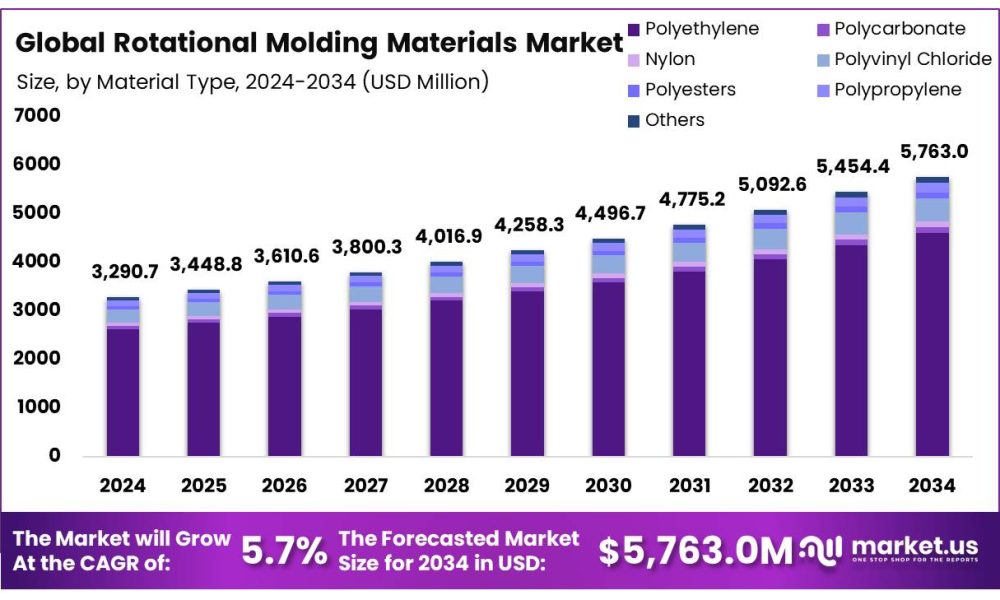
According to Market.us, The global rotational molding materials market is projected to reach approximately USD 5,763.0 million by 2034, up from USD 3,290.7 million in 2024, registering a CAGR of 5.7% during the forecast period from 2025 to 2034. In 2024, Europe held the leading position, accounting for 29.6% of the market share with revenue amounting to USD 855.5 million.

The rotational molding materials market is increasingly influenced by targeted government investments aimed at advancing polymer innovation and energy-efficient industrial processes. In the United States, the Department of Energy has allocated USD 136 million across 66 projects focused on developing critical industrial technologies, which often include advancements in polymer processing and material efficiency.
Additionally, federal support is being channeled through academic and workforce development initiatives. For instance, Pennsylvania College of Technology received a USD 594,574 grant from the National Science Foundation in June 2024 to enhance polymer workforce training via its Rotational Molding Center of Excellence.
Polyethylene remains the most commonly used material in rotational molding due to its excellent impact resistance, durability, and cost-effectiveness. Other materials such as polypropylene, polyamide, and polycarbonate are also gaining traction in specific applications where higher temperature resistance or strength is needed.
The market is witnessing steady growth driven by rising demand in sectors such as packaging, agriculture, automotive, construction, and consumer goods. The method’s ability to produce complex, seamless parts with low tooling costs makes it especially attractive for low-to-medium volume production. Additionally, increasing emphasis on lightweight and recyclable materials is further promoting the use of rotationally molded plastics.
Key Takeaways
- The global rotational molding materials market was valued at US$ 3,290.7 million in 2024.
- The global rotational molding materials market is projected to grow at a CAGR of 5.7% and is estimated to reach US$ 5,763.0 million by 2034.
- Among material types, polyethylene accounted for the largest market share of 80.0%.
- Among types, virgin accounted for the majority of the market share at 82.0%.
- Based on forms, powder held the majority of the revenue share at 80.4%.
- Among applications, storage tanks accounted for the largest revenue share of 38.6%.
- Based on end-use, construction held the majority of the revenue share at 24.3%.
- Europe is estimated as the largest market for rotational molding materials with a share of 29.6% of the market share.
Download Exclusive Sample Of This Premium Report (Including Full TOC, Table & Figures): https://market.us/report/rotational-molding-materials-market/request-sample/
Factors Affecting the Growth of the Global Rotational Molding Materials Market
Rising Demand in End-Use Industries: The increasing use of rotationally molded products in agriculture, automotive, packaging, and infrastructure sectors is significantly driving demand. Applications such as water tanks, storage bins, fuel tanks, and outdoor furniture are expanding as these industries grow, boosting material consumption.
Material Versatility and Performance: The adaptability of materials like polyethylene, polypropylene, and polyamide for varied product requirements—such as flexibility, strength, and chemical resistance—has made them suitable for diverse applications. Continuous innovations in material formulations are enhancing the quality and expanding the scope of rotational molding.
Low Tooling and Manufacturing Costs: Rotational molding allows for economical production of complex and hollow parts with minimal material waste and lower tooling costs compared to other molding processes. This cost advantage supports its adoption among small- to mid-scale manufacturers across various regions.
Environmental Regulations and Sustainability Trends: Growing regulatory focus on plastic waste reduction and the shift toward eco-friendly materials are shaping market dynamics. The use of recyclable resins and bio-based polymers in rotomolding is gaining traction as industries aim for sustainable production practices.
Technological Advancements in Machinery and Automation: The development of advanced rotomolding machines with improved temperature control, cycle efficiency, and automation capabilities is enhancing production output and consistency. These improvements are encouraging manufacturers to scale up operations and meet increasing demand efficiently.
Key Market Segments
Material Type Analysis
In 2024, polyethylene dominated the rotational molding materials market, accounting for 80.0% of the total revenue share. Its widespread use across industries such as automotive, construction, agriculture, and consumer goods is driven by its durability, flexibility, chemical resistance, and cost-effectiveness. These properties make polyethylene the preferred material for manufacturing a wide range of molded products, reinforcing its leading position in the market.
Type Analysis
In 2024, virgin materials held a dominant 82.0% share of the rotational molding materials market. This dominance is driven by their superior quality, strength, and consistency compared to recycled alternatives. Virgin resins like polyethylene, polypropylene, and PVC are widely used in high-performance applications across automotive, agricultural, industrial storage, and medical sectors, where durability and compliance with safety standards are essential.
Technological advancements have further improved the performance of virgin plastics for precision molding. Despite growing interest in recycled materials due to sustainability goals, issues such as inconsistent quality, contamination, and limited supply continue to reinforce the market preference for virgin resins.
Form Analysis
In 2024, the powder form dominated the rotational molding materials market with an 80.4% share. This dominance is driven by its superior processing efficiency, uniform heat distribution, and cost-effectiveness. Powdered resins provide better flowability and faster melting, leading to high-quality molded products with consistent wall thickness.
Their fine particle size supports the production of durable, complex components across industries such as automotive, construction, packaging, and agriculture. The growing demand for lightweight, high-performance plastics with strong mechanical and chemical properties continues to drive the preference for powder over granules.
Application Analysis
In 2024, storage tanks held the largest share in the rotational molding materials market, accounting for 38.6% of the total. Their dominance is attributed to widespread use across industrial, agricultural, and residential sectors for storing water, chemicals, fuel, and agricultural liquids. These tanks are favored for their seamless construction, durability, chemical resistance, and cost-effectiveness.
The growing need for water storage in developing regions, along with strict chemical storage regulations, has further driven demand. Polyethylene-based materials, due to their corrosion resistance and lightweight nature, are widely used in large-capacity tanks. The adoption of rainwater harvesting, wastewater treatment, and sustainable agriculture practices continues to support the segment’s growth and leadership.
End-Use Analysis
In 2024, the construction sector held the leading position in the rotational molding materials market, accounting for a 24.3% share. This dominance was driven by the rising demand for durable, lightweight, and cost-effective plastic components in infrastructure and building projects. Key applications included water tanks, septic tanks, pipelines, road barriers, and roofing, primarily using polyethylene-based materials.
These products are favored for their strength, corrosion resistance, and weather durability, suitable for harsh construction environments. Additionally, urbanization, smart city initiatives, and government investments in sustainable infrastructure have further supported market growth.
Key Market Segments List
By Material Type
- Polyethylene
- LLDPE
- HDPE
- XLPE
- MDPE
- LDPE
- Polycarbonate
- Nylon
- Polyvinyl Chloride
- Polyesters
- Polypropylene
- Others
By Type
- Virgin
- Recycled
By Form
- Powder
- Granules
By Application
- Storage Tanks
- Automotive Components
- Containers
- Toys and Leisure
- Materials Handling
- Industrial
- Others
By End-Use
- Construction
- Automotive
- Agriculture
- Consumer Goods
- Chemical
- Food & Beverage
- Others
Geopolitical Impact Analysis
The global rotational molding materials market has been notably affected by ongoing geopolitical tensions and disruptions in international trade dynamics. Conflicts, trade disputes, and regulatory uncertainties have significantly influenced the supply chain, particularly in sourcing key raw materials such as polyethylene and polypropylene. Many manufacturers rely heavily on imports from select regions, and any political instability or diplomatic strain can trigger disruptions in availability, resulting in delayed shipments and increased procurement costs.
The imposition of tariffs and trade barriers has added complexity to international transactions, often leading to volatility in raw material prices. For instance, trade wars between major economies have impacted the cost structure of polymer imports, making it challenging for companies to maintain stable pricing. Additionally, regions facing political unrest may experience interruptions in production or export activities, further intensifying material shortages.
The following are some of the major players in the industry
- SCG Chemicals
- LyondellBasell Industries Holdings B.V.
- ExxonMobil
- Reliance Industries Limited
- SABIC
- Matrix Polymers Limited
- Rototech Industries
- GreenAge Industries
- Prisma Colour Limited
- Petrotech Group
- PTT Global Chemical Public Company Limited.
- DOMO Chemicals
- Broadway Colours
- Roto Polymers
- OSWAL HITECH PVT. LTD.
- Mabaplast
- Kalpataru Polymer Private Limited
- Pinaxis Polymer
- Xiamen Keyuan Plastic Co., Ltd
- Other Key Players
You may Also Like
Dishwasher Detergent Market: https://www.newstrail.com/dishwasher-detergent-market-worth-usd-41-5-bn/
Power Purchase Agreement Market: https://www.newstrail.com/power-purchase-agreement-market/
Get in Touch with Us:
Market.us (Powered By Prudour Pvt. Ltd.)
Address: 420 Lexington Avenue, Suite 300 New York City, NY 10170, United States
Send Email: [email protected]



