
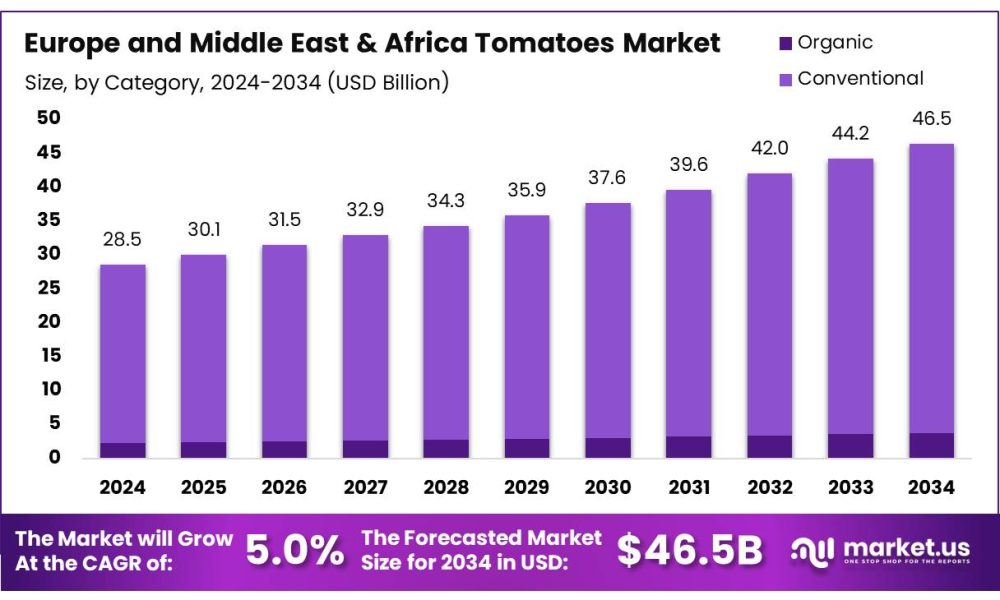
According to market.us, The Europe and Middle East and Africa Tomatoes Market is projected to reach approximately USD 46.5 billion by 2034, increasing from USD 28.5 billion in 2024. This growth reflects a compound annual growth rate (CAGR) of 5.0% over the forecast period spanning 2025 to 2034.
The Europe and Middle East and Africa Tomatoes Market is witnessing steady growth, driven by rising demand for fresh produce, processed foods, and health-conscious consumption habits. Tomatoes remain one of the most widely cultivated and consumed vegetables across both regions due to their versatility in culinary applications and their nutritional profile, which includes high levels of vitamin C, potassium, and antioxidants like lycopene.

In Europe, countries such as Spain, Italy, and the Netherlands are major producers, supported by advanced greenhouse cultivation and export infrastructure. In the Middle East, nations like Turkey and Egypt lead production, benefitting from favorable climate conditions and government-backed agricultural development programs.
In the European Union, the Common Agricultural Policy (CAP) allocates approximately €387 billion for the period 2021–2027 toward agricultural subsidies. A portion of this budget supports tomato growers—particularly those involved in processing tomatoes—through direct payments under the Voluntary Coupled Support scheme, although its price impact has been assessed as “not significant”. Additionally, trade mechanisms such as a 14.4 % tariff on processed tomato imports and limited export subsidies (capped at 135,000 MT) help stabilize domestic markets and protect producers.
In Jordan, a targeted governmental package of JD 1 million (approximately US $1.4 million), drawn from the Agricultural Risk Fund, offers farmers JD 50 per metric ton of tomatoes destined for export or processing. This measure is intended to offset rising input costs and support approximately 20,000 tons of tomato production.
Key Takeaways
- The Europe and Middle East and Africa Tomatoes Market was valued at US$ 28.5 billion in 2024.
- The Europe and Middle East and Africa Tomatoes Market is projected to reach US$ 46.5 billion by 2034.
- Among tomato types, the beefsteak held the majority of revenue share in 2024, with a market share of 42.0%.
- Based on categories, conventional tomatoes accounted for the majority of the market share with 92.0% owing to its higher affordability, large-scale production, and widespread availability.
- Among applications, fresh tomatoes accounted for the majority of the Tomatoes market share with 71.9%.
- Based on end-use, the household/retail industry dominated the market with a share of 62.6%.
- Among distribution channels, offline channels are more preffered by conusmers hence, they accounted for the majority of the tomatoes market share with 87.6%.
Access a Complimentary Sample of This Premium Report: https://market.us/report/europe-and-middle-east-africa-tomatoes-market/request-sample/
Factors Affecting the Growth of The Europe and Middle East and Africa Tomatoes Market
Climatic Conditions and Water Availability: Tomato production is highly sensitive to weather patterns and water access. In Southern Europe and much of the Middle East, rising temperatures, erratic rainfall, and drought conditions can directly impact crop yield and quality. Irrigation technology and sustainable water management practices have become critical to maintaining a consistent supply, particularly in arid regions.
Government Agricultural Policies and Subsidies: The role of national agricultural support policies, such as subsidies, export incentives, and investment in rural infrastructure, significantly influences the production and distribution of tomatoes. In both Europe and the Middle East, governmental efforts to modernize agriculture and promote self-sufficiency in food production can enhance market stability and output.
Consumer Dietary Preferences and Health Trends: Shifting consumer behavior towards fresh, nutrient-rich, and plant-based diets is driving sustained demand for tomatoes. Their widespread use in regional cuisines, as well as growing health awareness regarding the benefits of antioxidants and low-calorie vegetables, continues to bolster consumption across households and the foodservice sector.
Expansion of Food Processing Industries: The growth of tomato-based product manufacturing—such as sauces, pastes, and canned tomatoes—is contributing to higher raw tomato demand. Urbanization and changing lifestyles are increasing the consumption of processed and ready-to-use foods, further supporting market expansion.
Trade Dynamics and Export-Import Regulations: Cross-border trade in tomatoes, especially between Mediterranean countries and neighboring markets, plays a vital role in market supply chains. Tariff policies, phytosanitary regulations, and trade agreements directly affect the availability and pricing of tomatoes, particularly in regions dependent on imports during off-seasons.
Key Market Segmentation
By Tomato Types Analysis
In 2024, beefsteak tomatoes accounted for the largest market share among all tomato types, capturing 42.0% of total revenue. Their popularity is attributed to their large size, meaty texture, and rich flavor, which make them ideal for sandwiches, salads, and burgers, particularly in the foodservice sector. Their high yield per plant, extended shelf life, and resistance to diseases further support their dominance in the market. Additionally, increasing consumer demand for organic and gourmet varieties has boosted their presence in supermarkets and specialty retail outlets.
By Category Analysis Analysis
In 2024, conventional tomatoes dominated the market with a 92.0% share, primarily due to their affordability, high yield, and wide availability. Grown using synthetic fertilizers and pesticides, conventional farming supports large-scale production and lower costs, making these tomatoes the preferred choice for supermarkets, grocery stores, and food processors.
The foodservice sector also favors conventional tomatoes for their cost-efficiency and consistent supply. Although organic tomatoes are gaining traction amid rising health awareness, their higher prices and limited output continue to restrict their market share, especially in price-sensitive developing regions.
By Application Analysis
In 2024, the fresh tomatoes segment led the Europe & MEA market with a 71.9% share, supported by strong consumer demand for natural and unprocessed produce. Fresh tomatoes are a daily staple in households, restaurants, and foodservice outlets across the region. The popularity of the Mediterranean diet, which emphasizes fresh vegetables, particularly tomatoes, has reinforced this trend.
The rising demand for organic and locally grown vegetables, along with the expansion of farmers’ markets, supermarkets, and direct-to-consumer channels, has further boosted fresh tomato sales. Although processed tomato products are gaining popularity, the preference for healthier and minimally processed options continues to sustain the dominance of fresh tomatoes in the market.
By End-Use Analysis
In the previous year, the household/retail segment dominated the tomatoes market with a 62.6% share, driven by rising demand for fresh and processed tomatoes in home cooking. The growing trend of home-prepared meals, health-conscious diets, and increased consumption of plant-based foods has significantly boosted tomato usage in households.
Consumers are purchasing fresh, canned, and tomato-based products from supermarkets, farmers’ markets, and online platforms. The wide culinary application of tomatoes in salads, sauces, soups, and global cuisines has reinforced their role as a staple household ingredient, supporting strong growth in the retail segment.
By Distribution Channel Analysis
In 2024, the offline distribution segment led the tomatoes market with an 87.6% share, supported by the strong presence of supermarkets, hypermarkets, grocery stores, and local farmers’ markets. Consumers favor buying tomatoes in person to assess freshness, ripeness, and quality directly.
Offline channels also ensure a consistent supply for both households and foodservice businesses through well-established distribution networks. While online grocery platforms are expanding, issues related to logistics, freshness, and limited consumer trust have restricted their growth. The offline segment remains dominant due to its convenience, affordability, and immediate access to fresh produce.
By Tomato Types
- Tomato Types
- Cherry Tomato
- Grape Tomato
- Roma Tomato
- Beefsteak Tomato
- Heirloom Tomato
- Green Tomato
- Tomato On the Vine
- Others
By Category
- Organic
- Conventional
By Application
- Fresh Tomatoes
- Primary Processed Tomato Category
- Dried/Dehydrated Tomato
- Puree, Pulp & Concentrate
- Canned Tomatoes
- Paste
- Others
- Secondary Processed Tomato Category
- Ketchup & Sauces
- Juice
- Pickles
- Soup
- Others
By End-Use
- Food Service Industry
- Household/Retail Industry
By Distribution Channel
- Online
- E-Commerce Websites
- Company-Owned Websites
- Offline
- Supermarket/Hypermarket
- Retail Stores
- Convenience Stores
- Others
Geopolitical Impact Analysis
Geopolitical conflicts significantly impact the tomato supply chain by disrupting transportation and production. In conflict-affected regions, the movement of fresh produce is often delayed or blocked due to closed borders or unsafe travel routes, compromising the quality and availability of tomatoes in markets. In Europe and the MEA, where supply chains are interdependent, such disruptions can have wide-reaching effects.
Agricultural production in war zones typically declines due to labor shortages from population displacement and the destruction or abandonment of farms. Additionally, essential inputs like seeds, fertilizers, and chemicals become scarce or costlier, further limiting tomato cultivation and supply across the affected regions.
Market Key Players
- Fresh Del Monte Produce
- Dole plc
- Mission Produce
- Chiquita Brands
- Greenyard
- RO-TEL
- Global Fresh Fruits & Vegetables L.L.C
- Global Green Company
- Azura Group
- ZZ2
- Houwelings
- Ontario Processing Vegetable Growers
- CASALASCO – SOCIETÀ AGRICOLA S.p.A.
- Tomato Growers Supply Company
- Sahyadri Farms Post Harvest Care Ltd.
- PACIFIC RIM PRODUCE
- Duijvestijn Tomaten
- Mucci Inc
- Other Key Players
Get in Touch with Us:
Market.us (Powered By Prudour Pvt. Ltd.)
Address: 420 Lexington Avenue, Suite 300 New York City, NY 10170, United States
Send Email: [email protected]
Refer More Related Reports:



