
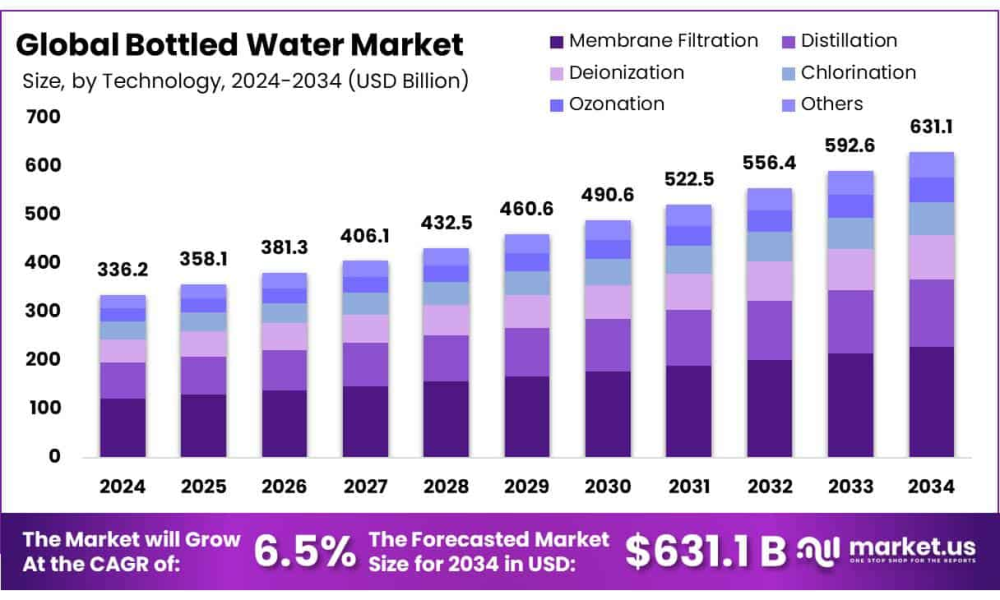
New York, NY – June 27, 2025 – The Global Bottled Water Market is growing fast, driven by rising demand for safe and convenient drinking water. In 2024, the market was valued at USD 336.2 billion and is expected to reach USD 631 billion by 2034, growing at a 6.5% CAGR from 2025 to 2034.
The Dubai Chamber of Commerce projects that bottled drinking water consumption in the UAE will reach 1.153 billion liters by 2025, driven by a steady annual growth rate of 1.4% by volume from 2020 to 2025. This consistent increase reflects a robust and sustained demand for bottled water in the region, highlighting its importance in meeting hydration needs. According to the National Institutes of Health, over half of the 700 million people worldwide without access to safe drinking water reside in sub-Saharan Africa, including Ethiopia. This significant lack of access underscores the growing reliance on bottled water as a critical alternative to ensure safe hydration in these regions.
A UNESCO report, published on behalf of UN-Water at the UN 2023 Water Conference in New York, reveals that 2 billion people globally (26% of the population) lack access to safe drinking water, while 3.6 billion (46%) do not have access to safely managed sanitation. These alarming statistics contribute to the rising demand for bottled water as a safer alternative to contaminated or unreliable water sources. In developing countries, poor drinking water quality, primarily due to contamination from unsanitary conditions, accounts for over 80% of the disease burden.
This widespread issue drives the demand for bottled water, as consumers seek to avoid health risks associated with unsafe water sources. Globally, 2.4 billion people lack access to basic sanitation, contributing to 1.8 billion annual deaths from diarrheal diseases, predominantly among children under five. As a result, bottled water consumption continues to grow as a vital strategy to reduce the risk of waterborne illnesses and improve public health outcomes.
Important Revelation
- The global bottled water market was valued at USD 336.2 billion in 2024, projected to grow at a CAGR of 6.5% and is estimated to reach USD 631 billion by 2034.
- Among technologies, membrane filtration accounted for the largest market share of 36.3%. Due to its efficiency in removing contaminants while preserving essential minerals, it ensures high-quality water.
- Among product types, the still bottled Water market accounted for the majority of the market share at 66.3%. Due to its widespread consumer preference for non-carbonated, simple hydration options.
- By NATURE, PLAIN ACCOUNTED for the largest market share of 86.3%. Due to its simplicity, widespread consumer preference for unflavored hydration, and its versatility in meeting diverse consumer needs.
- By Packaging type, PET bottles accounted for the largest market share of 77.3%. Due to their lightweight, cost-effectiveness, and recyclability, they are the preferred choice for both manufacturers and consumers.
- By distribution channel, supermarkets/hypermarkets accounted for the largest market share of 46.5%. Due to their wide reach, convenience, and the ability to offer a variety of bottled water market brands in one location.
- North America is estimated as the largest market for Bottled Water with a share of 43.3% of the market share.
➤ Download Exclusive Sample Of This Premium Report (Including Full TOC, Table & Figures): https://market.us/report/global-bottled-water-market/request-sample/
Report Segmentation
Technology Analysis: Membrane Filtration Leads Bottled Water Market in 2024
Through the bottled water market, segmentation by technology includes membrane filtration, distillation, deionization, chlorination, ozonation, and others. In 2024, membrane filtration captured a significant 36.3% revenue share. Its efficiency in removing contaminants like bacteria, viruses, and chemicals while retaining essential minerals makes it the preferred choice for high-quality bottled water. The natural taste and consumer focus on health and safety have driven its dominance in the market.
Product Type Analysis: Still Bottled Water Holds Major Market Share
The bottled water market is divided into still, sparkling, and functional bottled water. In 2024, the bottled water market still led with a commanding 66.3% market share. Its simplicity, versatility, and appeal as a healthy, natural alternative to sugary drinks make it the top choice for health-conscious consumers. The universal appeal and convenience of still water across diverse demographics solidify its market leadership.
Nature Analysis: Plain Bottled Water Market Dominates
The market splits into plain and flavored bottled water, with plain water holding an 86.3% share in 2024. Its purity and lack of added flavors or ingredients make it the go-to option for consumers prioritizing health and wellness. Growing demand for natural, calorie-free beverages and its broad appeal ensure plain water’s strong market presence.
Packaging Type Analysis: PET Bottles Lead Packaging Preferences
By packaging type, the market includes PET bottles, glass bottles, and cans. In 2024, PET bottles dominated with a 77.3% share. Their cost-effectiveness, lightweight durability, and recyclability make them ideal for storage and transportation. PET’s versatility in design and affordability compared to glass or cans, combined with consumer demand for portable hydration, drives its market dominance.
Distribution Channel Analysis: Supermarkets and Hypermarkets Lead Distribution
The market is segmented by distribution channels into supermarkets/hypermarkets, convenience stores, HoReCa, online retail, and others. In 2024, supermarkets/hypermarkets held a 46.5% share. Their wide accessibility, diverse brand offerings, and high foot traffic make them the primary choice for bottled water purchases. Promotional offers, bulk buying options, and the availability of both premium and budget-friendly options reinforce their market leadership.
Market Key Segmentation
By Technology
- Membrane Filtration
- Distillation
- Deionization
- Chlorination
- Ozonation
- Others
By Product Type
- Still Bottled Water
- Sparkling Bottled Water
- Functional Bottled Water
By Nature
- Plain
- Flavored
By Packaging Type
- PET Bottles
- Glass Bottles
- Cans
By Distribution Channel
- Supermarkets/Hypermarkets
- Convenience Stores
- HoReCa
- Online Retail
- Other Distribution Channels
Geopolitical Impact Analysis
Geopolitical water conflicts and climate change-driven water scarcity are expected to boost the bottled water market demand in vulnerable regions, accelerating market growth. Disputes over shared water resources, such as those involving the Brahmaputra River, Ethiopia’s GERD dam on the Nile, and Turkey’s Ilisu Dam on the Tigris, threaten water security for millions. In affected areas, unreliable or contaminated water supplies may push consumers toward bottled water as a safer alternative.
Additionally, worsening droughts and shrinking freshwater reserves due to climate change could further drive demand, particularly in water-stressed regions. As access to clean drinking water becomes more uncertain, bottled water market sales are likely to rise, creating new growth opportunities for the industry. This trend highlights how environmental and political instability can shape consumer behavior, reinforcing bottled water as a critical resource in water-scarce regions.
Factors Affecting the Growth of the Bottled Water Market
1. Health & Safety Concerns: Rising awareness of waterborne diseases and contamination drives the bottled water market demand. Consumers prefer it over tap water due to perceived purity. Governments enforce strict safety regulations, boosting trust. In developing nations, poor water infrastructure increases reliance on bottled water. Health trends like hydration awareness also support market growth.
2. Convenience & Portability: Busy lifestyles and on-the-go consumption fuel bottled water market sales. Lightweight packaging makes it easy to carry. Travel, sports, and outdoor activities increase demand. Single-use bottles dominate, though reusable options are growing. Vending machines and retail availability enhance accessibility.
3. Environmental & Sustainability Issues: Plastic waste concerns pressure the industry to adopt eco-friendly packaging. Brands shift to recycled PET and biodegradable materials. Regulations on single-use plastics impact market dynamics. Consumers prefer brands with green initiatives. Sustainable practices are now a key competitive factor.
4. Climate Change & Water Scarcity: Droughts and depleting groundwater increase bottled water market reliance. Regions with water conflicts see higher demand. Climate-related disasters disrupt municipal supplies, boosting sales. Long-term scarcity may drive innovation in water sourcing. Companies invest in drought-resistant supply chains.
5. Economic & Regional Factors: Disposable income growth in emerging markets raises demand. Urbanization and tourism boost sales in developing nations. Price sensitivity affects low-income consumers. Inflation and supply chain costs impact pricing. Regional water quality issues shape market trends.
Competitive Landscape
- Nestle S.A.
- The Coca-Cola Company
- PepsiCo Inc.
- Danone
- Suntory Beverage & Food Ltd.
- Tata Consumer Products
- CG Roxane
- Keurig Dr Pepper Inc.
- Talking Rain Beverage Company
- Harvest Hill Beverage Company
- Spindrift Beverage Co.
- Nongfu Spring
- Voss of Norway
- Crystal Springs
- FIJI Water Company LLC
- Gerolsteiner Brunnen GmbH & Co. KG
- VOSS WATER
- National Beverage Corp.
- Other Key Players
Get in Touch with Us:
Market.us (Powered By Prudour Pvt. Ltd.)
Address: 420 Lexington Avenue, Suite 300, New York City, NY 10170, United States
Send Email: [email protected]
Refer More Related Reports:
1. Black Masterbatch Market
2. Tetramethyl Bisphenol F Market



