
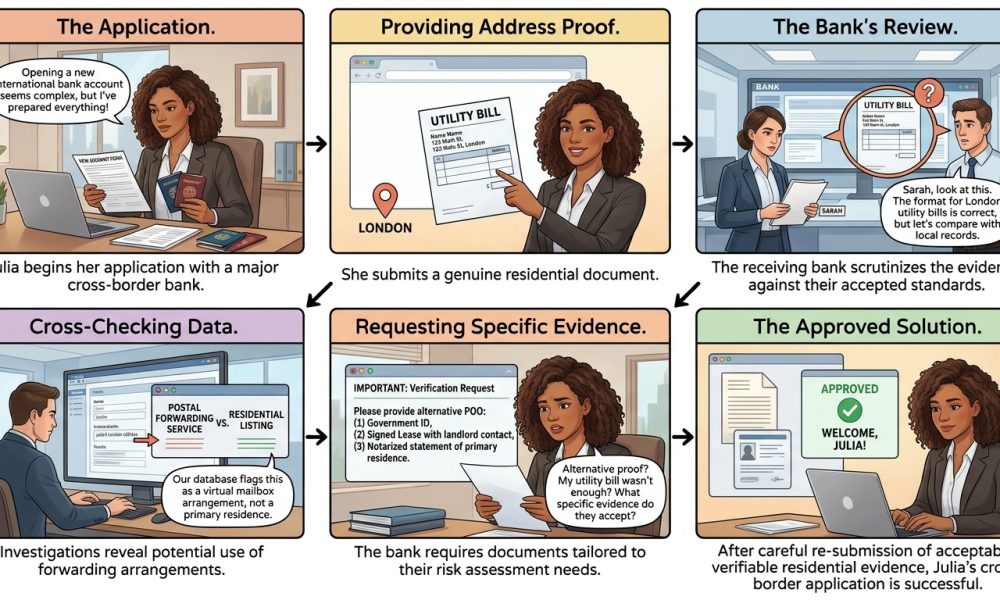
Applicants need to distinguish genuine residential Information from mailing arrangements and understand what evidence the receiving institution accepts.
Washington, DC, October 26, 2026 — Proof-of-address requests can complicate international banking when applicants have recently moved, maintain homes in several countries, or receive correspondence somewhere other than where they live, making accurate explanations and institution-specific instructions essential to preparing an Application.
A mailing address can provide a reliable place to receive documents without establishing residential occupancy. At the same time, a genuine residence may be hard to document when you share accommodation or household counts belong to someone else.
Those differences matter because banks can ask for address Information for different purposes, and what one institution accepts may not satisfy another institution reviewing a different account, customer category, or regulatory requirement in another jurisdiction.
A useful preparation process therefore begins by identifying what the bank needs to establish, allowing applicants to present genuine Information and suitable supporting records rather than assume that any document displaying their name and an address will suffice.
Clarify Which Address the Bank Is Requesting
The first question is whether the institution wants a residential address, a correspondence address, or another address relevant to the account, because those descriptions can refer to different facts even when a person uses one location for several purposes.
A residential address indicates where the applicant lives. In contrast, a correspondence address identifies where communications should be delivered, so explain any difference rather than assume the bank will infer the arrangement from the documents.
Applicants using a relative’s home for mail should establish whether that address is also their actual residence, then ask how the institution wants the circumstances recorded if the two functions are separate in the proposed banking relationship.
Where a form provides only one address field, obtain clarification before submission to ensure the Information supplied answers the institution’s intended question, rather than forcing a complicated situation into an inaccurate description for administrative convenience.
Address Collection and Verification Are Different Steps
The Hong Kong Monetary Authority’s consumer guidance on banking requirements distinguishes collecting address Information from verifying it, explaining that its anti-money-laundering guidance requires collection. In contrast, banks may still require verification for other applicable purposes in particular circumstances.
That distinction shows why applicants should avoid treating documentary proof as a universal requirement imposed identically by every regulator, while also recognizing that an institution may have a legitimate reason to request evidence beyond a stated address.
If a bank asks for supporting documents, the applicant can ask for clarification on the purpose and acceptable alternatives, so the response addresses the actual requirement rather than relying on a general online statement about another jurisdiction.
The relevant instructions should identify what Information must appear and how it will be submitted, giving the applicant a concrete basis for preparation without assuming that a requirement described elsewhere automatically applies to the account under consideration.
Acceptable Documents Depend on the Receiving Institution
Banks publish their own documentary instructions, which can distinguish applicants living locally from those applying overseas and specify different evidence depending on the account or verification method, making the receiving institution’s current guidance the appropriate starting point.
HSBC UK, for example, lists documents it accepts from applicants outside the United Kingdom and attaches conditions to particular categories, illustrating why a foreign document should be evaluated against the relevant instructions rather than rejected or accepted by assumption.
Applicants should confirm whether the institution accepts their proposed document before arranging translations or certification, especially where obtaining a replacement requires contacting an overseas Authority or returning to a country where they no longer live permanently.
A document accepted for one Application should not be treated as permanently approved for every subsequent purpose, since the institution may need more recent Information or evidence addressing a different question when circumstances or services change later.
Recent Movers May Need Alternative Evidence
Someone who has genuinely moved may not yet have a utility bill or other familiar document in their own name, so explain the timing rather than provide an older address just because it is easier to document.
The applicant should ask which records the bank accepts during that transition, identifying any available tenancy, official correspondence, or other evidence, without assuming a particular document category is universally sufficient across institutions and account types.
If a record relates to a previous residence, state its historical purpose accurately so the institution can distinguish evidence of an earlier address from Information intended to demonstrate the applicant’s current accommodation and living arrangements.
A realistic relocation timetable should therefore include the time needed to obtain acceptable banking documentation, particularly when employment payments or essential household transactions depend on an account that has not yet completed the institution’s review process.
Mail Forwarding Does Not Establish Residential Occupancy
A postal box, mail-forwarding service, or commercial correspondence arrangement may help someone receive communications. Still, access to that service does not itself demonstrate that the person lives at the address associated with the arrangement.
Applicants should describe such arrangements accurately and ask whether the institution permits them for correspondence, while providing residential Information separately where requested rather than presenting the mailing location as a home without a factual basis for doing so.
The same distinction applies when an adviser offers an address as part of a banking package, so it is important to establish whether the service provides accommodation, correspondence handling, or something else before relying on its description in an Application.
Any supporting document should reflect the actual arrangement, with questions resolved directly through the bank’s process rather than by obtaining statements or letters designed to suggest residential facts that do not correspond to the applicant’s circumstances.
Shared Housing Requires an Accurate Explanation
People living with relatives, partners, or other household members may have limited documentation in their own names, even when the accommodation is their genuine home, so the absence of a personal utility account can raise an evidentiary issue that requires clarification.
Applicants should ask whether the bank accepts documents linking them to the household and what accompanying Information is needed, rather than assume another person’s bill proves their residence simply because the address matches.
If the institution accepts a supporting letter, it should identify the relationship and living arrangement accurately, and confirm any additional requirements before the applicant submits private documents belonging to another household member.
When several people apply together, the bank should clarify what each applicant must provide, ensuring that one person’s accepted evidence isn’t assumed to satisfy the separate Identification and address requirements for everyone else involved.
Lack of Conventional Documents Does Not End Every Option
Some institutions offer arrangements for people whose circumstances make conventional address evidence difficult to obtain, showing why applicants should ask about alternatives rather than assume a standard checklist covers every possible route to banking access.
In October 2019, Big Issue North reported on banking access for people without fixed addresses, describing an HSBC initiative involving supporting organizations, a historical example of institutions developing procedures that address circumstances outside ordinary documentary expectations.
HSBC UK’s current guidance describes its No Fixed Address service as a specialist arrangement available through selected branches and participating support organizations, making clear that it has defined eligibility and referral conditions rather than universal availability.
That example should not be presented as a general solution for overseas applicants. Still, it supports a broader practical point: discuss unusual circumstances honestly with the institution so it can identify any legitimate alternative.
Document Dates and Formats Need Attention
A document’s Authenticity does not necessarily mean it meets the bank’s requirements for recency, format, or content, so check those conditions before submitting evidence that may accurately describe the person but still require replacement.
Applicants should confirm whether the institution accepts downloaded statements, electronic documents, or certified copies, and whether it needs complete pages showing the issuer and relevant details rather than a cropped Image containing only the name and address.
If a document contains a genuine error, request a correction from the issuer through its normal procedure, preserving the distinction between obtaining an accurate record and independently editing the document to fit an Application.
Translation requirements should also be confirmed with the receiving bank, so applicants can use an accepted process and avoid assuming an informal translation or an unexplained address variation will be understood consistently during the verification review.
Address Evidence Does Not Settle Tax Residence
A document showing an address can support a banking request without determining tax residence, so it’s important to distinguish evidence of accommodation or correspondence from the legal analysis required for tax classification.
The OECD explains that citizenship or permission to reside in a jurisdiction does not automatically establish tax residence there or terminate residence elsewhere, reinforcing why an address associated with a foreign passport cannot resolve the entire tax position.
Applicants living across borders should obtain advice where their circumstances create uncertainty, then complete the institution’s tax certifications according to the applicable rules rather than selecting a jurisdiction simply because supporting address documents are available there.
The bank should be told about relevant differences between residential, correspondence, and tax Information when its forms require them. As a result, the records reflect the person’s real circumstances instead of creating apparent consistency through inaccurate answers.
Family Records Serve Different Verification Purposes
A family may have extensive Identification records yet still need separate evidence of where particular members live, so the presence of names or relationships in official documents should not be mistaken for proof of current residence.
Amicus International Consulting’s article on parental photographs in Mexico’s children’s passports describes how those documents support family Identification, illustrating the importance of understanding what a record establishes rather than assigning it an unrelated function in a banking Application.
When submitting documents concerning children or relatives, the applicant should clarify whether the bank is verifying identity, parental Authority,, or address, ensuring each record answers the right question and that unnecessary family Information is not circulated.
When a bank requests another household member’s records, the applicant should establish the necessary consent and submission arrangements, use verified channels, and ask about alternatives if the requested evidence cannot be provided under the circumstances.
Address Changes Should Be Reflected in Existing Accounts
Once an account is established, customers should review the institution’s instructions on address changes, because accurate Information remains relevant to account administration and later customer reviews rather than serving only as an initial Application requirement.
Distinguish a change in correspondence arrangements from a residential move, allowing the bank to update the appropriate fields without assuming every new mailing instruction also changes the customer’s residence or tax circumstances.
Customers should confirm that updates have been recorded and ask whether additional evidence is required, particularly when a move crosses national borders and may affect the account’s availability or the Information the institution needs to maintain.
If earlier records are incorrect, the correction should explain the actual circumstances and relevant dates, giving the institution a coherent account rather than leaving inconsistent addresses across applications, correspondence and supporting documents without clarification of their respective purposes.
Resolve Uncertainty Before Paying for Address Services
Before purchasing assistance described as providing proof of address, applicants should clarify exactly what service is offered and whether the resulting documents accurately reflect their circumstances, rather than assuming an official-looking statement proves genuine residence.
The intended bank should confirm what it accepts for the relevant purpose, allowing the applicant to evaluate a proposal against actual requirements rather than rely on an intermediary’s assurance that the same arrangement works everywhere for every customer.
If evidence is rejected, the applicant should ask what remains unresolved and whether review or alternative documentation is available, keeping subsequent submissions accurate instead of changing the claimed residence merely to obtain a different administrative response.
Cross-border banking is easier to navigate when residential facts, mailing arrangements, and documentary requirements are clear, allowing applicants to provide evidence that meets the receivinginstitution’ss purpose without claiming more than the underlying records genuinely establish.




