
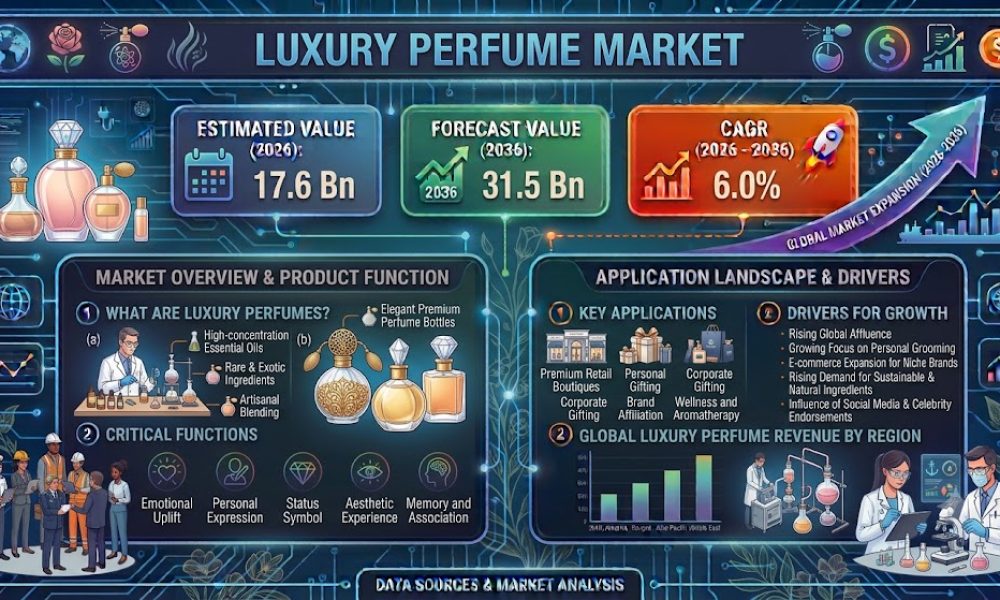
The global luxury perfume market is estimated at USD 17.6 billion in 2026 and is projected to reach USD 31.5 billion by 2036, expanding at a 6.0% CAGR during the forecast period. The market was valued at USD 16.6 billion in 2025. Rising prestige beauty spending, premium fragrance launches, and stronger consumer focus on scent identity are supporting demand for luxury perfumes.
Luxury fragrance is increasingly linked with personal identity, gifting, and premium beauty routines. Fragrance houses are using new scent launches and controlled retail experiences to support brand value. Online platforms are also improving fragrance discovery through brand content, curated scent profiles, and sample-led programs.
Get Detailed Market Forecasts, Competitive Benchmarking, and Pricing Trends: https://www.factmr.com/connectus/sample?flag=S&rep_id=8022
Global Segment Leaders
- Eau de Parfum is projected to account for 36.0% of the market in 2026. Its higher concentration and longer-lasting scent support premium positioning, flagship launches, and gifting.
- Female-oriented perfumes hold a 48.0% share in 2026. Established premium beauty routines, seasonal launches, and gifting campaigns support this segment.
- Offline sales account for 64.0% of the market in 2026. Department stores and brand boutiques remain important because consumers can test fragrances before purchasing.
- Natural ingredient-based perfumes hold 42.0% share in 2026. Ingredient quality and sourcing stories support the premium positioning of luxury fragrances.
- Prestige perfumes lead the price-tier segment with 56.0% share in 2026. The segment provides accessible luxury while supporting repeat purchases and gifting.
Country-Level Performance
- South Korea: The luxury perfume market is forecast to expand at a 6.4% CAGR from 2026 to 2036. Beauty retail, younger consumers adopting fragrance as part of personal styling, and department-store discovery support demand.
- Japan: The market is projected to grow at a 6.1% CAGR. Premium grooming, selective retail, trusted brand heritage, and demand for refined scent profiles support expansion.
- France: Demand is forecast to rise at a 5.9% CAGR. Fragrance heritage, perfume craftsmanship, specialty perfumeries, and luxury tourism strengthen the country’s premium fragrance market.
- United States: The market is expected to grow at a 5.6% CAGR. Prestige beauty retail, department-store fragrance testing, premium gifting, and online repeat purchases support demand.
- United Kingdom: The market is projected to expand at a 5.4% CAGR. Department stores, online premium platforms, niche fragrance interest, and premium beauty spending contribute to growth.
What Is Driving Luxury Perfume Demand?
Prestige beauty spending remains a key market driver. Fragrance houses are using premium launches to strengthen their wider beauty portfolios. Estée Lauder reported that fragrance net sales increased 2.0% in the fiscal 2025 fourth quarter, supported by luxury brands including Le Labo and Jo Malone London.
Fragrance is also becoming more closely connected with personal identity. Consumers increasingly compare scent longevity, concentration, presentation, and brand story when selecting premium fragrances.
Offline retail continues to play an important role because scent testing helps consumers make purchasing decisions. Department stores and brand boutiques also provide beauty advisors who can explain fragrance profiles and guide gifting purchases.
Online channels are creating another route for discovery and repeat sales. Sample programs, scent quizzes, official brand content, and curated fragrance profiles can help reduce uncertainty when consumers buy without physically testing a product.
Opportunities for Fragrance Brands
The market presents several opportunities through product development and retail innovation.
Unisex fragrances can help brands address younger consumers who prefer more flexible approaches to scent identity. Unisex positioning also allows fragrance houses to broaden product appeal without relying solely on traditional gender categories.
Online fragrance discovery provides another opportunity. Scent quizzes and sample programs can help consumers understand fragrance profiles before making a higher-value purchase.
Refill formats may also gain attention as fragrance houses explore packaging options that support sustainability positioning while maintaining a premium product experience.
Pricing and Regulatory Challenges
High product pricing remains a key restraint for luxury perfume demand. Consumers compare scent performance with brand value before committing to premium products.
Formulation requirements also require close attention. Ingredient rules and allergen disclosure increase the need for disciplined product development and regulatory compliance. The International Fragrance Association’s 2025 annual report highlighted regulatory engagement and fragrance standards during a period of increased policy activity.
Competitive Landscape
The luxury perfume market includes major luxury houses and prestige beauty companies such as LVMH Moët Hennessy Louis Vuitton SE, The Estée Lauder Companies Inc., Coty Inc., CHANEL Limited, Shiseido Company, Limited, Hermès International SCA, and Puig Brands, S.A.
Coty reported in its fiscal 2025 annual filing that approximately 60.0% of fiscal 2025 net revenue came from prestige fragrance, with around 91.0% of that revenue generated by its top seven prestige fragrance brands. Estée Lauder also reported a 2.0% increase in fragrance net sales in the fiscal 2025 fourth quarter.
Competition is centered on scent identity, product performance, brand trust, premium presentation, and distribution control. Luxury fragrance companies are also balancing physical scent-testing experiences with online discovery and repeat purchasing.
Analyst Perspective
Shambhu Nath Jha, Senior Analyst at Fact.MR, states:
“Luxury perfume demand is moving from simple brand recall toward scent identity. Fragrance houses that combine lasting performance with premium retail experience can protect repeat demand. The strongest brands will defend value through storytelling and controlled distribution.”
About the Luxury Perfume Market Report
Fact.MR’s Luxury Perfume Market report covers premium personal fragrances sold through prestige retail and luxury brand channels. The study analyzes the market by product type, consumer orientation, sales channel, ingredient positioning, price tier, and region.
The report covers Eau de Parfum, Eau de Toilette, Eau de Cologne, and Eau Fraiche, along with male, female, and unisex consumer orientations. It also evaluates offline and online sales channels, natural ingredient-based, synthetic blend and hybrid formulations, and prestige through limited-edition price tiers.
The forecast covers 2026 to 2036, with country-level analysis for South Korea, Japan, France, the United States, and the United Kingdom.
Explore More Related Studies Published by Fact.MR Research:
Stamp Pad Market
Massaging Cosmetic Applicators Market
About Fact.MR
Fact.MR is a market research and consulting firm providing syndicated and customized research across automotive, chemicals and materials, technology, industrial goods, healthcare, and consumer markets. Its research combines primary interviews, secondary research, market sizing, competitive analysis, and industry data validation.



