
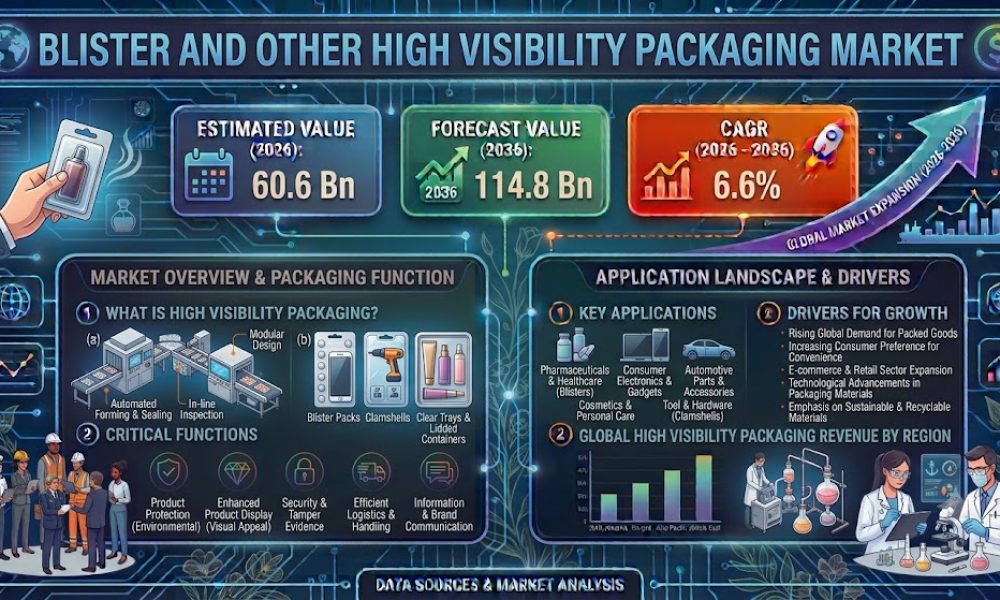
The global blister and other high visibility packaging market is estimated at USD 60.6 billion in 2026 and is projected to reach USD 114.8 billion by 2036, expanding at a 6.6% CAGR during the forecast period. The market was valued at USD 56.8 billion in 2025 and is expected to create an incremental revenue opportunity of USD 54.2 billion between 2026 and 2036.
Demand is supported by healthcare packaging requirements, food retail formats, and consumer goods that need product visibility and protection. Unit-dose healthcare packs require sealed cavities, clear labeling, and tamper evidence, while food and retail products use clamshells, carded blisters, and windowed formats to protect products and improve shelf presentation.
Get Detailed Market Forecasts, Competitive Benchmarking, and Pricing Trends: https://www.factmr.com/connectus/sample?flag=S&rep_id=8195
Global Segment Leaders
- Carded blister packaging is projected to hold 39.2% share in 2026. Paperboard backing gives brands space for instructions, barcodes, and product information while the clear cavity protects the item.
- Healthcare accounts for an estimated 36.5% share. Medicines, diagnostic products, and small medical goods require sealed formats for handling, labeling, and tamper evidence.
- PET is projected to represent 31.4% of the market. Its clarity and form strength support its use in clamshell and windowed packaging.
- Thermoforming is expected to account for 48.8% share. The process allows converters to produce different cavity depths and pack shapes at high output rates.
- Unit-dose packs are projected to hold 37.6% share. Single cavities are widely used for tablets, small medical products, and sample formats.
- Direct sales are estimated to account for 42.1% share. Large packaging users often require design approvals, tooling discussions, sealing trials, and resin validation before commercial production.
Country-Level Performance
- India: The market is projected to expand at an 8.4% CAGR from 2026 to 2036, the highest among the countries covered. Pharmaceutical exports and demand for sealed unit-dose packs support the country’s packaging requirements.
- China: Growth is forecast at 7.8% CAGR. Online retail and packaged consumer goods support demand for clamshell and carded formats.
- South Korea: The market is expected to advance at 7.2% CAGR, supported by biopharmaceutical exports and demand for validated healthcare packaging.
- United States: The market is projected to grow at 6.8% CAGR, with over-the-counter drugs, store brands, and custom retail packs supporting demand.
- Germany: Growth is forecast at 6.2% CAGR. Pharmaceutical production and packaging waste rules are encouraging closer evaluation of packaging materials.
- Japan: The market is expected to expand at 5.9% CAGR as quality-focused pharmaceutical production maintains demand for barrier blister packs and unit-dose formats.
Healthcare Remains a Core Demand Source
Healthcare packaging is a major contributor to demand because tablets, medical accessories, and diagnostic products need controlled handling. Blister formats can provide individual cavities while leaving space for batch information, instructions, and other product details.
The market also benefits from food applications. Fresh snacks, bakery products, and other retail foods use clear clamshell formats to reduce product damage and allow consumers to inspect products before purchase.
Consumer goods manufacturers use carded blister and clamshell packaging for small household products, personal care items, hardware, and electronics accessories. These formats combine product protection with shelf visibility and can also support hanging displays.
PET, Paperboard and Material Shifts Create Opportunities
Material selection is becoming an important part of packaging development. PET is gaining attention where brands need clarity, stiffness, and compatibility with forming processes. PVC remains established in some pharmaceutical blister applications, while packaging companies are evaluating PET and PP as waste policies and recycling targets influence material decisions.
Carded blister formats also provide an opportunity to combine plastic cavities with paperboard backing. This allows brands to maintain product visibility while creating additional space for printed information.
For converters, material changes can require sealing trials and machine validation. Suppliers that support these technical changes can address the needs of large healthcare and consumer goods customers.
Key Market Restraints
Plastic packaging waste remains a major challenge for high visibility packaging. Regulatory changes and recycling targets are pushing companies to review established materials and test alternatives.
Cost is another consideration. Resin price changes can affect packaging economics, while switching from one material to another may require testing for seal strength, forming performance, and compatibility with existing production equipment.
The report also identifies the need to balance product visibility, protection, forming efficiency, and material requirements when developing new packaging formats.
Competitive Landscape
The competitive landscape includes packaging manufacturers and specialized healthcare packaging suppliers such as Amcor plc, Constantia Flexibles, Klöckner Pentaplast, TekniPlex Healthcare, Sonoco Products Company, Prent Corporation, Winpak Ltd., and UFP Technologies, Inc.
Competition is shaped by packaging design capabilities, material expertise, forming technology, sealing performance, healthcare compliance requirements, and the ability to support customized packaging programs. Direct relationships with large users remain significant because packaging designs often require engineering reviews and production trials before commercial orders.
Analyst Perspective
Shambhu Nath Jha, Principal Consultant at Fact.MR, states:
“CXOs should view blister and other high visibility packaging as a shelf protection and compliance tool, not a simple plastic pack. The main demand comes from healthcare unit-dose needs and retail packs that need tamper evidence.”
About the Blister and Other High Visibility Packaging Market Report
Fact.MR’s Blister and Other High Visibility Packaging Market report analyzes see-through retail and healthcare packaging formats that protect products while allowing visual inspection at the shelf or point of use.
The study covers carded blister packaging, clamshell packaging, windowed packaging, skin packaging, and cold form blister packaging. It analyzes applications across healthcare, consumer goods, food, personal care, and industrial goods.
The report also examines PET, PVC, PP, paperboard, and aluminum across thermoforming, cold forming, heat sealing, die cutting, lidding, and other processes. Pack-size analysis includes unit dose, multi-pack, family pack, trial pack, and refill pack formats.
The forecast covers 2026 to 2036, with country-level analysis for India, China, South Korea, the United States, Germany, and Japan, alongside regional coverage of North America, Europe, Asia Pacific, Latin America, and the Middle East and Africa.
Explore More Related Studies Published by Fact.MR Research:
Office Real Estate Market
Mutual Fund Assets Market
About Fact.MR
Fact.MR is a market research and consulting firm providing syndicated and customized research across automotive, chemicals and materials, technology, industrial goods, healthcare, and consumer markets. Its research combines primary interviews, secondary research, market sizing, competitive analysis, and industry data validation.



