
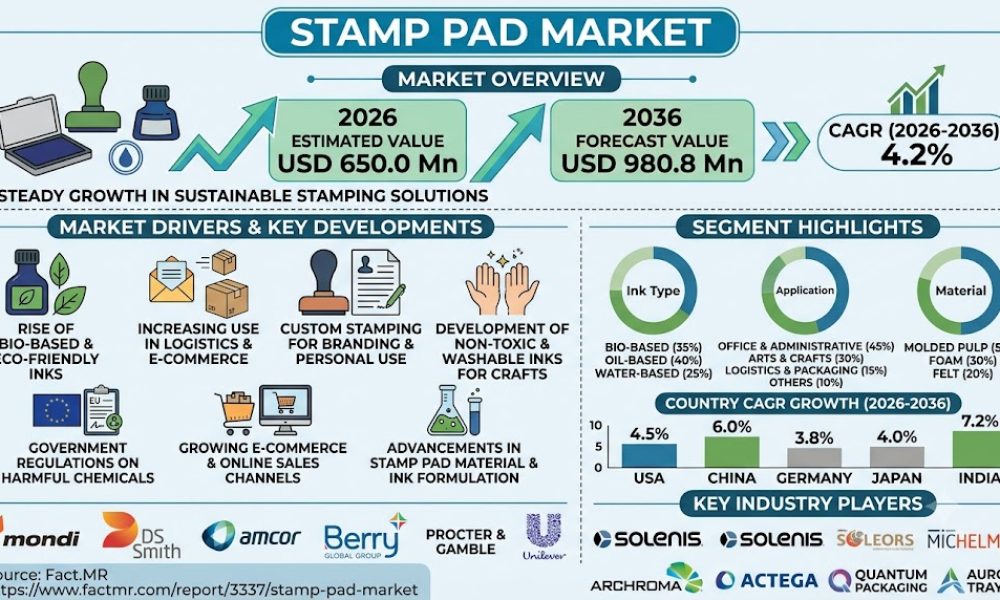
The global Stamp Pad Market is projected to increase from USD 650.0 million in 2026 to USD 980.8 million by 2036, expanding at a 4.2% CAGR during the forecast period. The market reached USD 623.8 million in 2025, while the absolute opportunity is estimated at USD 330.8 million between 2026 and 2036.
Demand continues to come from physical document handling, legal and certification workflows, education, creative applications and manual industrial marking. At the same time, digital signatures, electronic seals and paperless records are reducing routine stamping in several markets.
Get Detailed Market Forecasts, Competitive Benchmarking, and Pricing Trends: https://www.factmr.com/connectus/sample?flag=S&rep_id=3337
Global Segment Leaders
- Inked Stamp Pads — 61.4% share: Ready-to-use inked pads remain the leading product segment because they work with common hand stamps and can be replenished without replacing the complete stamping device.
- Office Documentation — 47.8% share: Date, approval, received, certification and routing impressions continue to support demand where paper documents move between desks, counters or departments.
- Corporate Offices — 55.2% share: Corporate workplaces combine administrative, finance, logistics and records-related stamping requirements, creating recurring demand for replacement pads and re-inking.
- Absorbent Ink Technology — 38.9% share: Porous pad structures act as both an ink reservoir and metering surface, supporting even transfer and repeated impressions.
- Water-Based Ink Formulations — 66.7% share: Water-based systems fit routine paper stamping because they offer clean transfer, lower odor and easier cleanup compared with many solvent-rich formulations.
- Office Supply Retailers — 42.6% share: Physical stationery and office-supply outlets remain important for immediate replacement purchases, while online channels expand access to specialty sizes, colors and formulations.
Country-Level Performance
- Germany — 4.8% CAGR: Germany’s 2024 business register contained about 3.5 million legal units. This broad business base supports recurring purchases of workplace consumables, while the 2026 Blue Angel criteria for writing instruments and stamps emphasize resource-efficient materials and reduced hazardous substances.
- Brazil — 4.4% CAGR: Brazil’s formal business and institutional base supports office-consumable demand. Ministry of Foreign Affairs guidance on document legalization also references stamps and seals used on original documents and in legalization workflows.
- USA — 4.0% CAGR: Notarial practice remains a direct physical stamping use case. The 2026 California Notary Public Handbook states that an official seal can be affixed using a compliant stamp or seal press. U.S. e-commerce also accounted for 17.1% of retail sales in Q2 2026, expanding access to specialty products.
- U.K. — 3.6% CAGR: England had 24,499 schools in the 2025/26 academic year, supporting education-related stationery demand. Certified-copy procedures also preserve specific physical document-marking requirements, although electronic signatures and digital public services constrain routine stamping.
- Japan — 3.2% CAGR: School, office and creative applications support demand for stamp-pad products. At the same time, government efforts to remove unnecessary seal requirements are shifting demand toward education, crafts, specialist inks and other physical-marking applications.
Regional Context
The Stamp Pad Market spans North America, Latin America, Europe and East Asia, with Germany, Brazil, the USA, the U.K. and Japan specifically covered in the country forecast.
Demand patterns differ by the role of physical documents in each market. Germany combines a large formal business base with environmental product criteria. Brazil retains document-legalization and administrative uses. The USA has continuing notarial applications and established office-supply and online distribution. The U.K. and Japan retain education and specialist applications while digital government and electronic signatures reduce routine office stamping.
Market Drivers and Opportunities
Recurring replacement is a central demand factor. Stamp pads are consumable components that may need replacement even when the stamp hardware remains in use for years. Fact.MR identifies persistent legal, certification and document-control stamping as having an estimated +0.7 percentage-point impact on CAGR, while corporate office replacement demand has an estimated +0.6 percentage-point impact.
Other opportunities include:
- Lower-impact water-based inks and recycled pad casings, particularly in Germany and the U.K.
- Specialty pads for manufacturing, logistics and non-paper surfaces, where fast-drying or surface-specific performance can support higher-value applications.
- Refillable pad systems that extend the useful life of stamp hardware.
- Online distribution of specialty and creative stamp pads, giving buyers access to uncommon colors, sizes and formulations.
- Institutional procurement across schools and public offices.
The principal restraint is digital substitution. Electronic signatures, e-government services and paperless corporate records are reducing the need for physical approvals. Self-inking and pre-inked devices also reduce standalone pad consumption, while dry-out, contamination and price competition affect conventional exposed-pad products.
Competitive Landscape
Key companies profiled in the Stamp Pad Market include Trodat GmbH, Camlin, Toyo Ink India, Shachihata Inc., Colop Stempelerzeugung Skopek GmbH & Co. KG, Cosco Industries, Faber-Castell, Tsukineko Co., Ltd., Max Co., Ltd., Reiner GmbH & Co. KG, Avery Dennison Corporation, Brother International Corporation, Shiny Corporation, Pelikan, Stampin’ Up!, Ranger Industries, ACME Stamp & Sign Co., JustRite Stampers, Hero Arts, Stampendous, Xstamper and Aladine SAS.
Competition is shaped by pad substrate, ink chemistry, drying time, impression quality, refill life, color range and compatibility with different stamp sizes and surfaces.
Trodat operates across conventional handstamp pads, water-based refill inks and specialty fast-drying inks. Shachihata focuses on pigment systems with fine pad surfaces and quick-drying characteristics, while Tsukineko offers water-based pigment and specialty creative ink pads for different craft substrates.
The market remains diversified across office stationery, marking systems, craft supplies and industrial applications rather than being centered on one pad technology.
Analyst Perspective
Shambhu Nath Jha, Principal Consultant at Fact.MR, states:
“Stamp pads remain a replacement-driven category rather than a high-frequency technology purchase. The durable part of demand comes from workflows where a clear physical impression still has operational value, including document receipt, certification, school administration and manual marking.
Suppliers can defend the category by improving ink transfer, refill life, low-odor formulations and specialty-surface performance, while accepting that routine approval stamping will continue to migrate toward digital signatures.”
The report’s strategic assessment points toward refillability, low-odor water-based formulations and specialty-surface performance as areas where manufacturers can address changing buyer requirements. Suppliers also need to account for the continuing shift from routine physical approvals toward digital workflows.
Explore More Related Studies Published by Fact.MR Research:
Venue Reusable Cup Systems Market
Low-Drag Satellite Platforms Market
About Fact.MR
Fact.MR is a market research and consulting firm providing syndicated and customized research across consumer goods, packaging, food and beverage, healthcare, technology, industrial goods, and chemical and materials markets. Its research combines primary research, secondary sources, company analysis, industry inputs and market modeling to support business planning and strategic decisions.



