
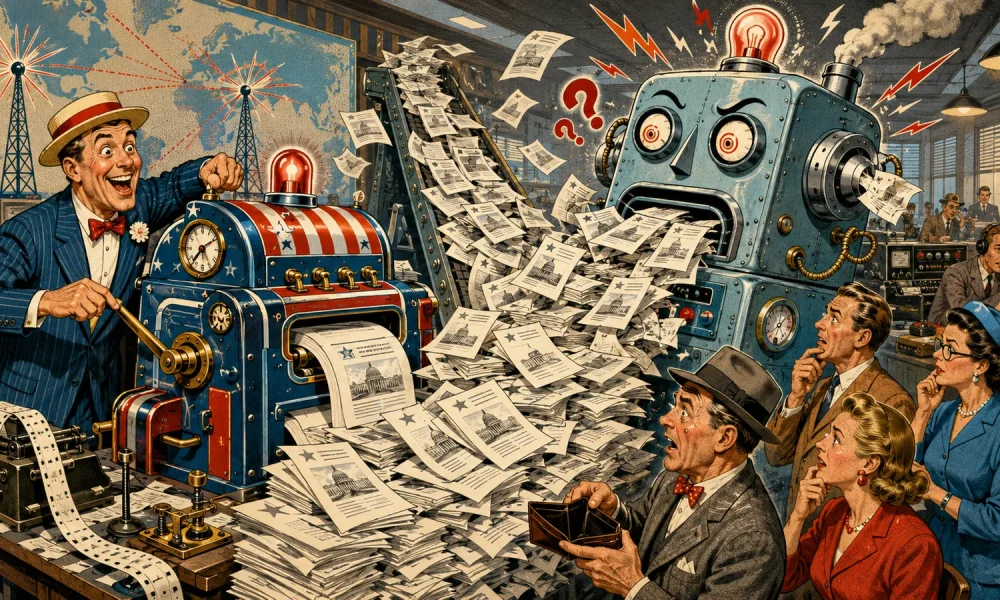
As businesses race to understand how large language models are changing search, public relations and brand discovery, a new category of marketing claims is beginning to attract scrutiny: promises that content can be “ingested by AI” and, by implication, become more visible, trusted or influential inside generative AI systems.
The timing is significant.
Marketing teams are under pressure to adapt to generative search at a moment when there is still no universally accepted playbook for Generative Engine Optimization, or GEO. Search behaviour is changing, executives are asking how their brands will appear in AI-generated answers, and agencies are attempting to determine which traditional SEO and PR practices still matter.
That uncertainty creates an unusually vulnerable market.
For marketers trying to make decisions now, technical-sounding phrases such as “AI ingestion,” “LLM visibility,” “machine learning distribution” and “AI discoverability” can sound considerably more powerful than what they may actually demonstrate.
The central problem is not whether AI systems can access public webpages. They often can.
The problem is the widening gap between being accessible to an AI system and being considered authoritative by one.
Accessibility Is Not Authority
A publicly available press release or article may be crawled, indexed or retrieved by systems that support AI-powered search.
That has legitimate value.
A company announcement can provide machine-readable information about a product launch, executive appointment, acquisition, partnership or other corporate event. It may help establish when something happened and what a company said about it.
But accessibility represents only the beginning of the process.
There are several fundamentally different stages between placing information online and having an AI system treat that information as meaningful evidence:
Ingestion or accessibility means a system is technically capable of reaching the document.
Retrieval means the document is actually found when a relevant question is asked.
Citation means an AI system independently chooses that document as a source for an answer.
Corroboration means separate and genuinely independent sources support the same underlying conclusion.
These stages are increasingly being blurred in marketing language, despite representing very different outcomes.
For businesses spending money specifically to improve their position in AI search, that distinction matters.
A Screenshot Can Prove Much Less Than It Appears To
One particularly questionable method of demonstrating AI visibility involves directing an AI system toward a specific article or release and then showing that the system can describe its contents.
If an AI tool is given an article, headline, publication name or sufficiently specific instructions to locate a document, successfully retrieving it proves something useful: the document is retrievable under those conditions.
It does not necessarily prove that the same AI system would independently discover or select the document when answering an ordinary customer’s question.
Those are completely different tests.
A marketer should be more interested in what happens when someone simply asks:
“Which companies are leading this sector?”
“What are the best providers of this technology?”
“Which businesses should I consider?”
At that point, nobody has supplied the company’s press release. Nobody has instructed the AI to search a specific publisher. Nobody has effectively handed the system the answer.
Whether the brand appears — and which sources the system chooses to support its answer — becomes a far more meaningful indication of genuine AI visibility.
The Industry Risks Confusing Distribution With Consensus
The issue becomes even more important when press releases are syndicated across large numbers of websites.
Publishing the same company-authored statement on 100 or 500 URLs may significantly increase its distribution footprint.
It does not create 100 or 500 independent opinions.
A press release ordinarily originates with the company itself or an agency working on its behalf. It is therefore an excellent primary source for statements such as:
The company launched a new product.
The CEO made a particular announcement.
The company entered another market.
A transaction occurred on a certain date.
It is much weaker evidence for statements such as:
The company is the market leader.
Its product is superior to competitors.
Industry experts regard it as the best provider.
Those conclusions require independent evidence.
Syndicating the original statement does not change who originated the claim. As the underlying analysis puts it, many URLs can still represent only one originating assertion.
That distinction may prove particularly important as companies begin spending larger portions of their marketing budgets on GEO.
Marketers Are Being Asked to Buy Into a System Nobody Fully Controls
The current market is unusually susceptible to exaggerated promises because even experienced marketers are working with incomplete information.
Google search marketing developed over decades. Businesses eventually learned how ranking systems broadly behaved, which practices carried risk and which performance metrics could be tested.
Generative AI search is far younger.
Different platforms use different retrieval systems, training datasets, search indexes, ranking logic and citation mechanisms. Those systems are also changing rapidly.
Yet marketers are already being asked to purchase products that appear to promise access to this emerging ecosystem.
Words such as “ingestion” can therefore become particularly powerful sales language.
Technically, a statement about content being accessible to AI may be correct.
Commercially, however, customers may hear something very different:
AI knows about us.
AI trusts us.
AI will cite us.
AI will recommend us.
There is an enormous distance between those propositions.
When that distance is not explained clearly, technically accurate language can still leave customers with a deeply inaccurate understanding of what they are buying.
The Damage Extends Beyond Individual Marketing Budgets
Poorly explained AI claims risk harming more than businesses that purchase ineffective campaigns.
They can damage the development of GEO itself.
The marketing industry is currently trying to establish which signals actually improve visibility inside AI-generated results. That requires careful testing, realistic prompts, control groups and a distinction between correlation and causation.
If simple crawlability becomes marketed as “AI success,” the industry loses the ability to distinguish meaningful results from technical demonstrations.
The same mistake occurred during earlier periods of search marketing.
SEO went through years in which businesses chased raw backlink counts, domain metrics and other easily measurable proxies. When those proxies became objectives themselves, entire industries emerged to manufacture them.
Generative AI creates the possibility of repeating that history with a new metric:
number of URLs carrying the same message.
The danger is that marketers may believe they are constructing an AI authority footprint when they are actually constructing an echo chamber.
AI Systems Need Information, Not Just Repetition
The more valuable objective is not merely increasing the number of places where one claim appears.
It is increasing the amount of genuinely useful information available about an entity.
A trade publication may explain why a company’s technology matters.
An independent reviewer may compare its product with competing options.
An industry specialist may discuss its market position.
A journalist may interview its executives and customers.
A community discussion may expose strengths, weaknesses and real-world experiences.
These documents are valuable not simply because they exist on different domains.
They are valuable because they introduce new information.
Different authors choose different facts. They use different terminology. They place the company in different contexts. They make comparisons that did not exist in the original corporate announcement.
Where unrelated sources independently converge around similar facts, an AI system encounters something substantially more meaningful than hundreds of syndicated copies of one statement.
The source material describes this as “independent semantic convergence”: multiple independent observations arriving at overlapping conclusions about an entity.
Press Releases Still Have an Important Role
None of this makes press release distribution obsolete.
Quite the opposite.
Press releases remain one of the clearest ways for companies to establish primary information about themselves in a public, structured and dated format.
For AI systems, that can help establish products, executives, corporate events, geographic markets, acquisitions, partnerships and other factual entity relationships.
The mistake is expecting one marketing tool to perform every function.
A press release provides a primary record.
Independent journalism provides third-party context.
Reviews provide evaluation.
Expert commentary provides analysis.
Community discussions provide experience and reaction.
An effective AI visibility strategy is therefore likely to depend on an ecosystem of information rather than one distribution mechanism.
Marketers Need Better Questions
Businesses evaluating AI visibility services can protect themselves by asking vendors for evidence that goes beyond screenshots and technical terminology.
If a company claims improved AI citation performance, marketers should ask whether the tests involved natural user prompts or whether the AI was directed toward the article.
They should ask how often citations occurred across a meaningful sample of prompts.
They should ask whether a control group was tested.
They should determine whether the AI merely cited the content for a factual announcement or actually relied on it for an evaluative recommendation.
And critically, they should ask whether hundreds of placements contain unique information or simply reproduce one originating release.
Those questions do not require marketers to become machine-learning engineers.
They require suppliers to distinguish clearly between what their service can demonstrate and what customers might reasonably infer from the terminology used to sell it.
An Industry Looking for Direction Needs Precision, Not Hype
Generative AI represents one of the biggest changes to information discovery since the emergence of modern search engines.
Marketers are right to take it seriously.
They are also right to experiment.
But precisely because businesses are still learning how these systems behave, the industry has a responsibility to avoid turning technical ambiguity into a sales advantage.
“AI can access this document” is a meaningful statement.
“AI will retrieve this document” is a stronger statement.
“AI independently cites this document” is stronger again.
“Independent sources consistently support what this company says about itself” is something entirely different.
The future of GEO may depend on marketers learning those distinctions before another generation of questionable metrics becomes entrenched.
Businesses do not need hundreds of digital echoes telling AI systems exactly the same thing.
They need a credible information environment in which primary sources establish facts, independent publishers add context, experts contribute analysis and unrelated sources provide genuine corroboration.
At a moment when thousands of marketers are seeking direction, the distinction is more than technical.
It is the difference between helping an industry understand AI — and exploiting its uncertainty.