
Market Overview
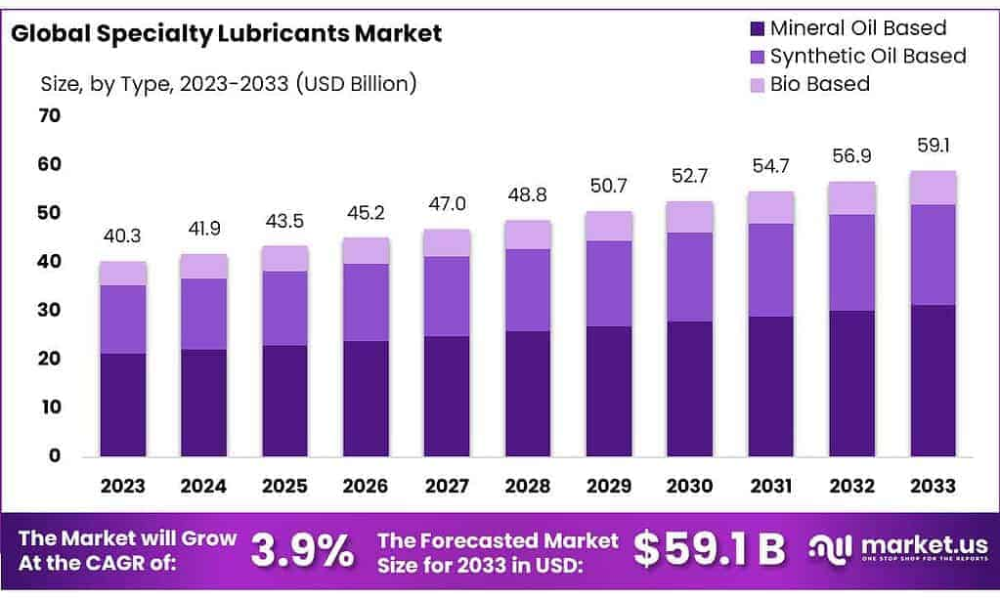
According to market.us, the global specialty lubricants market is projected to grow steadily, with its value expected to rise from USD 40.3 billion in 2023 to approximately USD 59.1 billion by 2033, reflecting a compound annual growth rate (CAGR) of 3.9% over the forecast period. Unlike standard lubricants, specialty lubricants are formulated for specific applications and demanding industrial environments. These products are engineered to provide superior performance, offering advantages such as high-temperature stability, enhanced load-bearing capacity, and material compatibility, which are essential across sectors like aerospace, food processing, automotive, manufacturing, and energy.
The market comprises a wide array of specialized products, including food-grade lubricants, high-performance aerospace lubricants, and industrial-grade formulations tailored to unique operational conditions. The growth of this segment is largely driven by increasing demand from end-use industries that require reliable and efficient lubrication under extreme or regulated conditions. Regulatory standards, especially in regions like the European Union, play a crucial role in shaping the market. For instance, the EU’s REACH regulation mandates safety assessments of chemical substances used in lubricants, pushing manufacturers to innovate and develop environmentally safe and compliant products.
Trade dynamics further underline the market’s momentum. In 2022, the United States reported lubricant exports worth approximately USD 2.5 billion, surpassing imports valued at around USD 1.8 billion, signaling strong global demand for high-performance and specialty lubricants market. In addition, government-led programs are reinforcing market development. The U.S. Department of Energy, for instance, is investing in lubricant efficiency initiatives, with projected R&D funding expected to reach USD 500 million by 2025. These investments are aimed at advancing the next generation of energy-efficient lubricants, thereby encouraging sustainable growth and innovation across the global specialty lubricants industry.
Download Exclusive Sample Of This Premium Report (Including Full TOC, Table & Figures): https://market.us/report/specialty-lubricants-market/free-sample/
Factors Affecting the Growth of the Specialty Lubricants Market
- Growing Demand for High-Performance Applications: Specialty lubricants market are essential in sectors requiring enhanced performance—such as automotive, aerospace, and heavy industrial machinery. These lubricants use advanced additives (e.g., anti-wear, friction reducers, and corrosion inhibitors) to extend equipment lifespan, improve fuel efficiency, and minimize downtime. The automotive sector, in particular, is fueling this demand as vehicles require oils that endure extreme conditions and contribute to mileage and emission targets.
- Emphasis on Energy Efficiency and Sustainability: With industries prioritizing energy conservation, specialty lubricants market play a key role by lowering friction losses. According to the U.S. Department of Energy, improved industrial lubrication can deliver 10–30% energy savings . Additionally, global sustainability initiatives like the EU Green Deal push manufacturers toward eco-friendly lubricants, supporting growth in bio-based and biodegradable formulations.
- Expansion of Renewable Energy Infrastructure: Rising renewable energy installations—especially in wind and solar—are generating demand for specialty lubricants designed for extreme conditions. As global renewable capacity surpassed 2,800 GW in 2021, lubricants capable of enduring wide temperatures and heavy loads became crucial for turbine longevity and operational fitness.
- Industrial Automation and Complex Machinery: Highly automated manufacturing environments rely on precision components—such as hydraulics, gears, and bearings—that require specialized lubrication to maintain uptime. The proliferation of robotics and automated systems increases reliance on lubricants engineered for corrosive resistance, high-temperature stability, and durability.
Report Segmentation
By Type: In 2023, mineral oil-based lubricants dominated the specialty lubricants market with a market share of over 53.4%. Their widespread use is attributed to their cost-effectiveness and broad availability, making them a practical choice for a wide range of industrial applications. These lubricants are especially preferred in sectors where performance requirements are moderate and cost management is a priority.
By Technology: Among all technologies, anti-wear additives held the leading market position in 2023 with a share of more than 27.8%. These additives play a key role in minimizing friction and mechanical wear, thereby extending the life of machinery and improving operational efficiency across various industries.
By Form: In 2023, oils were the most widely used form of specialty lubricants market, capturing more than 64.5% of the market share. Their versatility and effective performance in both industrial and automotive applications make them a go-to solution for a range of lubrication needs.
By Performance Characteristics: Low-friction lubricants led the market in 2023, accounting for more than 29.5% of total demand. These lubricants are crucial for reducing mechanical resistance, improving efficiency, and lowering energy consumption in engines and machines.
By End User: In 2023, the automotive sector dominated the specialty lubricants market, capturing more than 44.4% of the total share. Lubricants in this segment are essential for reducing friction, protecting engine components, and enhancing overall vehicle performance and efficiency.
To Purchase this Premium Report@ https://market.us/purchase-report/?report_id=129426
Market Key Segmentation List
By Type
- Mineral Oil Based
- Synthetic Oil Based
- Bio Based
By Technology
- Anti-Wear Additives
- Anti-Friction Additives
- Extreme Pressure Additives
- Anti-Oxidants
- Corrosion Inhibitors
- Detergents and Dispersants
By Form
- Oils
- Greases
- Pastes
- Sprays
By Performance Characteristics
- Low Friction
- High-Temperature Stability
- Corrosion Resistance
- Wear Resistance
- Water Resistance
- Biodegradability
By End User
- Automotive
- Cement
- Chemical
- Oil & Gas
- Others
Regional Analysis
The specialty lubricants market shows notable regional differences, with the Asia Pacific region leading globally by capturing approximately 37.8% of the total market share, which was valued at around USD 16.6 billion in 2023. This dominance is largely attributed to the region’s rapid industrial expansion, increasing automotive manufacturing, and rising need for high-performance lubricants across industries like construction and heavy machinery.
In contrast, North America accounted for nearly USD 10 billion of the market in the same year, driven by a well-established automotive sector and continuous innovation in lubricant technologies. The region is also witnessing growing demand for specialty lubricants that align with sustainability goals and energy-efficient operations, reflecting shifting consumer and industrial priorities.
Recent Developments
In 2023 Anderol Inc., the company reported a revenue increase of approximately 8%, driven by growing demand in industries such as food processing, pharmaceuticals, and manufacturing.
In 2023, BASF reported a revenue increase of approximately 6% in its lubricants segment, driven by strong demand from the automotive and industrial sectors.
Competitive Landscape
- Anderol Inc.
- BASF SE
- Castrol Limited
- Chevron Corporation Royal Dutch Shell
- CONDAT
- Dow
- Exxonmobil Corporation
- FUCHS LUBRITECH GmbH
- Gelest Inc.
- Gemtek Products
- Halocarbon Products Corporation
- Henkel AG & Company, KGaA Nye Lubricants, Inc.
- HUSK-ITT Corporation Sinopec Corporation
- Klüber Lubrication München SE And Co. KG
- LUBRILOG
- Matrix Specialty Lubricants BV
- Royal Dutch Shell PLC
- Solvay
- The Chemours Company
- Total S.A.
Get in Touch with Us
Market.us (Powered By Prudour Pvt. Ltd.)
Address: 420 Lexington Avenue, Suite 300 New York City, NY 10170, United States
Send Email: [email protected]



