
Market Overview
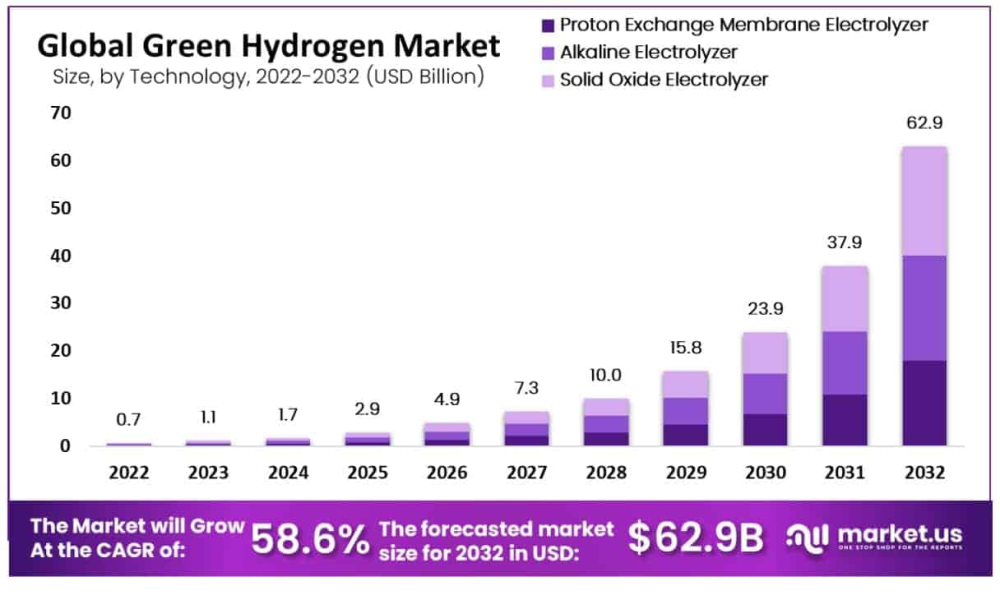
According to market.us, The global Green Hydrogen Market is projected to grow significantly, reaching approximately USD 62.9 billion by 2032, up from USD 0.7 billion in 2022, registering a robust compound annual growth rate (CAGR) of 58.6% during the forecast period from 2022 to 2032. Green hydrogen is produced through the electrolysis of water, using electricity derived from renewable sources such as wind and solar energy. This process emits no carbon dioxide, making it the most environmentally friendly form of hydrogen production.
The increasing generation capacity of renewable energy is expected to support the expansion of green hydrogen production in the coming years. The market is also being propelled by a growing number of government policies promoting the development of green hydrogen and clean energy alternatives.
Rising global demand for renewable energy sources, coupled with stringent environmental regulations and growing pressure to reduce the reliance on fossil fuels, is further fueling market growth. Additionally, strict government mandates aimed at cutting greenhouse gas (GHG) emissions from power generation facilities are accelerating the adoption of green hydrogen, reinforcing its critical role in achieving carbon neutrality and driving the market forward.
Download Exclusive Sample Of This Premium Report (Including Full TOC, Table & Figures): https://market.us/report/green-hydrogen-market/free-sample/
Factors Affecting the Growth of the Green Hydrogen Market
- Government Policies and Regulatory Support: One of the primary factors driving the green hydrogen market is the growing number of government initiatives promoting clean energy and low-carbon technologies. Many countries have introduced national hydrogen strategies, financial incentives, and regulatory frameworks aimed at accelerating the adoption of green hydrogen. These policies are designed to meet net-zero emissions targets and reduce dependency on fossil fuels.
- Increasing Renewable Energy Generation: The expansion of renewable energy capacity—especially wind and solar—is a crucial enabler for green hydrogen production. Electrolysis, the process used to produce green hydrogen, requires electricity from renewable sources. As global investments in renewable infrastructure grow, more low-carbon electricity becomes available to power electrolysis, supporting market growth.
- Rising Demand for Decarbonization: Industries and governments are under increasing pressure to reduce greenhouse gas (GHG) emissions, particularly in sectors that are hard to electrify, such as heavy industry, long-haul transport, and chemical production. Green hydrogen offers a viable solution for decarbonizing these sectors, thereby increasing its adoption as a clean energy carrier.
- Environmental Regulations: Stringent environmental regulations aimed at limiting carbon emissions from energy generation and industrial processes are accelerating the shift toward cleaner alternatives like green hydrogen. These include emission reduction mandates, carbon pricing mechanisms, and penalties for non-compliance, which collectively encourage investment in sustainable technologies.
- Technological Advancements and Cost Reductions: Improvements in electrolyzer efficiency, scalability, and cost are making green hydrogen more commercially viable. As technology matures and economies of scale are realized, the cost of producing green hydrogen is expected to decrease, making it more competitive with fossil fuel-based hydrogen.
Report Segmentation
By Technology Analysis: The alkaline electrolyzer segment holds the dominant position in the global green hydrogen market under the technology category and is expected to maintain the largest market share throughout the forecast period. This dominance is primarily attributed to the cost-effectiveness and wide availability of the electrolytes used in alkaline electrolysis. The technology’s reliability and scalability have made it the preferred choice for large-scale green hydrogen production. Alkaline electrolyzers utilize inexpensive electrolytes that exhibit low corrosive effects on electrodes, contributing to their long operational life and consistent performance. While solid oxide electrolyzers also use stable and interchangeable electrolytes with low corrosion, their segment is anticipated to grow steadily, supported by ongoing technological advancements. However, alkaline electrolysis remains the most widely adopted method due to its maturity, durability, and compatibility with renewable energy sources for hydrogen generation.
By Application Analysis: In terms of application, the transportation segment leads the global green hydrogen market and is projected to hold the largest share during the forecast period. Hydrogen is increasingly being used in internal combustion engines and fuel cell technologies to power vehicles. Hydrogen fuel cells are particularly favored due to their high energy efficiency, which is reported to be two to four times greater than that of traditional internal combustion engines. This enhanced efficiency is encouraging the adoption of hydrogen in the automotive, rail, and aviation sectors. Notably, Airbus has announced plans to introduce a hydrogen-powered aircraft by 2035, which is expected to further accelerate the growth of the transportation segment in the green hydrogen market.
By End-User Analysis: The petrochemical industry is the leading end-user segment in the global green hydrogen market and is projected to continue holding the largest market share over the forecast period. The demand for green hydrogen in this sector is rising due to its ability to replace conventional fossil fuels while producing zero tailpipe emissions—only water vapor is released during its use in hydrogen fuel cells. As environmental concerns intensify and emission regulations tighten, the petrochemical sector is increasingly turning to green hydrogen for sustainable operations. The rapid development of this industry, combined with the need for cleaner energy alternatives, positions green hydrogen as a critical input for reducing carbon emissions in petrochemical processes.
To Purchase this Premium Report@ https://market.us/purchase-report/?report_id=99200
Market Key Segmentation List
Based on Technology
- Proton Exchange Membrane Electrolyzer
- Alkaline Electrolyzer
- Solid Oxide Electrolyzer
Based on Application
- Power Generation
- Transport
- Others
Based on End-User
- Food & Beverages
- Medical
- Chemical
- Petrochemicals
- Glass
- Others
Regional Analysis
Europe currently leads the global green hydrogen market, holding the largest market share. This regional dominance is primarily driven by the presence of several key green hydrogen manufacturers, including major players such as Siemens Energy AG and Nel ASA, both headquartered in Europe. The continued expansion of green hydrogen production facilities across the region is expected to further accelerate market growth during the forecast period.
North America follows as the second-largest market, with a strong compound annual growth rate (CAGR) projected due to increasing investments and supportive government initiatives aimed at clean energy transition. The Asia Pacific region holds the third-largest share globally, supported by growing renewable energy infrastructure and emerging interest in hydrogen as a sustainable energy solution across countries like China, Japan, and India.
Competitive Landscape
- Green Hydrogen Systems
- Solena Group
- Air Products Inc.
- Siemens Energy
- Cummins Inc.
- FuelcellWorks
- Plug Power
- Fuelcell Energy
- Hydrogenics
- Ballard Power Systems
- Nikola Motors
- Linde Plc
- Plug Power Inc.
- Syzygy Plasmonics
- Other Key Players
Recent Developments
- In June 2022, Air Liquide S.A. and Siemens Energy entered into a strategic collaboration in Europe to develop renewable hydrogen production on an industrial scale. This partnership aims to accelerate the emergence of sustainable hydrogen energy across the region. The production is scheduled to commence by mid-2023, with a target output of approximately 3 gigatons per year by 2025.
- In April 2022, Lhyfe and WPD established a joint venture to develop one of the largest green hydrogen production facilities. The project will be based at the Soderhamn municipality site and supported by the Storgrundet offshore wind farm, marking a significant step toward scaling renewable hydrogen generation.
Get in Touch with Us
Market.us (Powered By Prudour Pvt. Ltd.)
Address: 420 Lexington Avenue, Suite 300 New York City, NY 10170, United States
Send Email: [email protected]



