
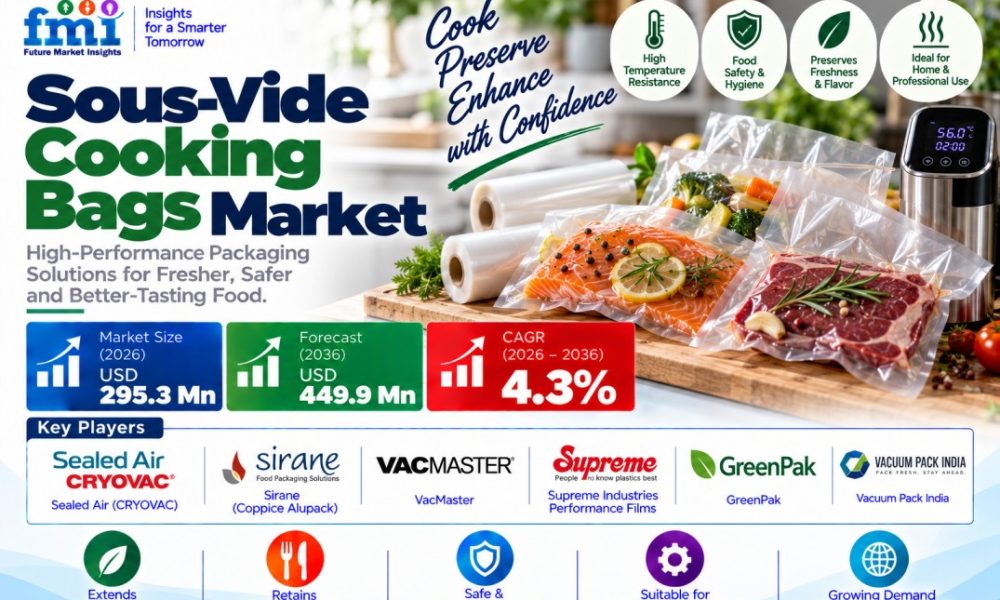
The global sous-vide cooking bags market is projected to grow from USD 295.3 million in 2026 to USD 449.9 million by 2036, registering a compound annual growth rate (CAGR) of 4.3%, according to Future Market Insights (FMI). Demand is supported by commercial kitchens that standardize portion sizes, vacuum sealing and thermal preparation across multiple locations.
Unlike equipment purchases, cooking bags are recurring consumables. Once a pouch specification is approved, each production cycle creates additional demand. Foodservice operators therefore evaluate suppliers on more than price and availability. Seal reliability, heat-use suitability, food-contact documentation and consistent replenishment all influence whether a trial progresses to repeat orders.
👉 Get Detailed Market Forecasts, Competitive Benchmarking, and Pricing Trends: https://www.futuremarketinsights.com/reports/sample/rep-gb-35109
Chamber Vacuum Bags Lead Product-Type Demand
Chamber vacuum bags are projected to account for 39.0% of product-type demand in 2026. These bags fit commercial kitchens and commissaries that use chamber vacuum machines for batch preparation. The format supports standardized workflows, while channel bags remain relevant for external suction machines. Roll stock offers sizing flexibility, and high-temperature retort-safe formats address more specialized thermal requirements.
By material, molded fiber and bagasse are forecast to represent 25.0% of demand in 2026 within FMI’s defined market scope, which includes eligible bag-format and bag-integrated cooking-pack solutions. Material selection remains application-specific: a lower-impact structure must still provide the necessary sealing, heat performance and product protection.
Standard meal formats are expected to account for 38.0% of format-size demand. Standardized portions help commercial kitchens link packaging consumption to menu planning, recipe weights and inventory forecasts.
QSR Chains Support Recurring Purchases
Quick-service restaurant (QSR) chains are projected to account for 33.0% of end-use demand in 2026. Centralized culinary teams can establish preparation methods and pouch specifications for use across multiple locations. This consistency helps operators manage portions and cooking processes while creating predictable packaging requirements.
Broadline foodservice distributors are forecast to represent 38.0% of sales-channel demand in 2026. These distributors can supply cooking bags alongside other kitchen consumables, allowing operators to consolidate purchasing and replenishment.
The United States provides an example of the scale behind commercial foodservice demand. The USDA Economic Research Service reported in June 2026 that US food-away-from-home spending reached USD 1.41 trillion in 2025, representing 56.3% of total food expenditure. This figure provides context for foodservice activity rather than a direct measure of sous-vide bag sales.
Qualification and Food Safety Shape Supplier Selection
Sous-vide packaging requires validation for the intended heating, sealing and storage conditions. Reduced-oxygen packaging also introduces food-safety considerations, particularly where cooked products are cooled or stored under controlled conditions.
The US Food and Drug Administration’s 2022 Food Code addresses controls for reduced-oxygen packaging and cook-chill or sous-vide processes. For suppliers, this makes clear intended-use guidance and suitable technical documentation important parts of the qualification process.
Nandini Roy Choudhury, Principal Consultant at Future Market Insights, says: “A sous-vide bag earns repeat business only after it survives the buyer’s real sealing, storage and cooking process. Material claims matter, but food-contact documentation, seal reliability and replenishment at the right size and gauge determine whether a trial becomes a contract.”
These requirements can lengthen supplier approval, but they also create an opportunity for manufacturers that can demonstrate performance under actual operating conditions. Documentation should cover the intended application, relevant temperature limits and food-contact suitability, supported by appropriate testing.
Material Development Creates New Opportunities
Lower-impact packaging structures offer a development opportunity when they maintain the performance required for cooking applications. However, recyclability or reduced-plastic claims alone are not enough to qualify a sous-vide pouch.
FMI notes that Berry Global reported positive converting trials and strong sealing performance for its Entour mono-material polyethylene laminates in January 2025. The films were positioned for bags and pouches across food and other applications. Their suitability for any particular sous-vide use would still require appropriate heat-use and food-contact validation.
For packaging manufacturers, the commercial challenge is to balance material objectives with seal integrity, barrier requirements and process reliability. For foodservice buyers, early testing can help identify limitations before a supplier change affects production.
👉 Access the Complete Report in PDF Format: https://www.futuremarketinsights.com/reports/brochure/rep-gb-35109
Country Growth Outlook
FMI projects the following country-level CAGRs for 2026 to 2036:
- United Kingdom: 5.6%
- France: 5.3%
- United States: 5.0%
- Germany: 4.7%
- Japan: 4.4%
The United Kingdom has the highest projected growth rate among these profiled countries, followed by France and the United States. These rates indicate forecast growth pace, not absolute market size. Local food-safety procedures, food-contact requirements, distributor coverage and procurement practices will continue to shape market entry.
Competitive Landscape
Companies identified in the report include Sealed Air (CRYOVAC), Sirane (Coppice Alupack), VacMaster, Supreme Industries Performance Films, GreenPak and Vacuum Pack India. Their offerings span cook-in packaging, professional vacuum formats and specialist pouch manufacturing.
Competition will depend on application suitability, technical support, consistent product specifications and reliable supply. Suppliers that can support qualification and replenishment across the customer’s operating network may be better positioned to secure repeat business.
Outlook
The sous-vide cooking bags market is forecast to expand as commercial kitchens continue to use standardized preparation workflows. The opportunity is not simply to supply more pouches, but to provide packaging that meets defined cooking, sealing, food-contact and replenishment requirements.
To explore how FMI Custom Research can support your strategic priorities, connect with our team at – [email protected]
About Future Market Insights (FMI)
Future Market Insights, Inc. is an ESOMAR-certified, ISO 9001:2015 market research and consulting organization trusted by Fortune 500 companies. With a global presence across the U.S., UK, India, and Dubai, FMI delivers data-driven insights across 30+ industries and 1200 markets worldwide.



