
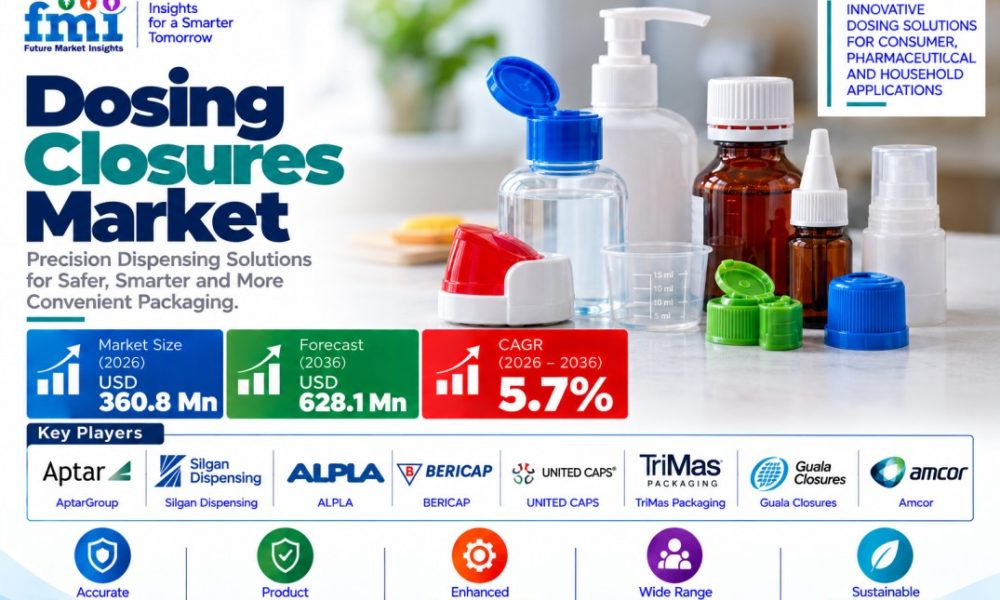
The global dosing closures market is projected to reach USD 628.1 million by 2036, rising from USD 360.8 million in 2026 at a 5.7% CAGR, according to Future Market Insights.
Dosing closures are gaining importance as food, personal-care, household and pharmaceutical brands require more control over product flow, package integrity and repeated dispensing. These components must deliver consistent performance while remaining compatible with established bottles and filling lines.
The commercial challenge is balancing functional performance with qualification costs. A change in closure geometry or material can affect torque, sealing pressure, line speed, child resistance and recyclability documentation. As a result, manufacturers increasingly need to validate the closure as part of the complete package rather than as an isolated component.
👉 Get Detailed Market Forecasts, Competitive Benchmarking, and Pricing Trends: https://www.futuremarketinsights.com/reports/sample/rep-gb-35048
Screw Closures Lead Product Demand
Screw closures are projected to account for 37.0% of product-type demand in 2026.
Their familiar thread geometry and broad compatibility with existing bottle designs make them practical for manufacturers seeking to introduce dispensing or safety features without replacing the entire container platform.
Standardized interfaces can also simplify production planning. Packaging engineers can retain established bottle dimensions while assessing changes to liners, tamper-evident bands or controlled-flow components.
ALPLA completed its acquisition of Energoplast closure production in Serbia in November 2025, extending its regional manufacturing base for caps and closures. The development highlights the importance of production capacity and supply continuity for established closure programs.
The 24–28 mm Neck Finish Leads
The 24–28 mm neck-finish category is expected to hold 38.0% share in 2026.
This range accommodates common bottle formats while leaving space for threads, tamper-evident features and dispensing mechanisms. It is relevant to personal-care, household and selected healthcare applications where manufacturers want functional upgrades without introducing a completely new bottle interface.
In April 2026, Aptar Closures introduced Cleo and Airy dispensing closures compatible with 28-400 and 28-410 finishes, respectively. The launch illustrates how dispensing features can be developed around established neck dimensions.
For brand owners, maintaining a familiar finish can reduce engineering changes, although every revised closure still requires appropriate line and package testing.
Polypropylene Remains the Leading Material
Polypropylene (PP) is projected to represent 38.0% of material demand in 2026.
PP supports the stiffness, mouldability and hinge behavior required across multiple closure designs. Its established injection-moulding processes also make it suitable for high-volume production with tight dimensional tolerances.
Material simplification is creating another opportunity. In May 2026, UNITED CAPS introduced its mono-material 26/22 S-SPRING sports cap, designed to combine user functionality with a simpler material structure.
However, moving to a mono-material design requires more than reducing the number of resins. The redesigned closure must retain the required seal, flow control, torque and handling characteristics.
Food and Beverage Is the Leading End Use
Food and beverage applications are forecast to account for 31.0% of end-use demand in 2026.
Sauces, oils and drinks depend on closures that control dispensing, limit leakage and remain usable after repeated opening and closing. Poor flow control can result in product waste, while inconsistent sealing can compromise package integrity during transport.
At the same time, pharmaceutical and household-chemical applications place additional emphasis on safety. In April 2026, the US Consumer Product Safety Commission recalled approximately 356,140 iron-supplement packages because they did not meet child-resistant packaging requirements.
This illustrates why closure performance can be a safety requirement rather than simply a convenience feature.
Qualification Costs Shape Purchasing Decisions
A new closure may appear commercially attractive because of lower material use, improved dispensing or a simpler recycling profile. Yet changes to the closure can trigger additional torque, seal, line-speed and package-safety testing.
Nandini Roy Choudhury, Principal Consultant at Future Market Insights, explains:
“Dosing closures earn margin during qualification because brands pay for repeatable output and line stability more readily than added mechanical complexity. Strong offers remove a test, tooling change or material conflict without changing the requested dosing behavior.”
This puts qualification efficiency at the center of supplier selection. Closure manufacturers that can provide reliable technical data, compatible neck finishes and consistent production tolerances can help customers reduce conversion risk.
👉 Access the Complete Report in PDF Format: https://www.futuremarketinsights.com/reports/brochure/rep-gb-35048
Regional Growth Outlook
The UAE is projected to record the fastest growth among the profiled countries, at 7.1% CAGR, followed by Saudi Arabia at 6.8%, South Korea at 6.5%, the USA at 6.2%, the UK at 5.9%, Germany at 5.6%, France at 5.3%, and Japan at 4.9% through 2036.
Regional conditions vary. Pharmaceutical manufacturing localization in the UAE and Saudi Arabia is creating opportunities for qualified local supply. South Korea is increasing attention to resin selection and circularity, while US safety applications require documented child-resistant performance.
In the UK and Germany, recyclability reporting and recovery compatibility influence redesign decisions. France continues to prioritize plastic reduction, while Japanese packaging programs place importance on precision manufacturing and established collection systems.
Competitive Landscape
Key companies profiled by Future Market Insights include AptarGroup, Silgan Dispensing, ALPLA, BERICAP, UNITED CAPS, TriMas Packaging, Guala Closures, and Amcor.
Competition spans engineered dispensing specialists, high-volume closure manufacturers and broader packaging groups. AptarGroup, Silgan Dispensing and TriMas Packaging emphasize dosing control and application engineering. ALPLA, BERICAP and UNITED CAPS bring manufacturing scale and standard neck-finish coverage, while Guala Closures and Amcor extend into safety-oriented and broader dispensing platforms.
Recent developments include Amcor’s April 2025 combination with Berry Global, Silgan Dispensing’s June 2025 partnership with Avantade for fragrance sampling, and Guala Closures’ October 2025 agreement to acquire KWK and expand into pharmaceutical closures and oral-dosing devices.
As packaging requirements become more specific, the commercial opportunity will depend on repeatable dispensing, package safety, line compatibility and material efficiency. Suppliers that can meet these requirements without creating unnecessary requalification work are better positioned to win recurring programs.
To explore how FMI Custom Research can support your strategic priorities, connect with our team at – [email protected]
About Future Market Insights (FMI)
Future Market Insights, Inc. is an ESOMAR-certified, ISO 9001:2015 market research and consulting organization trusted by Fortune 500 companies. With a global presence across the U.S., UK, India, and Dubai, FMI delivers data-driven insights across 30+ industries and 1200 markets worldwide.



