
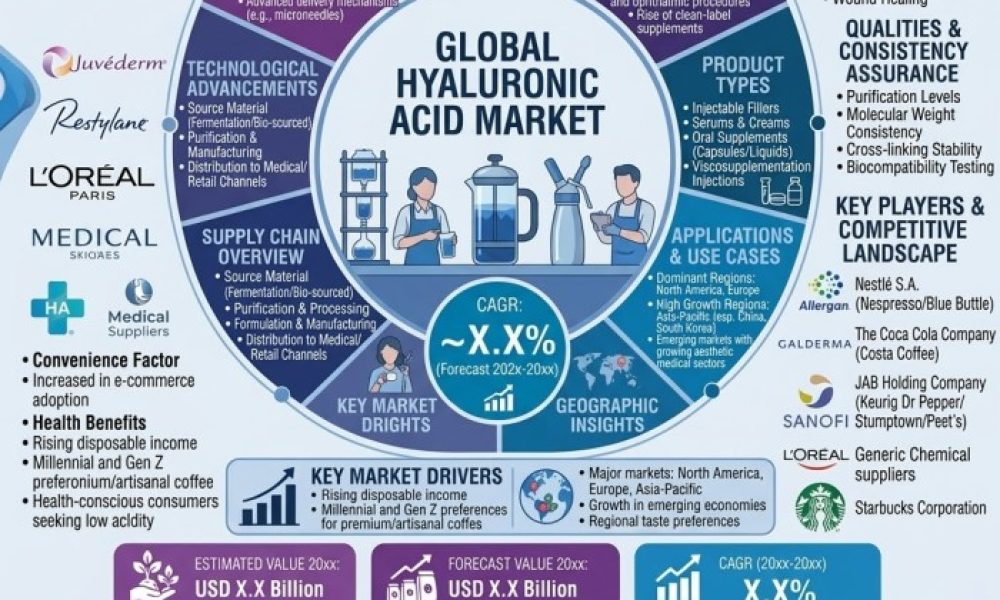
Demand for injectable aesthetic treatments, orthopedic viscosupplementation and fermentation-based production is shaping the next phase of market growth, according to Fact.MR.
NEWARK, Del., October 9, 2026. The global hyaluronic acid market is projected to increase from USD 14.9 billion in 2026 to USD 31.8 billion by 2036, expanding at a compound annual growth rate (CAGR) of 7.9%, according to Fact.MR. The market is expected to generate an incremental opportunity of USD 16.9 billion over the 2026–2036 forecast period.
Demand is supported by the use of hyaluronic acid in dermal fillers, orthopedic viscosupplementation, ophthalmic applications and pharmaceutical formulations. Manufacturers are also shifting toward microbial fermentation-based production, which supports consistent purity and expands opportunities across pharmaceutical and cosmetic applications.
The report identifies regulatory scrutiny, post-market surveillance requirements and pricing pressure from lower-cost Asian producers as key challenges. Companies must balance product quality, compliance costs and competitive pricing as demand develops across established and emerging markets.
Get detailed market forecasts, competitive benchmarking, and pricing trends:
Where growth is fastest
Asia offers the strongest country-level growth rates among the markets listed in the Fact.MR report. India leads, followed by China and Japan.
- India — CAGR 6.7%: Expanding private dermatology networks, medical tourism for aesthetic procedures and domestic microbial fermentation capacity support demand.
- China — CAGR 6.5%: Domestic production capacity, hospital procurement and consumer demand for aesthetic and nutraceutical products contribute to market expansion.
- Japan — CAGR 6.0%: An aging population, osteoarthritis-related demand and established domestic producers support continued use in orthopedic applications.
- United States — CAGR 5.8%: Dermal filler procedures, established distribution networks and demand for orthopedic viscosupplementation underpin market development.
The published country-growth table does not provide a CAGR for a European country. Germany and the United Kingdom are discussed in the report’s regional outlook, but their country-level growth rates are not listed in the supplied country table.
What leads the market
Pharmaceutical-grade products and orthopedic applications account for the largest shares in their respective segments, according to Fact.MR’s 2026 estimates.
- Pharmaceutical-grade hyaluronic acid — 69.3%: This product segment leads the market, supported by demand across injectable formulations and established medical applications.
- Orthopedic applications — 58.6%: This application segment holds the largest share, reflecting demand for viscosupplementation products used in orthopedic care.
- Pharmaceutical companies — 63.9%: The end-use segment accounts for the largest share, reflecting the concentration of demand among pharmaceutical manufacturers.
These segment shares refer to different classification categories and should not be added together.
The hurdle
Regulatory compliance and pricing pressure remain important constraints. Manufacturers face scrutiny over adverse events associated with dermal fillers and requirements for post-market surveillance, increasing the cost of maintaining compliant products.
Competition from lower-cost Asian fermentation-based suppliers can also compress margins, particularly in cosmetic and nutraceutical applications. For buyers, evaluating suppliers solely on unit price may overlook differences in quality documentation, product consistency and regulatory support.
Recent developments and industry participants
The Fact.MR report describes three industry developments from 2025. However, it does not provide exact months or specific announcement dates for these items.
- Allergan (AbbVie) — Juvederm portfolio expansion (2025): The report describes continued expansion of the Juvederm injectable dermal filler portfolio.
- Sanofi — Viscosupplementation portfolio maintenance (2025): The report identifies continued support for its viscosupplementation product portfolio for osteoarthritis management.
- Bloomage BioTechnology — Microbial fermentation capacity expansion (2025): The report describes efforts to expand production capacity to serve pharmaceutical and cosmetic demand.
These summaries reflect the report’s descriptions and should be independently verified against company announcements before publication.
Key companies profiled in the report include Allergan Plc, Sanofi, Seikagaku Corporation, Zimmer Biomet and LG Chem. The report also identifies Bloomage BioTechnology and Shanghai Haohai in its discussion of China’s domestic supply market.
Analyst perspective
Shambhu Nath Jha, Principal Consultant at Fact.MR, said:
“The hyaluronic acid landscape is shifting from volume-driven procurement toward value-based purchasing, where institutions evaluate total cost of ownership, clinical integration capability, and service network coverage alongside unit pricing. Companies that combine reliable product performance with digital connectivity and responsive after-sales support are positioned to capture a larger share of institutional budgets. The most commercially significant growth pockets over the forecast period are concentrated in markets where healthcare infrastructure investment is creating new facility demand alongside replacement cycles in established networks.”
What this means for manufacturers, procurement teams and investors
- Prioritize product quality alongside price. Buyers should compare product specifications, quality documentation, regulatory requirements and supplier consistency before selecting a hyaluronic acid supplier. Price competition is a reported market constraint, but procurement decisions should also consider the cost of compliance and supplier reliability.
- Assess opportunities by application. Pharmaceutical-grade products and orthopedic applications hold the largest reported segment shares. Manufacturers and investors can use these figures to identify established demand categories while evaluating growth opportunities in dermatology, ophthalmology and regenerative medicine.
- Evaluate regional expansion against local demand. India and China have the highest country CAGRs listed in the report. Companies considering expansion should assess local manufacturing capabilities, distribution access, regulatory requirements and customer demand before committing additional capacity.
Report details
Fact.MR’s Hyaluronic Acid Market report covers market size and forecasts from 2026 to 2036, product and application segmentation, country-level growth, competitive positioning, market drivers, restraints and opportunities.
Explore More Related Studies Published by Fact.MR Research
General Surgical Devices Market
Radiation Proctitis Treatment Market
About Fact.MR
Fact.MR is a market research and consulting firm providing syndicated research, customized research, investment research, and market intelligence across a broad range of industries. Its research coverage includes food and beverage, healthcare, pharmaceuticals, biotechnology, consumer products, chemicals and materials, technology, industrial goods, and packaging.
Fact.MR provides market intelligence designed to help organizations understand market dynamics, emerging opportunities, competitive developments, and changing industry requirements.
Media Contact
Fact.MR
Email: [email protected]
Phone: +1 (628) 251-1583
Website: www.factmr.com



