
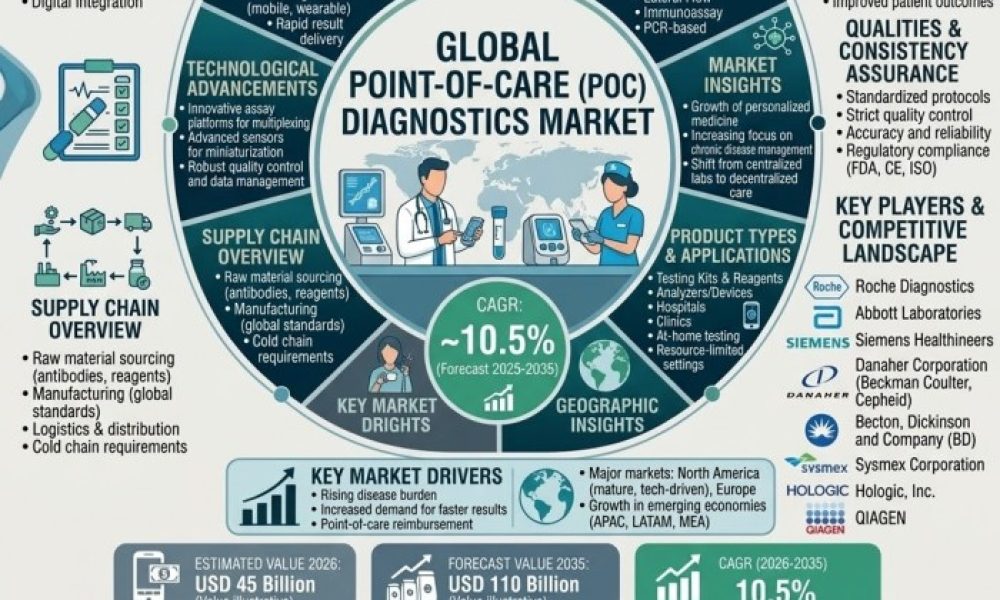
Growing demand for decentralized testing, connected diagnostic platforms and institutional healthcare procurement is reshaping purchasing priorities, according to Fact.MR.
NEWARK, Del., October 9, 2026. The global point of care diagnostics market is projected to increase from USD 47.8 billion in 2026 to USD 94.1 billion by 2036, expanding at a compound annual growth rate (CAGR) of 7.0%, according to Fact.MR. The market is expected to generate an incremental opportunity of USD 46.3 billion over the forecast period as healthcare providers invest in diagnostic systems for hospitals, clinics and decentralized care settings.
Demand is supported by expanding healthcare infrastructure, rising institutional procurement and the adoption of portable testing technologies. Glucose monitoring systems account for 64.8% of the product segment in 2026, while acute care diagnostics represents 58.3% of the application segment. Hospitals and clinics account for 69.2% of end-use demand, highlighting the importance of institutional purchasing decisions.
Get detailed market forecasts, competitive benchmarking, and pricing trends:
What is driving demand now?
Healthcare providers are seeking diagnostic platforms that fit into existing clinical workflows while supporting testing outside centralized laboratories. Fact.MR identifies approvals for molecular respiratory and infectious disease panels under the Clinical Laboratory Improvement Amendments (CLIA) waiver framework as one factor enabling adoption in urgent care clinics, retail pharmacies and primary care practices.
Reimbursement developments are also influencing purchasing decisions. Expanded reimbursement opportunities for remote physiological monitoring, including new Current Procedural Terminology (CPT) codes covering connected diagnostic devices, are supporting additional use cases. Meanwhile, government procurement programs in emerging markets are creating demand for rapid infectious disease and malaria testing.
Technology developments are widening the range of tests that can be performed using portable systems. Advances in biosensors, microfluidics and molecular amplification are enabling platforms designed to process multiple analytes in decentralized settings.
Where growth is fastest
Fact.MR identifies five country markets with forecast growth rates ranging from 7.3% to 7.8% through 2036.
- India — 7.8% CAGR: Expansion of Ayushman Bharat and National Health Mission procurement is supporting demand for glucose monitoring, infectious disease testing and cardiac marker systems at primary health centres. Gaps in tier-2 and tier-3 healthcare infrastructure also create demand for portable systems.
- China — 7.6% CAGR: Hospital modernization budgets, provincial procurement tenders and domestic biosensor manufacturing are supporting demand for diagnostic platforms.
- South Korea — 7.5% CAGR: Reimbursement coverage through the Health Insurance Review and Assessment Service (HIRA), alongside advanced hospital IT infrastructure, supports adoption of connected diagnostic systems.
- Germany — 7.4% CAGR: European In Vitro Diagnostic Regulation (IVDR) compliance requirements and decentralized primary care models are influencing institutional purchasing specifications.
- United States — 7.3% CAGR: Medicare reimbursement developments, CLIA-waived molecular testing and the expansion of retail health clinics are supporting demand across clinical and outpatient settings.
What leads the market?
Established glucose testing and acute care workflows account for the largest reported segment shares.
- Glucose Monitoring Systems: 64.8% of product segment share in 2026.
- Acute Care Diagnostics: 58.3% of application segment share in 2026.
- Hospitals and Clinics: 69.2% of end-use segment share in 2026.
These figures indicate that procurement strategies should account for established testing requirements alongside emerging applications. Hospitals and clinics remain a central customer group, while connected and portable platforms offer opportunities to serve additional care settings.
The hurdle: Reimbursement and quality assurance
Commercial adoption depends on more than device availability. Fact.MR identifies reimbursement uncertainty for newer point-of-care analytes as a constraint in markets where payer coverage influences purchasing decisions. Without predictable reimbursement, providers may hesitate to introduce tests that increase operating costs without a clear funding pathway.
Quality assurance presents another challenge. User errors and variability in results can limit regulatory acceptance for certain clinical applications. Manufacturers and healthcare providers must therefore consider training, quality-control procedures and the requirements applicable to each testing environment when evaluating decentralized diagnostic systems.
Industry investment and competitive outlook
Opportunities are emerging in consumer glucose monitoring, multi-analyte testing and preparedness-related procurement. Fact.MR identifies over-the-counter continuous glucose monitoring approvals, including Dexcom Stelo, as opening a consumer testing channel beyond prescription-based devices. Cartridge platforms that combine respiratory, cardiac and metabolic panels may also increase the range of tests performed during a single testing event.
Government-funded diagnostic stockpiling programs for pandemic preparedness represent another potential source of bulk demand for rapid antigen and molecular testing platforms.
Key companies profiled in the Fact.MR report include:
- Abbott Laboratories
- Hoffmann-La Roche Ltd.
- Siemens Healthineers (Siemens AG)
- Danaher Corporation, including Beckman Coulter, Cepheid and Radiometer
- Thermo Fisher Scientific Inc.
- BD (Becton, Dickinson and Company)
- bioMérieux SA
- QuidelOrtho
- Johnson & Johnson Services Inc.
- Nova Biomedical
These companies operate across diagnostic systems and related technologies. The report identifies their competitive positions within a market shaped by institutional procurement, product performance, regulatory requirements and service coverage.
Analyst perspective
Shambhu Nath Jha, Principal Consultant at Fact.MR, said:
“The point of care diagnostics landscape is shifting from volume-driven procurement toward value-based purchasing, where institutions evaluate total cost of ownership, clinical integration capability, and service network coverage alongside unit pricing. Companies that combine reliable product performance with digital connectivity and responsive after-sales support are positioned to capture a larger share of institutional budgets. The most commercially significant growth pockets over the forecast period are concentrated in markets where healthcare infrastructure investment is creating new facility demand alongside replacement cycles in established networks.”
What this means for healthcare procurement teams and diagnostic manufacturers
- Evaluate total cost of ownership. Compare purchase prices alongside consumables, maintenance, training, connectivity and after-sales support. A lower upfront cost may not represent the lowest operating cost over the equipment’s useful life.
- Assess reimbursement before expanding test menus. For newer analytes and connected diagnostic applications, verify applicable payer coverage and reimbursement requirements before committing to large-scale procurement.
- Match platforms to the testing environment. Hospitals, primary health centres and ambulatory clinics have different workflow and infrastructure needs. Evaluate quality-control requirements, staff training and connectivity before selecting systems for decentralized use
Report coverage
Fact.MR’s Point of Care Diagnostics Market report examines global market size, forecasts through 2036, country-level growth, segment shares, demand drivers, adoption barriers and the competitive landscape.
Explore More Related Studies Published by Fact.MR Research
General Surgical Devices Market
Critical Care Diagnostics Market
About Fact.MR
Fact.MR is a market research and consulting firm providing syndicated research, customized research, investment research, and market intelligence across a broad range of industries. Its research coverage includes food and beverage, healthcare, pharmaceuticals, biotechnology, consumer products, chemicals and materials, technology, industrial goods, and packaging.
Fact.MR provides market intelligence designed to help organizations understand market dynamics, emerging opportunities, competitive developments, and changing industry requirements.
Media Contact
Fact.MR
Email: [email protected]
Phone: +1 (628) 251-1583
Website: www.factmr.com



