
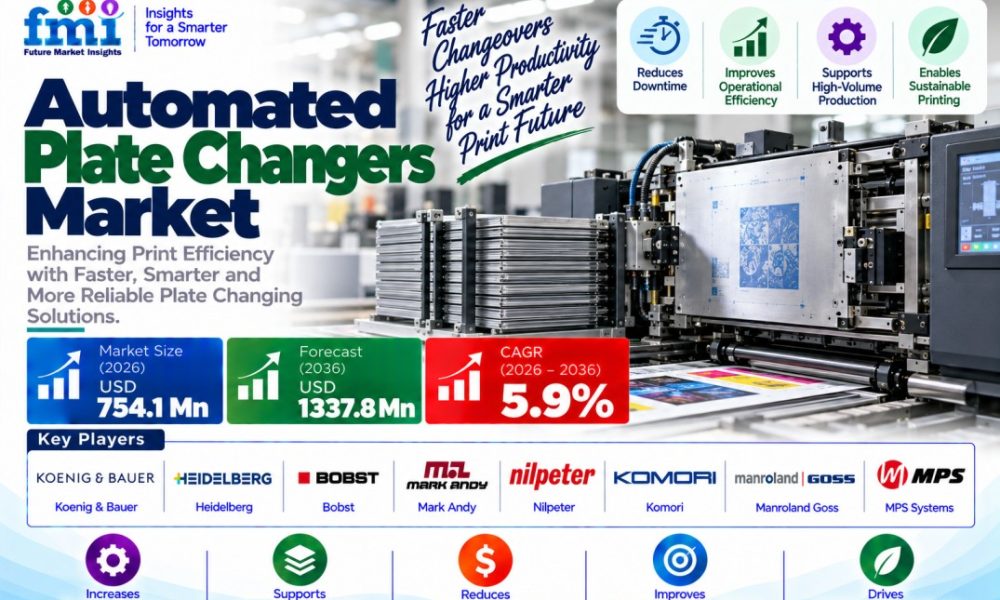
The global automated plate changers market is projected to grow from USD 754.1 million in 2026 to USD 1,337.8 million by 2036, registering a compound annual growth rate (CAGR) of 5.9%, according to Future Market Insights (FMI). Demand is being supported by commercial printers and packaging converters seeking to recover productive press time as shorter campaigns and frequent artwork changes increase the number of setup operations per shift.
Automated plate changers help reduce manual handling during plate exchange and integrate plate loading into the press setup sequence. The business case depends on how frequently a press changes jobs, how much time automation saves, and whether the equipment can integrate with existing press controls.
For converters running multiple short jobs, even small reductions in changeover time can accumulate across a production shift. However, older equipment, installation downtime and limited job-change frequency can weaken the return on investment.
>> Access detailed market insights: https://www.futuremarketinsights.com/reports/brochure/rep-gb-35092
Fully Automatic Systems Gain Ground
Fully automatic plate changers are projected to account for 32.0% of system-type demand in 2026. These systems reduce operator involvement during plate transfer and loading, making them relevant to production environments where repeatable setup and reduced manual handling are priorities.
By press type, flexographic presses are expected to hold a 35.0% share in 2026. Flexographic packaging production often involves multiple plates or sleeves for each job, creating repeated setup requirements before printing begins. Automating plate handling can help converters reduce non-printing time while maintaining registration and setup consistency.
Narrow-web systems are forecast to account for 28.0% of demand by format. Label printers often manage numerous artwork versions and shorter production campaigns, increasing the frequency of changeovers. In such environments, automation can help recover capacity without requiring longer production runs.
Packaging printing is projected to lead end-use demand with a 37.0% share in 2026. Folding cartons, labels and corrugated packaging often require multiple colors and frequent design changes, making makeready time an important part of production planning.
Changeover Frequency Determines the Business Case
Automation does not generate the same savings at every printing facility. Plants with frequent job changes can recover more productive time than facilities running long, stable campaigns. The economics also depend on press age, installation requirements, compatibility with existing controls and the availability of technical service.
Nandini Roy Choudhury, Principal Consultant at Future Market Insights, explains: “Automatic plate changing pays back on presses where repeated job changes turn makeready into measurable lost production time. The strongest purchase case measures plate exchange beside washing and presetting, then tests whether controls compatibility and local service can preserve those savings through the press’s remaining life.”
This highlights the importance of evaluating plate exchange alongside other setup tasks. If plate loading is automated but washing, presetting or registration still causes delays, the overall improvement may be smaller than expected.
For procurement teams, a practical assessment should measure the current changeover cycle, estimate the time that can realistically be recovered and include commissioning costs, planned downtime and service requirements.
Industry Developments Support Integrated Automation
Recent press installations illustrate how plate handling is becoming part of wider makeready automation.
In December 2025, Nilpeter reported that Reflex Group had invested in four new FA-22 flexographic presses for installations in the United Kingdom and United States. In October 2025, Koenig & Bauer documented a Rapida 106 X workflow combining simultaneous plate changes with automated plate logistics. In March 2025, HEIDELBERG reported that All Color Printers had installed a Speedmaster XL 106 with AutoPlate Pro for folding-carton production.
These developments demonstrate continued investment in equipment and workflows designed to reduce setup effort. The value of each installation depends on the production mix, the degree of automation and the operating conditions of the plant.
Canada and Mexico Lead the Country Growth Forecast
FMI projects Canada to record a 6.5% CAGR from 2026 to 2036, followed by Mexico at 6.1% and the United States at 5.8%. Italy is forecast to grow at 5.5%, Germany at 5.1%, France at 4.8% and Japan at 4.5%.
These growth rates reflect differences in packaging production, installed press fleets, investment cycles and service requirements. Canada’s projected growth points to opportunities where repeated carton and commercial-print jobs make shorter makeready valuable. Mexico’s export-oriented production base creates a need for dependable equipment performance and service coverage. In the United States, a varied installed base means suppliers must address both new equipment purchases and retrofits.
For European and Japanese printers, equipment longevity and integration with existing controls can influence investment timing. Suppliers that provide modular upgrades, lifecycle support and dependable commissioning may be better positioned to serve plants that cannot justify full press replacement.
>> Get Detailed Market Forecasts, Competitive Benchmarking, and Pricing Trends:https://www.futuremarketinsights.com/reports/sample/rep-gb-35092
Competitive Landscape
Companies profiled in the automated plate changers market include Koenig & Bauer, HEIDELBERG, BOBST, Mark Andy, Nilpeter, Komori, Manroland Goss and MPS Systems.
Competition spans press manufacturers with integrated plate logistics and flexographic specialists focused on setup automation. Differentiation depends on the ability to integrate plate handling with press controls, coordinate makeready tasks and provide technical support throughout installation and operation.
Outlook
The automated plate changers market is positioned for growth as printers seek to improve capacity from existing equipment and manage increasingly fragmented job schedules. Yet automation decisions remain plant-specific.
The strongest investment cases will connect measured changeover savings with realistic commissioning costs, controls compatibility and the remaining life of the press. As printers pursue higher utilization, automation that fits their actual production workflow is likely to remain a central purchasing consideration.
To explore how FMI Custom Research can support your strategic priorities, connect with our team at – [email protected]
About Future Market Insights (FMI)
Future Market Insights, Inc. is an ESOMAR-certified, ISO 9001:2015 market research and consulting organization trusted by Fortune 500 companies. With a global presence across the U.S., UK, India, and Dubai, FMI delivers data-driven insights across 30+ industries and 1200 markets worldwide.



