
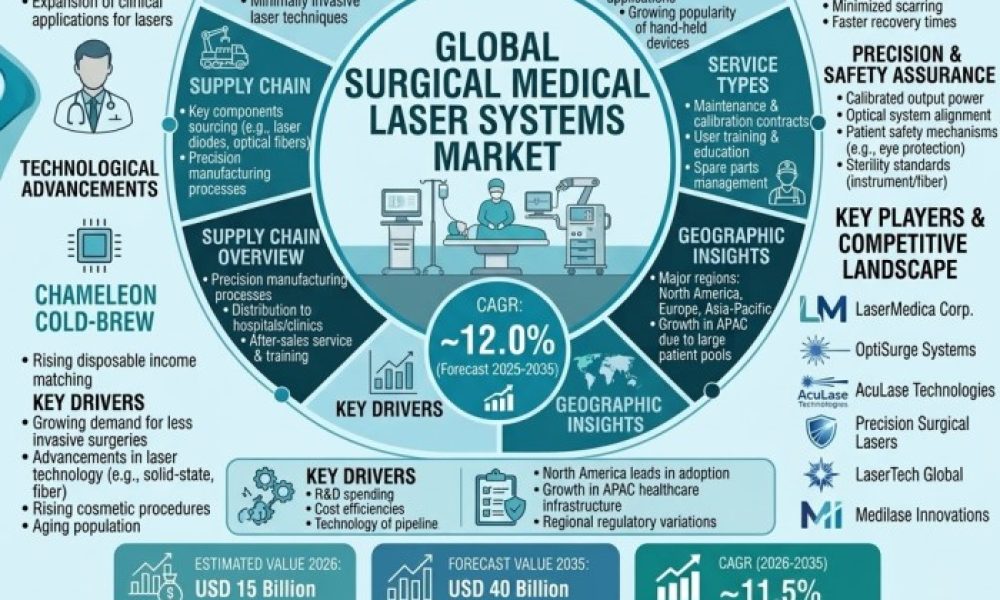
Growing demand for minimally invasive procedures, investments in healthcare infrastructure and advances in laser technology are reshaping equipment procurement priorities, according to Fact.MR.
NEWARK, Del., October 9, 2026. The global surgical medical laser systems market is projected to grow from USD 4.5 billion in 2026 to USD 10.9 billion by 2036, expanding at a compound annual growth rate (CAGR) of 9.2%, according to Fact.MR. The market is expected to create an incremental opportunity of USD 6.4 billion over the forecast period, as hospitals and specialist healthcare facilities invest in surgical equipment for a wider range of clinical applications.
Demand is supported by the growing use of laser-based procedures in general surgery, ophthalmology, dermatology and other specialties. Advances in solid-state, diode and fiber-coupled laser architectures are also expanding the range of system configurations available to healthcare providers. Meanwhile, ambulatory surgical centers and single-specialty clinics are creating additional demand for compact equipment suited to outpatient procedures.
Get detailed market forecasts, competitive benchmarking, and pricing trends:
Where growth is fastest
Asia is expected to account for the fastest-growing national markets, while Germany represents the European opportunity among the countries highlighted in Fact.MR’s forecast.
- India – CAGR 10.4%: Medical-device production incentives under the Production Linked Incentive (PLI) scheme, private hospital investment and expansion of urban tertiary-care facilities are supporting demand.
- China – CAGR 9.8%: Hospital equipment modernization, domestic laser manufacturing capacity and demand for aesthetic and vision-correction procedures are contributing to market growth.
- South Korea – CAGR 9.4%: The country is projected to expand faster than the global market, although the report summary does not provide a separate country-specific explanation for its growth rate.
- Germany – CAGR 8.9%: Hospital modernization and European compliance requirements support demand, according to the report’s regional analysis.
- Australia and New Zealand (ANZ) – CAGR 8.7%: The combined market is projected to grow steadily, although the summary does not specify a separate growth driver for this grouping.
What leads the market
Established product categories and hospital procurement continue to shape demand. Fact.MR identifies the following leading segments for 2026:
- CO2 laser systems – 47.9% share: These systems lead the product segment, supported by established clinical use and institutional procurement.
- General surgery applications – 58.3% share: General surgery represents the largest application segment, reflecting demand across institutional and acute-care settings.
- Hospitals – 69.7% share: Hospitals account for the largest end-use share, highlighting the importance of institutional purchasing decisions in the market.
These shares indicate that purchasing strategies centered on established clinical applications and hospital requirements remain commercially significant. Manufacturers seeking additional demand will also need to account for specialist clinics and ambulatory surgical centers, where compact and cost-efficient platforms may be more suitable.
The hurdle: High upfront equipment costs
Capital expenditure remains a significant barrier to adoption. Advanced laser consoles can require substantial upfront investment, particularly for public hospitals and healthcare facilities operating under tight budgets. Specialist training requirements and learning curves can further delay implementation where established laser surgery programs are absent.
Reimbursement limitations for elective and aesthetic laser procedures in several European and Asian markets also restrict the commercially viable range of applications. For buyers, evaluating the purchase price alongside staff training, servicing, consumables and expected utilization can provide a more complete view of total ownership costs.
Recent developments
Product launches and acquisition activity illustrate how companies are expanding their capabilities across ophthalmic surgery and aesthetic applications.
- March 2025 – Alcon and Lensar: Alcon signed a definitive agreement to acquire Lensar, strengthening its femtosecond laser capabilities and ophthalmic surgery equipment portfolio.
- April 2025 – Acclaro Medical: The company launched the AuraLux cold-fiber laser system for skin-health and anti-aging treatments.
- May 2025 – Alcon: The company launched the Unity VCS ophthalmic surgical platform globally, combining vitreoretinal and cataract capabilities. The report identifies availability across the United States, Europe, Japan, Australia, India and Canada.
Fact.MR profiles Lumenis, Alcon, Bausch + Lomb (STERIS), IRIDEX Corporation, Philips (Spectranetics Corporation), Fotona, Alma Lasers, Quantel Medical (Lumibird Medical), NIDEK Co., Ltd., Carl Zeiss Meditec AG, Topcon Medical Laser Systems and Boston Scientific.
Competition reflects differences in product portfolios, clinical specialization, geographic coverage, regulatory compliance and after-sales service. The report also identifies digital connectivity and service-network quality as factors influencing institutional purchasing decisions.
Analyst opinion
Shambhu Nath Jha, Principal Consultant at Fact.MR, says:
“The surgical medical laser systems landscape is shifting from volume-driven procurement toward value-based purchasing, where institutions evaluate total cost of ownership, clinical integration capability, and service network coverage alongside unit pricing. Companies that combine reliable product performance with digital connectivity and responsive after-sales support are positioned to capture a larger share of institutional budgets. The most commercially significant growth pockets over the forecast period are concentrated in markets where healthcare infrastructure investment is creating new facility demand alongside replacement cycles in established networks.”
What this means for hospital procurement teams and medical-device manufacturers
- Evaluate total ownership costs. Hospitals should compare acquisition costs with training, maintenance, consumables and service availability before committing capital budgets. This is particularly relevant for facilities with limited investment capacity.
- Match equipment to procedure demand. Manufacturers and procurement teams should assess the intended clinical applications, expected utilization and facility requirements. The leading share of CO2 systems and general surgery applications provides useful context, but individual purchasing decisions should reflect local needs.
- Prioritize market-specific strategies. Manufacturers evaluating expansion should consider India’s projected 10.4% CAGR and China’s 9.8% CAGR alongside regulatory requirements, distribution coverage and after-sales capabilities. In established markets such as Germany, procurement planning should also account for compliance and replacement demand.
Report details
Fact.MR’s Surgical Medical Laser Systems Market report examines global and regional market size, forecasts for 2026–2036, product and application segments, end-use demand, country-level growth and competitive positioning.
Explore More Related Studies Published by Fact.MR Research
Critical Care Diagnostics Market
Radiation Proctitis Treatment Market
About Fact.MR
Fact.MR is a market research and consulting firm providing syndicated research, customized research, investment research, and market intelligence across a broad range of industries. Its research coverage includes food and beverage, healthcare, pharmaceuticals, biotechnology, consumer products, chemicals and materials, technology, industrial goods, and packaging.
Fact.MR provides market intelligence designed to help organizations understand market dynamics, emerging opportunities, competitive developments, and changing industry requirements.
Media Contact
Fact.MR
Email: [email protected]
Phone: +1 (628) 251-1583
Website: www.factmr.com



