
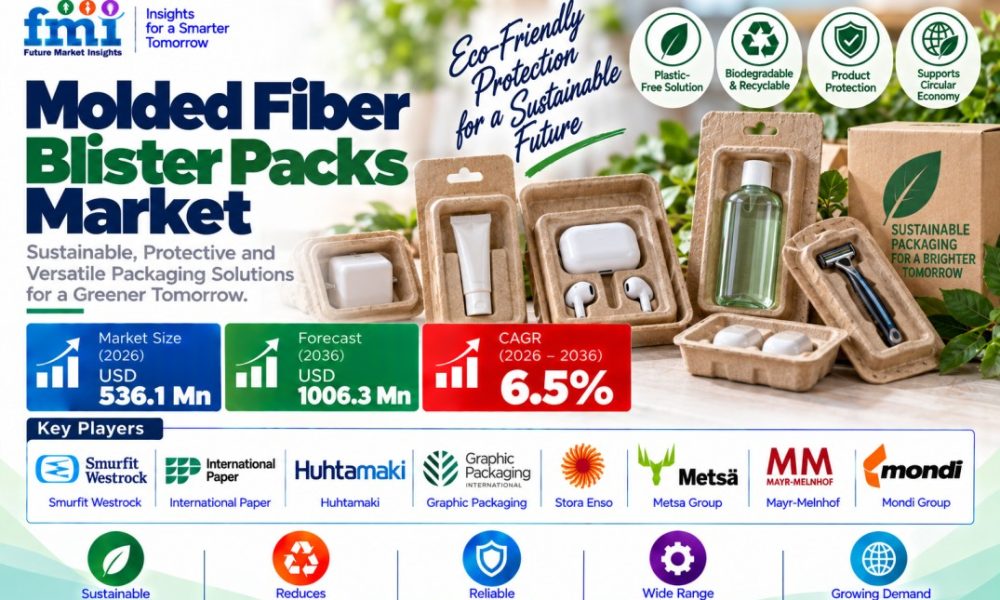
The global molded fiber blister packs market is projected to grow from USD 536.1 million in 2026 to USD 1,006.3 million by 2036, expanding at a compound annual growth rate (CAGR) of 6.5%, according to Future Market Insights (FMI). Demand is being supported by packaging rules that emphasize recyclability and material reduction, alongside efforts to develop fiber-based formats that maintain product protection and work with existing packing operations.
The shift from conventional plastic structures to molded fiber is not simply a material substitution exercise. Packaging manufacturers and brand owners must assess cavity geometry, barrier performance, sealing behavior, manufacturing consistency and the suitability of the finished pack for its intended recovery route. These requirements will influence which applications can transition successfully and how quickly new formats move from trials to commercial production.
👉 Access the Complete Report in PDF Format: https://www.futuremarketinsights.com/reports/brochure/rep-gb-35091
Standard Formats Lead Market Demand
Standard formats are expected to account for 40.0% of the market in 2026. Their familiar dimensions and sealing footprints can reduce tooling changes and limit disruption to downstream packaging equipment. This makes standardization an important consideration for companies seeking to introduce fiber-based structures without redesigning entire packing lines.
By material, virgin kraft and solid bleached sulphate (SBS) are projected to hold a 39.0% share in 2026. Their stiffness and predictable converting behavior support forming, printing, scoring and barrier application where dimensional consistency matters.
Standard retail formats are expected to represent 42.0% of the market by format size in 2026. These formats can fit established shelf, case and handling systems, helping brands manage the transition without introducing unnecessary pack variants.
Food and foodservice are forecast to account for 39.0% of market demand in 2026. Applications in this segment require packaging to withstand filling, handling, moisture, grease and temperature changes while meeting hygiene and distribution requirements. As a result, adoption depends on matching the fiber structure and any barrier or liner to the product and operating environment.
Regulations Strengthen the Case for Fiber-Based Packaging
Packaging policy is increasingly influencing material selection and procurement decisions. The European Commission confirmed in February 2025 that the Packaging and Packaging Waste Regulation had entered into force, reinforcing the importance of recyclability and material reduction in packaging design.
California also approved packaging producer-responsibility rules in May 2026 that include a 25% reduction in single-use plastic and requirements for packaging to be recyclable or compostable. Such measures can create opportunities for fiber-based alternatives, although actual conversion depends on product requirements, line compatibility and the recovery options available.
In the United Kingdom, recyclability assessments are linked to producer-responsibility fee modulation. In South Korea, packaging recyclability grading can affect material and design choices. These different policy frameworks mean suppliers need to understand local requirements rather than assume that one fiber construction will qualify across all markets.
Qualification Remains a Key Commercial Hurdle
Nandini Roy Choudhury, Principal Consultant at Future Market Insights, explains: “Molded fiber blister conversion is decided on the packing line, where cavity tolerance, liner choice, and seal behavior determine whether plastic can be removed. Programs scale faster once barrier performance and recovery classification are proven before tooling, because late redesigns can erase the savings from material substitution.”
The assessment highlights the importance of validating the complete pack structure before tooling and production settings are finalized. Moisture, grease and oxygen protection may require additional barrier treatments, while liners and coatings must be assessed against the intended recycling route. A design that meets product-protection requirements but complicates recovery may not satisfy the brand owner’s wider packaging objectives.
For packaging converters, the opportunity lies in developing repeatable production processes and clear material specifications. For brand owners, early technical trials can help identify incompatibilities before larger investments are committed.
Country-Level Growth Outlook
The report identifies the United Arab Emirates as the fastest-growing profiled market, with a projected CAGR of 8.1% from 2026 to 2036. Saudi Arabia follows at 7.8%, while South Korea is forecast to grow at 7.5%. The United States is projected to expand at 7.2%, followed by the United Kingdom at 6.9%, Germany at 6.6%, France at 6.3% and Japan at 6.0%.
These growth rates reflect differing packaging requirements, market conditions and adoption pathways. In the UAE and Saudi Arabia, suppliers must consider heat, moisture and distribution stresses. South Korean programs place importance on material classification and recyclability documentation. In European markets, producers must align packaging specifications with applicable producer-responsibility and recovery requirements.
For suppliers, local qualification and compliance support will remain important alongside product design and manufacturing capability.
👉 Get Detailed Market Forecasts, Competitive Benchmarking, and Pricing Trends: https://www.futuremarketinsights.com/reports/sample/rep-gb-35091
Competitive Landscape and Industry Developments
Key companies profiled in the molded fiber blister packs market include Smurfit Westrock, International Paper, Huhtamaki, Graphic Packaging, Stora Enso, Metsä Group, Mayr-Melnhof and Mondi Group.
Competition spans direct formed-fiber producers and companies with adjacent paperboard, coating, barrier and sealing capabilities. This makes technical integration and customer qualification important differentiators, particularly for applications requiring reliable product protection and high-volume production.
Recent developments include Metsä Group’s August 2026 commitment to a new Muoto fiber-packaging production line in Äänekoski, Finland, with start-up planned for 2028 and nominal capacity above 100 million products annually. Stora Enso partnered with Matrix Pack in June 2025 to accelerate formed-fiber packaging development and commercial manufacturing. In March 2025, Mayr-Melnhof demonstrated its Carton Cavity System, which produces cartonboard cavity inserts designed to replace plastic trays.
These developments indicate continued investment in formed-fiber capacity, cavity design and alternatives to conventional plastic components. Their commercial impact will depend on cost, production consistency, application suitability and customer acceptance.
Outlook
The molded fiber blister packs market is positioned for expansion as recyclability requirements and plastic-reduction initiatives influence packaging specifications. However, growth will depend on demonstrating that fiber structures can deliver the necessary protection, fit existing operations and meet the requirements of their intended recovery systems.
Companies that address these technical and compliance requirements early will be better positioned to qualify new formats and support repeat orders.
To explore how FMI Custom Research can support your strategic priorities, connect with our team at – [email protected]
About Future Market Insights (FMI)
Future Market Insights, Inc. is an ESOMAR-certified, ISO 9001:2015 market research and consulting organization trusted by Fortune 500 companies. With a global presence across the U.S., UK, India, and Dubai, FMI delivers data-driven insights across 30+ industries and 1200 markets worldwide.



