
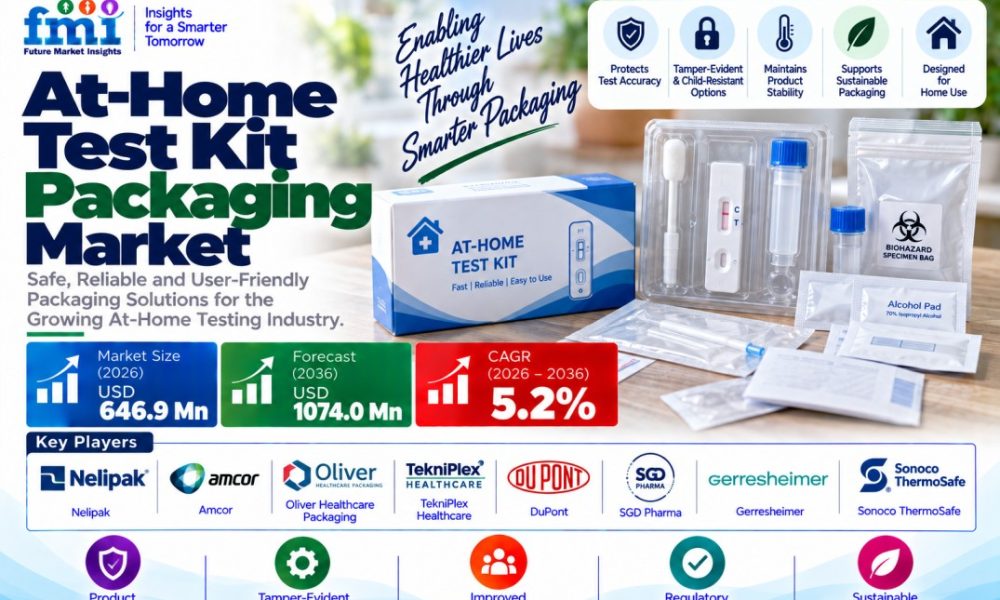
The global at-home test kit packaging market is projected to grow from USD 646.9 million in 2026 to USD 1,074.0 million by 2036, registering a compound annual growth rate (CAGR) of 5.2%, according to Future Market Insights (FMI). The expansion of over-the-counter (OTC) and home-use diagnostic tests is creating demand for packaging that organizes collection components, protects sensitive materials and presents instructions clearly to users outside clinical settings.
At-home testing changes the role of packaging. A kit must keep swabs, vials, test devices and instructions organized throughout assembly, distribution and use. It must also protect the contents during parcel delivery while maintaining the labeling and configuration required for the specific diagnostic product.
For packaging suppliers, the commercial opportunity extends beyond supplying trays, cartons or pouches. Manufacturers need qualified structures that accommodate product variations while controlling the cost and time associated with changes to artwork, labels and kit components.
>> Get Detailed Market Forecasts, Competitive Benchmarking, and Pricing Trends: https://www.futuremarketinsights.com/reports/sample/rep-gb-35084
Swab and Vial Kits Lead Product-Type Demand
Swab and vial kits are projected to account for 30.0% of product-type demand in 2026. These formats require secure component retention and clear sequencing so users can identify collection and transfer materials during home testing.
Polymer systems are forecast to represent 36.0% of the market by material in 2026. Lightweight thermoformed and molded structures can position small components and support compact packaging configurations. Glass, aluminium and foil, and fiber-based structures remain relevant where the test’s requirements call for different barrier, containment or packaging properties.
Child-resistant formats are expected to account for 29.0% of demand by compliance feature in 2026. The requirement is relevant to selected kits that contain liquid vials or other components requiring access control in household settings. Child resistance and tamper evidence address different risks and should be assessed according to the specific kit design and intended use.
Direct Pharma Contracts Support Qualification-led Purchasing
Direct pharmaceutical contracts are projected to account for 54.0% of sales-channel demand in 2026. Diagnostic packaging programs often require controlled specifications, approved artwork, component compatibility and documented change management. These requirements favor direct coordination between diagnostic manufacturers and packaging suppliers when a kit’s geometry, barrier structure or printed information changes.
Specialty distributors can support standard components, while online business-to-business procurement can serve more routine requirements. However, multi-component kits and products intended for several markets may require closer technical coordination before a new packaging configuration is approved.
Nandini Roy Choudhury, Principal Consultant at Future Market Insights, states: “At-home test kit packaging earns repeat business once one qualified structure can absorb new analytes, labels and country instructions without changing component geometry. The commercial advantage is lower requalification work with lay-user sequencing, barrier performance and parcel protection preserved.”
Regulatory and Product Developments Influence Packaging Design
Recent developments in home diagnostics highlight the need for packaging that can support different test configurations. The US Food and Drug Administration granted traditional authorization to ACON Laboratories in October 2025 for an over-the-counter test covering RSV, influenza A/B and COVID-19. In March 2025, the FDA also authorized Visby Medical’s at-home test for chlamydia, gonorrhea and trichomoniasis.
These products illustrate why packaging design must account for component placement, collection steps and consumer instructions. As test menus expand, suppliers that can reuse qualified structural platforms while managing approved changes may help customers reduce unnecessary redesign and validation work.
Healthcare packaging investment is also strengthening technical support. In March 2026, Nelipak opened an Asia-Pacific Technical Development Center in Singapore to support package design and validation. In April 2026, Gerresheimer partnered with Milliken to apply LeneX UltraGuard additive technology to pharmaceutical polymer packaging requiring higher protection and process consistency.
Such developments reflect the importance of technical capabilities, although their direct impact on individual at-home test kit programs depends on application suitability and qualification.
Germany Leads the Profiled Country Growth Forecast
FMI projects Germany to record the highest CAGR among the profiled countries at 6.8% from 2026 to 2036. The United States follows at 6.5%, while South Korea is forecast to grow at 6.2%. The United Kingdom is projected to expand at 5.9%, France at 5.6% and Japan at 5.3%.
The country outlooks reflect different market access, labeling and distribution considerations. Germany’s broader retail access for eligible self-tests creates opportunities for packaging that supports pharmacy and retail channels. In the United States, parcel protection and the ability to accommodate changing test configurations remain important. South Korea’s evolving self-test landscape increases the relevance of controlled local-language artwork and reusable packaging structures.
Across markets, suppliers must manage the applicable regulatory and quality requirements rather than assume that one packaging configuration can be adopted unchanged everywhere.
>> Access detailed market insights: https://www.futuremarketinsights.com/reports/brochure/rep-gb-35084
Competitive Landscape
Companies profiled in the at-home test kit packaging market include Nelipak, Amcor, Oliver Healthcare Packaging, TekniPlex Healthcare, DuPont, SGD Pharma, Gerresheimer and Sonoco ThermoSafe.
Their capabilities span formed and flexible healthcare packaging, barrier materials, primary containers and temperature-qualified transport solutions. Competition is shaped by the ability to deliver suitable packaging structures, maintain component integrity and support technical validation throughout a product’s lifecycle.
Outlook
The at-home test kit packaging market is expected to benefit from continued demand for consumer-facing diagnostic formats. However, growth will depend on more than the number of tests entering the market. Packaging suppliers must support clear instructions, reliable component organization, distribution protection and controlled changes to approved configurations.
Companies that combine design flexibility with documented performance and dependable supply will be well positioned to serve diagnostic manufacturers as home testing applications evolve.
To explore how FMI Custom Research can support your strategic priorities, connect with our team at – [email protected]
About Future Market Insights (FMI)
Future Market Insights, Inc. is an ESOMAR-certified, ISO 9001:2015 market research and consulting organization trusted by Fortune 500 companies. With a global presence across the U.S., UK, India, and Dubai, FMI delivers data-driven insights across 30+ industries and 1200 markets worldwide.



