
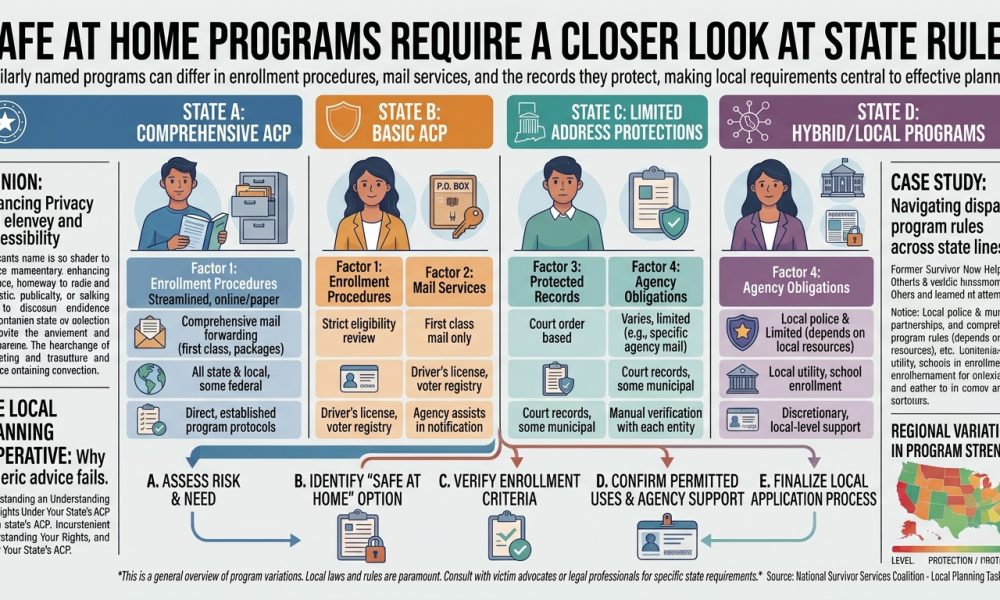
Similarly named address confidentiality programs can differ significantly in eligibility, enrollment procedures, mail forwarding services, government agency obligations, and the public records they protect, making state-specific requirements essential for survivors seeking greater residential privacy and personal safety.
WASHINGTON, DC, October 25, 2026: Americans seeking Protection from domestic violence, stalking, sexual assault, human trafficking, and other threats may encounter government programs operating under the familiar Safe at Home name, but the protections available under these initiatives are not identical across state boundaries.
Although address confidentiality programs commonly provide substitute mailing addresses to reduce public exposure of residential Information, eligibility rules, enrollment methods, mail services, and administrative obligations can vary substantially by state.
For survivors considering relocation, confidential name changes, protected voter registration, or other privacy measures, understanding these differences matters because participation in one state’s program does not automatically provide equivalent protections in another jurisdiction.
A comparison of programs in California, Minnesota, Georgia, and Tennessee demonstrates that similarly named initiatives can serve related safety objectives while maintaining distinct operational requirements that affect how participants interact with government agencies and private organizations.
Safe at Home Is a Program Name, Not One National System
Safe at Home generally refers to state-administered address confidentiality programs designed to help qualifying individuals protect their actual residential locations from unnecessary disclosure through certain public records and government transactions.
Rather than creating an entirely new identity, these programs typically provide a designated substitute address that participants may use for specified purposes. At the same time, the administering agency retains the cInformation information needed for mail forwarding and program administration.
The United States does not operate a single nationwide Safe at Home enrollment system, so eligibility in California cannot simply transfer to Minnesota, Georgia, or Tennessee without considering the receiving state’s laws.
This jurisdictional distinction matters because a survivor relying on an authorized substitute address must understand which institutions must legally recognize it and which transactions remain subject to other Identification requirements.
California’s Program Serves Several Eligible Groups
California’s Safe at Home program, administered by the Secretary of State, serves qualifying individuals affected by domestic violence, stalking, sexual assault, human trafficking, child abduction, and certain forms of elder or dependent adult abuse.
Its eligibility framework also recognizes specified people facing threats associated with reproductive healthcare services, gender-affirming healthcare services, and certain public employment responsibilities, together with qualifying household members under applicable circumstances.
The program provides a substitute mailing address, an authorization Identification card, and access to particular confidentiality protections established through California law, although individual services remain subject to specific statutory conditions.
Applicants must ordinarily work with a designated enrolling agency rather than submit an initial Application independently, so California’s prescribed enrollment procedure includes assistance from an authorized program representative.
Minnesota Uses a Broader Safety-Based Eligibility Standard
Minnesota’s Safe at Home program, also administered through its Secretary of State, allows qualifying residents to seek enrollment when they fear for their own safety or the safety of certain children, wards, or household members.
Unlike programs organized primarily around specified categories of victimization, Minnesota’s eligibility language emphasizes the applicant’s safety concerns while retaining particular statutory exclusions and administrative requirements.
Since July 1, 2024, Minnesota has also allowed qualifying applicants who intend to establish residence in the state within sixty days to apply before they move.
This provision can matter for individuals considering an interstate relocation, but prospective participants must still meet the program’s Application requirements and should not assume anticipated residence automatically guarantees acceptance.
Georgia Introduced a Different Program Framework
Georgia established its Safe at Home program through legislation enacted in 2024, creating an address-confidentiality framework intended to protect eligible individuals whose safety could be compromised by disclosing their residential Information.
The Georgia Secretary of State’s official Safe at Home guidance identifies three principal services: address substitution, forwarding qualifying mail, and confidential voter registration arrangements.
The program describes protections for survivors of domestic violence, sexual assault, human trafficking, stalking, and other eligible individuals, with applications requiring documentation and a sworn statement under the established procedure.
Georgia’s framework shows why residents should review the rules their state administers rather than relying on enrollment instructions copied from California or Minnesota.
Tennessee Demonstrates How Programs Develop Over Time
Tennessee launched its Safe at Home address confidentiality initiative in 2019 and later expanded it, providing eligible residents with a substitute address for certain government services and official records.
In January 2023, the Associated Press reported on Tennessee’s Safe at Home program, explaining how it helped qualifying survivors protect residential Information associated with voter registration, driver’s licenses, and other administrative transactions.
The report described more than 580 participants across 43 counties at that time, providing a historical illustration of program use rather than a current statewide enrollment estimate.
Tennessee’s experience demonstrates that individual programs can evolve through legislative amendments and administrative expansion, making current official instructions more reliable than descriptions prepared several years earlier.
Enrollment Procedures Can Vary Significantly Between States
Even when two states run programs with similar names and goals, the Application process may use different forms, authorized assistants, sworn declarations, residency requirements, and methods for submitting sensitive Information.
California requires applicants to work through designated enrolling agencies. At the same time, Minnesota similarly uses trained Application assistants who help assess eligibility and explain how participation fits within an individual’s broader safety plan.
Georgia’s published framework includes an Application and sworn statement, reflecting the state’s own legal requirements rather than an interchangeable national Application that every Safe at Home office accepts.
Prospective participants should therefore obtain instructions directly from the appropriate state Authority before disclosing identifying Information, particularly when an earlier Application was completed in another jurisdiction.
Application Assistants Help Explain Program Limitations
Authorized Application Assistants can serve as an important point of contact for survivors who need to understand enrollment requirements without navigating unfamiliar administrative procedures on their own.
Their role may include discussing program eligibility, completing the required Application materials, explaining forwarding limitations, and helping applicants understand how the substitute address fits within an individualized safety plan.
However, participating in an orientation or consultation does not necessarily mean an Application will be approved, because the administering Authority remains responsible for determining whether statutory conditions have been satisfied.
Applicants should also distinguish enrollment assistance from legal representation, since complex custody, immigration, court confidentiality, or financial issues may require appropriately qualified professionals with different responsibilities.
Substitute Addresses Have Different Legal Functions
A substitute mailing address is not simply a commercial mailbox chosen by the participant, because its legal recognition depends on the statutory framework governing the relevant address confidentiality program.
In California, state and local agencies generally must recognize a participant’s designated address for applicable records, except when an agency has a legitimate statutory or administrative need for the actual location.
Minnesota’s framework likewise establishes an official address that participants can use in qualifying interactions, although its administrative rules and verification procedures differ from those maintained by California.
The scope of Protection should be examined carefully because an address accepted for government correspondence may not automatically satisfy the requirements of every private transaction or federal Application.
Mail Forwarding Rules Are Not Identical
Mail forwarding is central to many Safe at Home programs, but states can set different rules for eligible correspondence, forwarding schedules, authorization numbers, package restrictions, and administrative handling.
California’s regulations generally require participants’ mail to be forwarded at least three times weekly and impose restrictions on dimensions, weight, acceptable contents, and the Identification details on correspondence.
Minnesota explains that its service forwards qualifying First-Class Mail but not most packages, showing why participants cannot assume every delivery normally sent to a residence will pass through the program.
Understanding these distinctions is essential when arranging correspondence involving employment, government benefits, financial institutions, or other matters where delivery delays and missing documents could create significant consequences.
Important Documents May Arrive Later Than Expected
Mail sent through a substitute-address program generally reaches the administering Authority before it is redirected to the participant’s confidential address, adding an administrative stage that doesn’t exist with ordinary direct delivery.
California’s regulations identify additional forwarding time, while Minnesota’s public assistance guidance acknowledges that forwarding delays can affect the timing of notices requiring participants to respond to government agencies.
These considerations matter when correspondence contains legal deadlines, employment documentation, benefits decisions, or requests for Information that could affect access to essential services.
Participants should understand the relevant delivery arrangements and applicable response requirements rather than assuming that enrollment automatically extends deadlines imposed by courts, agencies, or private organizations.
Packages and Prescriptions May Require Other Arrangements
A substitute mailing address may not provide complete delivery service for parcels, online purchases, medications, or other items outside the program’s authorized mail categories.
California excludes several categories, including packages and mail containing online purchases or medication, while Minnesota also warns participants that its service cannot forward most packages.
Participants should consequently review acceptable mail categories before using a designated address for deliveries, particularly when the contents involve important personal needs or time-sensitive medical supplies.
Evaluate any alternative delivery arrangement based on the individual’s circumstances and the provider’s legitimate requirements, recognizing that the program is for protected correspondence, not unrestricted package handling.
Private Businesses May Not Have the Same Obligations
State laws often impose specific requirements on participating government agencies while subjecting private companies to different legal standards for residential Information, mailing addresses, and customer Identification.
California expressly states that private businesses and the federal government are not universally required to honor its substitute addresses, even though applicable state and local agencies generally must.
Banks, insurers, landlords, utilities, and telecommunications companies may therefore request additional Information under legitimate administrative or regulatory requirements that the address confidentiality program does not independently eliminate.
Survivors should distinguish necessary, confidential Information collection from unnecessary public disclosure, and seek professional assistance when institutional procedures appear inconsistent with legally available protections.
Voter Registration Protections Require Separate Review
Voter registration can raise sensitive address questions because election authorities may need residential Information to establish eligibility, while public access rules can affect how they disclose registration details.
Georgia’s Safe at Home program includes confidential voter registration arrangements, and California and Minnesota also provide mechanisms addressing the privacy needs of qualifying participants under their respective laws.
However, participation in an address confidentiality program should not be assumed to establish identical voting procedures across states, especially where registration deadlines, Identification requirements, and residency qualifications differ.
Participants should consult their state election Authority for current instructions and ensure that protected residential Information is handled according to the relevant confidentiality provisions.
School Records May Receive Special Protection
Families participating in Safe at Home programs may need to provide schools with Information for enrollment, transportation, emergency contact, and other legitimate educational purposes, raising questions about how schools handle actual residential addresses.
California requires public schools to keep protected residential Information confidential, even when school administrators have legitimate reasons to know a student’s location for attendance or emergency purposes.
Other states may set different procedures, so parents and guardians should review local education requirements instead of assuming a substitute mailing address resolves every enrollment question.
Legal Proceedings Can Involve Separate Disclosure Rules
Address confidentiality and court-record sealing serve different purposes, meaning that participation in Safe at Home does not automatically make every judicial proceeding confidential or remove existing public filings.
California and Minnesota recognize specific arrangements for serving legal process through their programs, allowing official correspondence to continue while residential Information remains protected under applicable law.
Participants seeking confidential name changes, Protection orders, or other judicial relief should examine the relevant court procedures separately, particularly when filings involve sensitive family Information or earlier residential records.
Renewal Periods and Reporting Duties Matter
Enrollment generally creates ongoing responsibilities, including keeping the administering program informed of relevant changes and complying with rules that ensure accurate correspondence and eligibility records.
California ordinarily certifies participants for four years and requires notification of certain changes involving names or addresses, while Minnesota maintains its own enrollment duration and renewal procedures.
Failing to follow the applicable rules can create problems with mail forwarding or continued participation, so administrative compliance is an important part of preserving the protections initially granted.
Relocation Between States Requires Fresh Planning
An individual moving from California to Minnesota may find that enrollment in the original state’s program does not automatically provide equivalent legal protections in the new state.
Different residency standards, enrollment procedures, agency obligations, and forwarding services can affect how a participant handles government records during and after a legitimate interstate move.
Minnesota’s provision allowing certain prospective residents to apply before moving shows that relocation planning benefits from early review, but the applicant must still meet the state’s specific conditions.
Historical Public Records May Remain Accessible
A newly established substitute address can reduce disclosure through particular future government transactions without necessarily removing older Information already recorded through property filings, public directories, or commercial data services.
This distinction matters when earlier names and addresses remain linked to financial accounts, professional licenses, historical court records, or commercial Information collected before participation began.
Applicants should understand that address confidentiality programs generally regulate specific uses and disclosures rather than deleting personal Information across every independent public and private database.
Safe at Home Is Not Witness Protection or a New Identity
California explicitly distinguishes its Safe at Home initiative from witness Protection, explaining that participation does not change a person’s identity, Social Security number, or actual residential location.
The substitute address provides a legally recognized privacy arrangement for specified purposes while preserving the accurate identity Information government authorities and organizations with legitimate administrative responsibilities need.
Individuals considering broader lawful identity-related matters can examine Amicus International Consulting’s New Identity Services, while independently verifying eligibility, authentic government procedures, and appropriate professional qualifications.
Qualified Survivor Assistance Remains Important
Address confidentiality programs are most useful when participants understand their actual protections and how those safeguards interact with housing, employment, education, financial services, legal proceedings, and personal safety planning.
Qualified victim advocates, legal aid providers, and properly trained Application assistants can explain relevant procedures without encouraging applicants to rely on unsupported promises of complete anonymity.
A responsible approach should preserve participants’ choices while maintaining accurate government records and recognizing that legal confidentiality measures operate within the limits set by applicable laws.
State Program Comparisons Should Focus on Practical Protections
When comparing similarly named programs, applicants should examine who qualifies, how enrollment occurs, which mail categories are forwarded, what records receive Protection, and how participating government agencies handle confidential Information.
They should also review rules on household members, legal process, renewal requirements, protected voter registration, and disclosures authorized by law, because these details can materially affect a program’s usefulness.
California, Minnesota, Georgia, and Tennessee show that a shared program name does not mean identical services, so jurisdiction-specific official guidance is essential when evaluating realistic privacy arrangements.
Effective Confidentiality Begins With Understanding State Rules
As additional states implement or modify address confidentiality legislation, survivors will continue encountering programs that pursue similar safety objectives through different eligibility standards, administrative systems, and public-record protections.
The strongest planning approach combines current government guidance with accurate Identification, confidential record handling, and qualified support, recognizing that protected addresses are one component of a broader personal safety strategy.
Ultimately, Safe at Home programs require a closer look at state rules because meaningful residential privacy depends on more than obtaining a substitute address, including understanding enrollment requirements, mail services, agency obligations, and the ongoing limits of confidentiality protections.




