
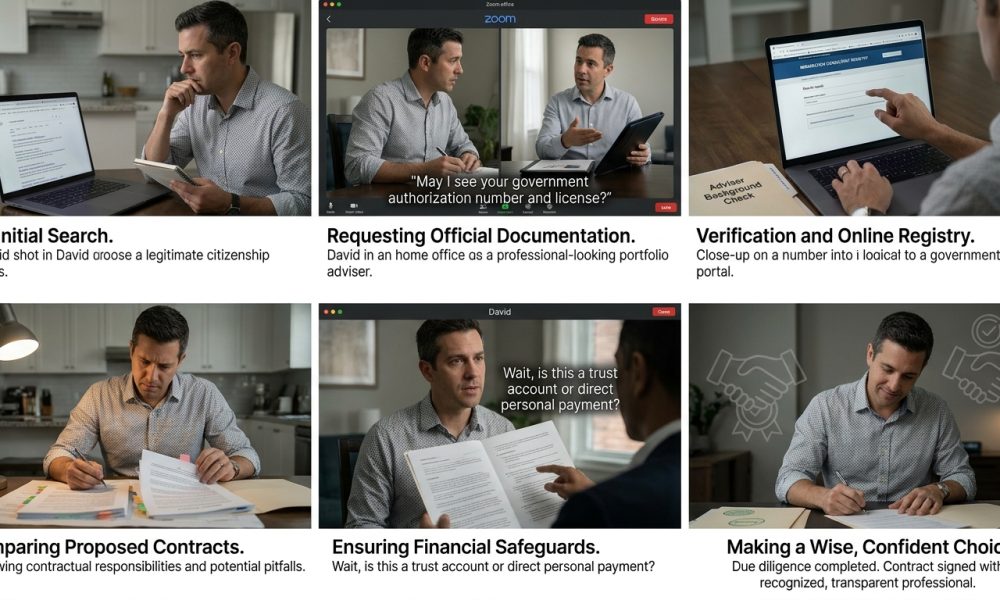
Applicants should review professional credentials, contractual responsibilities, and, where applicable, government authorization before entrusting an adviser with funds and personal records.
Washington, DC, October 26, 2026 — Choosing a citizenship adviser involves more than comparing fees or promised completion dates, because the engagement may involve sensitive family records, substantial payments, and decisions whose consequences extend well beyond preparing an Application.
Applicants need to establish who will provide advice, what Authority that person holds, and which services the agreement covers, particularly when a proposal involves representatives, marketing intermediaries, or professionals working across several countries with different regulatory requirements.
Official guidance in Canada and the United Kingdom directs applicants toward authorization checks, illustrating why a polished website, professional title or personal recommendation should be followed by independent verification of the credentials relevant to the proposed work.
A useful assessment therefore connects the adviser’s identity, professional standing and contractual commitments with the applicant’s actual needs, creating a clear basis for engagement before personal records are distributed or significant financial commitments are made to unfamiliar parties.
Identify Who Will Actually Handle the Application
The initial inquiry should establish the business’s legal name and the individual responsible for the advice, because the person conducting a sales consultation may not be the one who prepares or submits the Application.
Applicants should ask whether employees, external counsel, or another authorized representative will complete the work, and explain the arrangement clearly enough to identify who answers substantive questions and who remains accountable for managing the client relationship.
Where several organizations are involved, a written explanation should describe their respective roles and the applicant’s contractual relationship with each, avoiding uncertainty about whether a payment purchases legal advice, administrative coordination, or an introduction to a separate provider.
This review should also identify the professional who will examine eligibility before submission, ensuring that the applicant understands whether the initial proposal reflects an individualized assessment or a general description awaiting review by someone qualified to advise.
Check Credentials Through the Relevant Register
Canada’s guidance on choosing an immigration or citizenship representative tells applicants to verify that a paid representative is authorized, making the professional’s current standing a practical first check before discussing the preparation or submission of a Canadian Application.
The United Kingdom similarly directs people to the Immigration Advice Authority or approved professional bodies, showing that the right verification route depends on the jurisdiction and the type of professional offering the proposed immigration or nationality advice.
Applicants should independently search the relevant official register and compare the person’s name, organization, and contact details, rather than rely solely on a certificate, screenshot, or registration number supplied by the business seeking the engagement.
If the register shows restrictions or leaves the proposed work uncertain, obtain clarification from the regulator or professional body before assuming registration authorizes every service advertised by the individual or their associated organization.
Government Authorization Has a Specific Scope
Some citizenship programs require applications to proceed through designated agents, creating an additional verification question that should be examined separately from whether the individual is a lawyer, consultant, or business adviser in another jurisdiction where they operate.
The St. Kitts and Nevis Citizenship Unit, for example, publishes an authorized-agent list and states that applications must be submitted through approved agents, illustrating how a program can prescribe a particular channel for preparing and presenting an Application.
Applicants should confirm whether the person promoting the service appears in the relevant category or works through another authorized party, and document that relationship rather than infer it from broad references to government connections or international partnerships.
Authorization to submit applications should also be distinguished from government endorsement of an adviser’s commercial promises, allowing applicants to verify the official role without assuming that it guarantees approval, investment quality, or the accuracy of every promotional statement.
Relevant Experience Matters Alongside Registration
Professional authorization provides an important starting point, but applicants should also ask about experience with the specific nationality pathway, particularly when the case involves complex descent records, adoption, previous refusals, or several family members with different circumstances.
A useful discussion should explore how the adviser would assess the applicant’s eligibility and identify missing evidence, allowing the applicant to evaluate the clarity of the explanation rather than relying entirely on claimed success rates.
References may help assess communication and service quality. Still, an adviser should protect former clients’confidential Information inn privatecasess; they should not use files oridentifyy documents, and they shouldnot be exposed too a prospective new client.
Where a matter falls outside the adviser’s competence, the proposal should identify the additional professional support needed, helping the applicant understand whether specialist counsel will be engaged and how that work affects responsibility, timing and the agreed fees.
The Contract Should Describe Concrete Responsibilities
Before engagement, the applicant should receive a written agreement identifying the services to be performed, the responsible parties and the expected communications, so that both sides understand what the adviser undertakes to deliver throughout the professional relationship.
The agreement should distinguish an eligibility assessment from Application preparation and later representation, and explain whether responses to further Information requests, interviews, or an unfavorable decision fall within the original scope or require a separate engagement afterward.
For Canadian regulated immigration consultants, the professional conduct framework requires a written service agreement before substantive services beyond an initial consultation, illustrating how contractual clarity can form part of a regulated professional’s obligations rather than merely a commercial preference.
Applicants should compare the agreement with the proposal discussed during consultations and ask to resolve inconsistencies before signing, ensuring important assurances appear in the terms rather than remaining in informal conversations.
Fees and Payment Arrangements Need Clear Explanations
A fee proposal should distinguish professional charges from government fees, document expenses, and any investment commitment, so the applicant can understand which payments compensate the adviser and which amounts go to other organizations involved in the process.
Each payment request should identify the recipient and purpose, and any change in bank instructions should be independently confirmed through an established contact method before transferring money, especially if the new instructions arrive unexpectedly or involve an unfamiliar entity.
Where advance payments will be held for future work or third-party expenses, applicants should ask what client-money rules apply and how the funds are accounted for, rather than assume that every provider follows the same arrangements or protections.
Refund and termination provisions should explain what happens if work stops, the applicant withdraws, or eligibility concerns emerge, giving the client a practical understanding of which amounts may remain payable and which services have already been completed.
Commercial Conflicts Should Be Disclosed
An adviser recommending an investment, property or service provider should explain whether they receive a commission or other benefit from the recommendation, allowing the applicant to consider that relationship when evaluating the advice and comparing available alternatives.
The question is particularly relevant when immigration advice is packaged with a financial transaction, because assessing whether an investment meets program conditions requires different expertise than evaluating its commercial risk, expected return, or suitability for the individual investor.
Applicants should establish who is providing each type of advice and under what Authority, with the scope of the engagement showing whether independent financial or tax advice is included or must be obtained from another qualified professional.
A disclosed commercial relationship does not, by itself, establish misconduct. Still, a clear explanation helps applicants understand the recommendation’s context and decide whether an additional independent review is appropriate before committing funds to the proposed transaction or related service.
Promises About Approval Deserve Close Examination
A representative can organize evidence and communicate with authorities. Still, applicants should distinguish those services from a promise that the government will approve the Application, particularly when the actual eligibility rules or official procedures do not support the assurance.
Canada’s representative authorization instructions expressly explain that appointing a representative does not bring special attention, faster processing, or a more favorable outcome, providing a concrete example of the limits applicants should recognize when evaluating claims about privileged access.
When a provider offers a completion date, the applicant should ask which stage it describes and what assumptions support it, separating a commitment to prepare documents from an estimate about decisions controlled by the responsible government Authority.
Claims that difficult eligibility questions can be resolved through undisclosed influence should prompt requests for the actual legal basis, enabling the applicant to assess an identifiable procedure instead of relying on an assurance that cannot be independently examined.
Applicants Should Review What Is Submitted
Clients should have an opportunity to review their Application and supporting statements before submission, check that the Information accurately describes their circumstances, and seek explanations for language they do not understand or factual claims they cannot personally verify.
In July 2026, Reuters reported allegations of false documents in American asylum cases, describing an enforcement action against a lawyer rather than an established finding of wrongdoing, with the report noting the availability of administrative and judicial review.
Although that report concerned asylum representation, it illustrates the importance of examining the material submitted through an adviser, rather than assuming professional involvement removes the need to verify the accuracy of statements made on the client’s behalf.
Applicants should retain the final submitted version and relevant confirmations, creating a reliable record for later questions and ensuring that their understanding of the Application rests on its actual contents rather than a brief verbal summary of the filing.
Personal Records Require Defined Handling Arrangements
Before providing passports, civil records, or financial documents, applicants should understand why each item is needed, who will receive it, and how it will be transmitted, especially when the engagement involves several organizations operating in different countries.
The service agreement and privacy Information should explain how sensitive records will be handled, including access, storage, and any necessary transfers. At the same time, applicants should ask how originals will be tracked and returned when they are required for a particular task.
Amicus International Consulting’s article on parental photographs in Mexico’s children’s passports describes the family Information contained in those documents, illustrating why a child’s passport copy can disclose details about more than the child whose travel credential is being examined.
Families should therefore review document-sharing arrangements carefully and provide records through verified channels, while recognizing that confidentiality commitments should explain lawful disclosure obligations rather than promise that Information can never be shared under any circumstances.
Communication and File Access Should Be Agreed
A workable engagement should specify how updates will be provided and who will respond to questions, allowing the applicant to distinguish routine progress reports from urgent government correspondence that requires instructions, additional documents, or action within a stated deadline.
Where official messages go to the representative, the applicant should ask how those communications will be forwarded and recorded, ensuring that important requests remain visible rather than depending on occasional informal summaries of the Application’s overall progress.
The agreement should also address access to the client’s file and arrangements if the adviser becomes unavailable, helping preserve continuity when illness, business closure or a change in representation interrupts the relationship before the matter is completed.
These arrangements are especially useful for families coordinating several applications, since one person’s outstanding documents or deadline can require attention even when the adviser reports that other members of the household are progressing through the expected stages.
Understand the Available Complaint and Exit Procedures
Before appointing an adviser, applicants should identify the internal complaint process and any relevant regulator or professional body, so they know where to raise concerns if communication breaks down or the services provided differ materially from the written agreement.
The review should also identify the contract’s governing law and dispute provision, particularly for cross-border engagements where the applicant, adviser and proposed citizenship Authority operate in different jurisdictions with potentially different routes for resolving disagreements.
If representation must change, the applicant should seek advice on notifying the Authority, transferring records, and protecting outstanding deadlines, rather than assuming that ending a commercial relationship automatically updates the government’s records or immediately redirects official correspondence.
Careful selection rests on verified credentials, a clear scope of work, and practical control over money and records, giving applicants a sound basis for professional assistance while keeping government decisions and theadviser’ss contractual responsibilities clearly understood throughout the engagement.




