
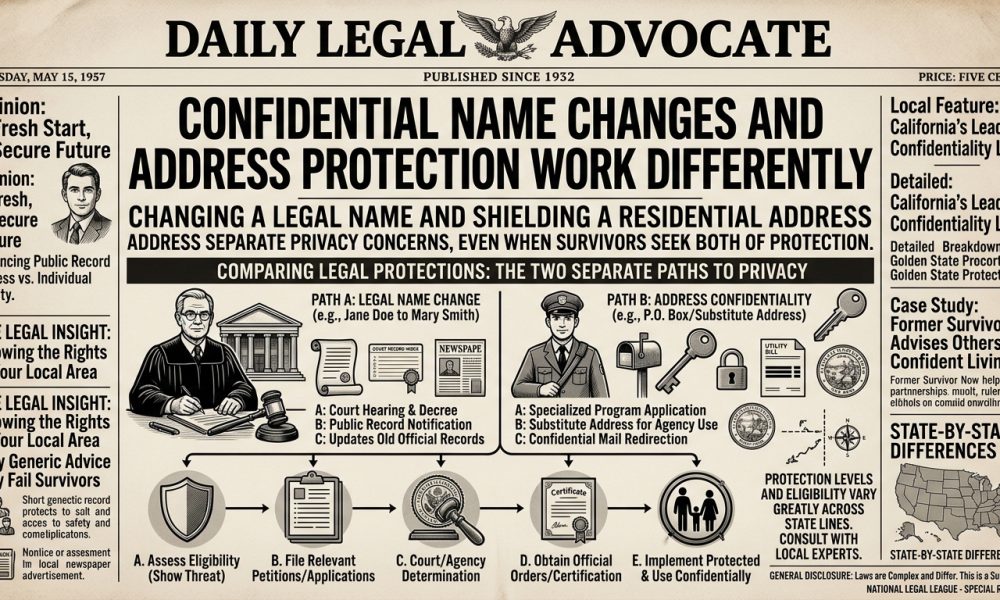
Changing a legal name and shielding a residential address are separate privacy concerns, even when survivors seek both forms of Protection, because court-approved identity updates and state-administered confidentiality programs operate under different laws, eligibility standards, and information-sharing requirements.
WASHINGTON, DC, October 25, 2026: Americans seeking Protection from domestic violence, stalking, sexual assault, or human trafficking may consider both confidential legal name changes and address confidentiality programs, although these measures protect different categories of personal Information and follow separate administrative procedures.
A confidential name change can limit public exposure of the relationship between a person’s former and current legal names. At the same time, an address confidentiality program generally replaces a residential address with an authorized mailing address in specified government records.
For survivors rebuilding their lives, understanding these differences is essential because changing a legal name does not automatically conceal a home address, and enrolling in a substitute-address program does not independently authorize a different legal identity.
The best approach depends on the individual’s safety concerns, relevant court orders, state eligibility requirements, and the need to keep accurate Identification across employment, banking, healthcare, education, and other essential services.
Two Privacy Protections Address Different Information
A confidential name-change proceeding primarily concerns the legal recognition of an updated personal name and the extent to which courts disclose documents connecting that name with earlier identifying Information.
An address confidentiality program, by contrast, generally helps eligible participants limit disclosure of their residential locations by using a government-designated substitute address in specified records and administrative transactions.
Although both protections may support the same survivor’s personal safety objectives, their legal functions remain distinct, so a person may qualify for one without automatically qualifying for the other.
Understanding this separation helps applicants avoid assuming a court order changes mailing arrangements or that enrolling in a residential privacy program automatically updates passports, driver’s licenses, or Social Security Information.
Legal Name Changes Establish an Updated Name
A legal name change generally begins with a petition or other procedure authorized by state law, requiring the applicant to provide appropriate Identification and satisfy applicable judicial or administrative conditions.
After approval, an individual can use the resulting order to request updates to government Identification and other records, although each institution may require its own supporting documentation and verification.
When safety concerns arise, applicants may seek special procedures that protect the petition, supporting evidence, or the relationship between former and current names from unnecessary public disclosure.
These confidentiality arrangements protect the handling of certain Information without establishing a different citizenship, replacing the individual’s personal history, or eliminating legal responsibilities associated with the same person.
Address Confidentiality Protects Location Information
The Virginia Attorney General’s official Address Confidentiality Program guidance explains that qualifying survivors can use an authorized substitute mailing address instead of their actual residential address for specified purposes involving state and local government agencies.
Virginia administers the program through the Office of the Attorney General, offering eligible participants protected mail forwarding while maintaining the confidential Information needed to deliver correspondence to the correct location.
The program is intended to help individuals who have relocated to addresses unknown to an abuser or stalker, making residential privacy a central consideration rather than a change of legal name.
Virginia also expressly states that the program cannot provide absolute Protection or operate retroactively, reinforcing the distinction between limiting future disclosure and erasing Information already maintained elsewhere.
Public Notice Requirements Can Complicate Name Changes
Some jurisdictions ordinarily require publication or notification when an individual petitions to change a legal name, raising concerns that an abusive person could discover identifying Information through publicly accessible court announcements.
For eligible applicants, the law may authorize exemptions from newspaper publication, confidential filings, or other procedures designed to reduce unnecessary disclosure during the legal name-change process.
However, publication exemptions depend on the governing jurisdiction and qualifying circumstances, so investigate local requirements before filing a petition that could reveal Information intended to remain private.
An address confidentiality card should not automatically be treated as a universal publication waiver, because courts may require a particular Application, statutory qualification, or additional judicial determination.
Sealed Court Records Offer a Separate Safeguard
A judicial sealing order generally restricts access to specified court records, potentially protecting documents containing a former name, proposed name, residential Information, or other sensitive details.
The precise Protection depends on the court’s order and applicable law, because sealing the entire proceeding differs from redacting particular Information or excusing the applicant from newspaper publication.
Some records may remain accessible to authorized officials or parties despite confidentiality restrictions, while Information unrelated institutions already hold may fall outside the court’s direct control.
Survivors should therefore understand the actual scope of an order rather than assuming that sealing a petition permanently removes every historical connection between their former and current identities.
California Demonstrates How Protections Can Intersect
California’s Safe at Home program illustrates how address confidentiality protections can interact with specialized judicial procedures for people seeking legally recognized name changes because of qualifying safety concerns.
The California court system provides eligible Safe at Home participants with a confidential cover sheet, with an updated version effective July 1, 2026, explaining how these applicants identify proceedings that require specialized handling.
Separate forms address requests to seal particular name-change records, showing that using protected mailing Information and restricting public access to judicial documents are distinct procedural questions.
Applicants should follow the requirements that match their circumstances, recognizing that California’s approach cannot be assumed to govern name-change proceedings in other American states.
Recent Privacy Reporting Shows Why Court Records Matter
In February 2023, the Associated Press reported on proposals in Washington and California to protect sensitive name-change records, including concerns that publicly available court Information could expose applicants to harassment, unwanted Identification, and threats.
The reporting focused on protections involving gender identity and related court proceedings, rather than exclusively on domestic violence survivors, but illustrated how legal name-change records can reveal sensitive Information beyond the immediate judicial process.
California later introduced broader confidentiality rules for certain gender-identity proceedings effective July 2026, showing that applicants must distinguish proposals from earlier years from laws and court procedures currently in force.
These developments underscore why confidential name-change applications require examination of the specific legal category involved, rather than relying on the general assumption that all sensitive petitions receive identical treatment.
Program Enrollment Rules Vary Between States
Confidentiality programs operate under individual state statutes, with different eligibility categories, Application procedures, residence requirements, mail services, and obligations for participating public agencies.
Virginia’s program includes a three-year certification period and specified participant responsibilities, while California and other jurisdictions maintain their own eligibility standards and administrative arrangements.
Applicants may need to work with authorized enrollment representatives or provide Information supporting qualifying safety concerns, depending on the rules established by the state administering the program.
A survivor who qualifies for confidential court proceedings in one jurisdiction should not assume that the same evidence automatically establishes enrollment eligibility for an address confidentiality program elsewhere.
Mail Forwarding Creates Continuing Administrative Responsibilities
A substitute address typically allows designated mail to reach a government-administered processing location before forwarding it to the participant’s confidential residence, creating handling requirements absent from ordinary direct delivery.
Virginia limits its ordinary forwarding service to qualifying First-Class mail and requires participants to keep program Information accurate, including reporting changes to names, addresses, and contact details.
These administrative responsibilities matter when correspondence contains time-sensitive notices, benefits decisions, employment documents, or other Information requiring action within a deadline established by an outside institution.
Survivors should examine their program’s forwarding procedures rather than assuming that all parcels, prescriptions, commercial deliveries, and legally significant documents will be accepted or delivered without additional delay.
Private Organizations May Not Accept Substitute Addresses
State address confidentiality statutes commonly govern selected government agencies, but they do not necessarily apply to every commercial organization that collects residential Information during ordinary transactions.
Virginia explains that private businesses and federal agencies generally are not required to accept its substitute address, although program administrators may discuss confidentiality concerns with organizations that receive participant Information.
Banks, insurers, telecommunications providers, and other institutions may have legitimate Identification obligations requiring confidential handling of actual residential details rather than unrestricted use of a substitute address.
Applicants should therefore distinguish a lawful requirement to verify Information from unnecessary public disclosure, recognizing that institutional cooperation and statutory obligations can differ considerably.
Legal Name Updates Require Separate Agency Procedures
A court-approved name change provides a lawful basis to update records. Still, the order does not automatically change Information held by the Social Security Administration, motor vehicle departments, or passport authorities.
Each agency may require specific evidence linking the former and current names, along with documentation showing citizenship, identity, or other eligibility requirements under the relevant administrative rules.
When a name-change proceeding is confidential, applicants should determine how to present authentic documents through authorized channels without unnecessarily expanding access to sensitive underlying Information.
Maintaining consistent official records supports employment, benefits, Identification, and travel while preserving the distinction between a lawful name change and the creation of an unrelated identity.
Social Security Records Maintain Legal Continuity
The Social Security Administration generally updates an individual’s name upon receipt of acceptable evidence, preserving the underlying record needed for employment reporting, government benefits, and applicable tax administration.
A legal name change does not ordinarily result in a different Social Security number, because requests for number changes are considered under separate federal eligibility standards.
Certain individuals facing serious harassment, abuse, or life-threatening circumstances may qualify for additional consideration, but confidential court proceedings do not automatically result in a new number.
Survivors should therefore seek accurate Information about the relevant federal procedures rather than assuming that changing a name or enrolling in address confidentiality replaces every identifying record.
Driver’s Licenses Can Involve Both Forms of Protection
A driver’s license may display a person’s updated legal name, while the motor vehicle agency separately maintains address Information under an authorized confidentiality arrangement under state law.
Obtaining the name update may require court documentation, while accepting a substitute address depends on the specific provisions governing the state’s motor vehicle records and confidentiality program.
These separate requirements show why survivors may need to coordinate more than one administrative procedure, even when both changes appear on a single Identification card.
Accurate Information remains essential because a protected address does not authorize false statements where the agency has a lawful reason to obtain actual residence Information under an applicable exception.
Financial Accounts Preserve Historical Identity Information
Banks and credit unions often retain Information connecting former and current legal names, allowing institutions to maintain continuous ownership records and comply with applicable customer Identification obligations.
An updated name may be recognized after you provide appropriate documentation, but an address confidentiality program does not necessarily remove the institution’s separate responsibility to verify identifying and residential details.
This distinction becomes especially important for survivors of financial abuse, who may also need to address unauthorized transactions, disputed accounts, or inaccurate credit records through established procedures.
A successful privacy arrangement should limit unnecessary disclosure while preserving lawful ownership, financial reporting, and access to essential banking services under the same individual’s accurate records.
Employment and Healthcare Records Require Coordinated Changes
Employers may need to update payroll, benefits, and professional Identification Information following a lawful name change, while maintaining accurate records required for taxation and legitimate administrative purposes.
Healthcare providers may separately need to update patient names, contact Information, and confidentiality preferences without disrupting medical histories, prescription records, or continuity of treatment.
An address confidentiality program can support certain mailing arrangements, but it does not automatically change employment records or establish uniform information-sharing restrictions across private institutions.
Survivors should seek appropriate assistance when coordinating these updates, especially when authorized personnel must handle sensitive Information without unnecessarily circulating it among unrelated employees or service providers.
Children’s Records Add Family-Law Considerations
When children are involved, a legal name-change request may raise questions about parental consent, required notice, custody arrangements, and the court’s evaluation of the child’s interests under applicable law.
Address confidentiality can help protect a family’s residence in specified records, but enrollment does not automatically change household members’ names or eliminate another parent’s existing legal rights.
Schools and medical providers may also require accurate Information to provide services, so careful coordination matters when the child’s current legal name differs from earlier enrollment records.
Qualified family-law advice can help families understand how privacy protections and valid court orders interact, without assuming either measure alone authorizes relocation or changes custody responsibilities.
Digital Records Can Retain Previous Names and Addresses
Commercial Information services, historical websites, professional directories, and public-record aggregators may preserve identifying details collected before a confidential name change or address confidentiality enrollment.
Neither measure necessarily requires every outside organization to delete historical records, especially when the data came from a source beyond the issuing court’s or state program’s Authority.
Separate privacy laws or correction procedures may offer options for particular records, but their availability and effectiveness depend on the Information involved and the organization maintaining it.
Realistic planning should therefore distinguish prospective limits on disclosure from correcting Information already circulating through digital services, and avoid promising that legal Protection produces complete anonymity.
Relocation Across State Lines Changes the Legal Framework
A survivor who relocates from one state to another may face different requirements for address confidentiality, legal name-change petitions, document updates, and how existing judicial orders are handled.
An enrollment card or substitute address recognized in the former state does not automatically provide equivalent protections under the receiving state’s laws, especially when residency and Application standards differ.
Likewise, a name-change order may remain legally valid but require separate administrative recognition when the person updates Identification, employment records, or other documents in a new state.
Individuals considering relocation should review these requirements with qualified professionals to maintain lawful continuity and personal safety without relying on assumptions about nationwide uniformity.
International Travel Introduces Different Identification Requirements
A confidential domestic name change may require an updated United States passport before international travel. At the same time, an address confidentiality program generally does not change citizenship or independently confer foreign immigration privileges.
Airlines and destination governments may require accurate passport Information, visas, or other authorizations, so it’s important to coordinate legitimate travel records with the person’s current legal Identification.
Where a survivor plans to relocate abroad with children, additional family-law and immigration questions may arise, including requirements established by existing custody orders or the destination country.
International planning should therefore distinguish lawful Identification changes from nationality acquisition, immigration permission, and Protection of residential Information, each of which involves separate legal and administrative decisions.
Professional Identity Advice Has Defined Limits
Individuals navigating multiple documentation systems may seek help with lawful name changes, secure record handling, and international mobility arrangements, especially when standard administrative procedures are hard to coordinate.
Amicus International Consulting discusses related matters through its New Identity Services, which prospective clients should evaluate alongside qualified legal representation, authentic government requirements, and appropriate survivor-support services.
Private advisers cannot independently issue court orders, create citizenship, compel agencies to accept substitute addresses, or guarantee that historical Information will disappear from unrelated databases.
Any professional arrangement should therefore emphasize legally supported documentation and realistic confidentiality rather than offering a supposedly disconnected identity unsupported by authoritative government records.
Confidentiality Does Not Eliminate Existing Legal Obligations
Changing a legal name does not ordinarily cancel financial obligations, child support responsibilities, court orders, or other lawful duties the person had before the change.
Similarly, an address confidentiality program protects specified residential Information without independently preventing legitimate government functions or eliminating disclosure exceptions authorized by the governing statute.
Courts and agencies may retain necessary historical Information under appropriate access controls, allowing administrative continuity while restricting unnecessary public exposure where the law provides Protection.
This distinction matters because meaningful privacy can coexist with accurate Identification, and genuine safety measures need not invent earlier life events or misrepresent legal history.
Survivor Safety Depends on Combining Appropriate Protections
For some individuals, restricting public access to a name-change petition may address a significant source of exposure, while others primarily need an authorized substitute address to protect their residence.
Survivors facing several overlapping risks may benefit from both measures, along with coordinated legal advice, institutional confidentiality practices, and services that support personal safety.
The combination should reflect individual circumstances rather than a predetermined identity-change package, because different legal protections address different Information and may carry distinct eligibility requirements.
Careful planning also means understanding what each program cannot do, including whether historical records remain accessible and whether private organizations must comply with relevant confidentiality rules.
Distinct Legal Tools Can Support the Same Safety Objective
Confidential name changes and address confidentiality programs share an important purpose in helping eligible individuals reduce unnecessary personal exposure while continuing to participate in ordinary legal, financial, and administrative activities.
Their methods differ, however: the first focuses on recognizing and disclosing a person’s legal name, while the second primarily governs the use of residential Information in specified records and correspondence.
For survivors, the most reliable approach involves understanding the separate requirements, obtaining qualified support where appropriate, and preserving accurate documentation throughout the process of establishing greater privacy.
Ultimately, confidential name changes and address Protection work differently: one addresses the legal recognition and disclosure of personal names, while the other limits exposure of residential locations, so coordinated, jurisdiction-specific protections are essential when survivors need both.




