
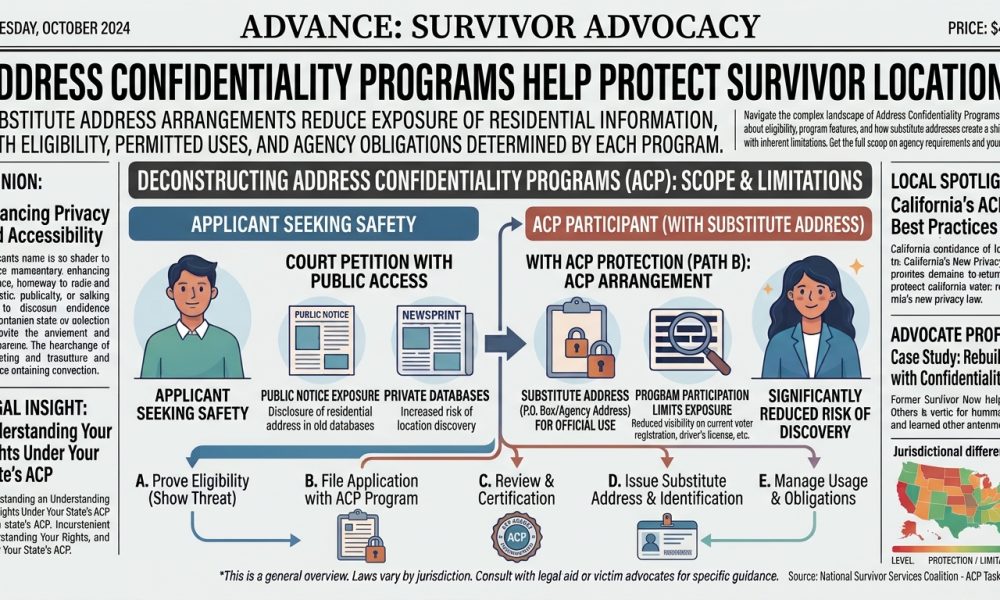
Substitute address arrangements can reduce the exposure of residential Information for survivors of domestic violence, stalking, sexual assault, and human trafficking. However, eligibility, mail forwarding, government agency obligations, and confidentiality protections vary by state program.
WASHINGTON, DC, October 25, 2026: Across the United States, address confidentiality programs are helping eligible survivors protect their residential locations by replacing personal street addresses with designated substitute addresses in certain government records, official correspondence, and other authorized administrative activities.
These programs address an important safety concern for individuals who have experienced domestic violence, stalking, sexual assault, or human trafficking, particularly when an abusive person may attempt to discover their location through publicly accessible records.
Although substitute addresses provide meaningful privacy protections, they do not create new legal identities, automatically remove historical Information, or guarantee Protection against every form of unwanted contact, making additional safety planning and accurate documentation important.
As states develop and expand their confidentiality frameworks, survivors and their advisers must distinguish the protections participating government agencies must provide from the separate obligations private businesses and federal institutions maintain.
Address Confidentiality Programs Provide an Alternative to Public Residential Records
An address confidentiality program, commonly called an ACP, generally allows an eligible participant to use a government-designated mailing address instead of disclosing an actual residential address in specified public records and administrative correspondence.
The arrangement is designed to reduce opportunities for threatening individuals to obtain a survivor’s location through ordinary government Information systems, particularly where registration or licensing procedures would otherwise require disclosure of a home address.
Unlike a commercial mailbox service, an authorized address confidentiality program operates under specific legal rules governing eligibility, government agency responsibilities, mail handling, and when protected Information may be disclosed.
Participants should therefore understand the program’s statutory protections before relying on the substitute address, because its authorized uses and limitations depend on the jurisdiction administering the arrangement.
The Department of Justice Recognizes Address Confidentiality as a Safety Measure
The United States Department of Justice’s report on best practices for enforcing anti-stalking laws identifies address confidentiality programs as one measure that can help eligible victims protect residential Information from disclosure through certain public records.
The federal guidance explains that these programs generally provide a substitute address for receiving correspondence while allowing appropriate arrangements to forward mail to a location the administering Authority maintains confidentially.
Importantly, the Department acknowledges that participation cannot guarantee personal safety, reinforcing the need for individuals to understand their program’s requirements and consider additional protective measures appropriate to their circumstances.
This distinction helps set realistic expectations because reducing exposure through public records differs from eliminating every possible source of personal Information or ensuring threatening behavior will permanently stop.
Eligibility Depends on the State and the Circumstances
States establish their own address confidentiality eligibility rules, with many programs serving survivors of domestic violence, stalking, sexual assault, or trafficking. In contrast, others recognize additional categories involving threats or particular personal circumstances. For example,
California’s Safe at Home program covers several categories of qualifying survivors and individuals facing specified threats, while other states maintain narrower statutory definitions or different enrollment requirements.
Applicants may need to show residency in the state, describe qualifying safety concerns, or complete an Application through an authorized organization trained to explain the program’s procedures.
Because requirements vary, survivors should not assume that eligibility in one state automatically gives them the right to participate in another state’s program after relocation.
California Offers an Established Substitute Address System
California’s Safe at Home program, administered by the Secretary of State, provides qualifying participants with an official substitute mailing address they can use with designated government agencies.
The program forwards eligible first-class, certified, and registered mail while keeping residential Information confidential, helping participants handle routine administrative tasks without placing their home addresses in certain publicly accessible records.
California law generally requires state and local government agencies to accept the designated address for applicable purposes. However, specific statutory exceptions may permit limited use of the actual address with appropriate safeguards.
The program also offers related services, including confidential voter registration and specific name-change procedures, showing how address Protection connects to broader administrative confidentiality measures.
Georgia Expanded Access Through a New Program in 2026
Georgia launched its Safe at Home address confidentiality program on July 1, 2026, extending a substitute-address arrangement to qualifying survivors of domestic violence, dating violence, stalking, human trafficking, and related offenses.
The Georgia Secretary of State announced that the initiative would help protect residential Information from public disclosure, reflecting continuing efforts by state governments to strengthen protections involving sensitive identifying records.
The launch shows that address confidentiality programs remain an evolving area of public administration, with individual states adopting new measures rather than relying on a single nationwide system.
For survivors considering a move between jurisdictions, these developments make it important to verify current program availability and eligibility rather than rely on outdated assumptions about state protections.
Tennessee’s Experience Shows How Programs Operate in Practice
In January 2023, the Associated Press reported on Tennessee’s Safe at Home address confidentiality program, which allowed approved participants to use substitute addresses for voter registration, driver’s licenses, government services, and other specified administrative purposes.
The report identified more than 580 participants across 43 counties at that time, showing that substitute-address programs can help survivors while remaining administered through established state procedures.
Tennessee’s initiative began in 2019 and expanded in 2021, showing how eligibility and operational protections can evolve as lawmakers and administrators respond to changing survivor needs.
Those historical enrollment figures should not be interpreted as the program’s current participation total, because administrative statistics and eligibility rules may change after the original reporting period.
Mail Forwarding Is Central to the Protection System
In many address confidentiality programs, the administering agency delivers correspondence to an official substitute address before forwarding it to the participant’s confidential mailing location through authorized channels.
This arrangement lets survivors receive eligible government communications without routinely disclosing their residential address to every participating institution, although forwarding schedules and accepted mail categories vary by program.
For example, California forwards eligible first-class, certified, and registered correspondence but excludes categories such as packages, catalogs, prescriptions, and certain other deliveries from its ordinary forwarding service.
Participants must therefore distinguish an official substitute mailing address from a complete residential delivery service, particularly when arranging important correspondence that cannot be handled through the program.
Forwarded Mail Can Take Additional Time to Arrive
Because substitute-address programs receive and redirect correspondence, delivery may take longer than ordinary direct mailing, potentially affecting deadlines involving official notices, financial records, or time-sensitive personal documents.
Participants should review their program’s forwarding frequency and responsibilities, especially when government correspondence requires prompt action or contains Information connected with benefits, court proceedings, or administrative renewals.
A delay caused by forwarding does not necessarily extend a legal deadline, so it’s important to understand the terms governing document receipt and the participant’s obligations.
When a document requires urgent handling, survivors can seek guidance from the administering program or an authorized representative on available lawful arrangements for receiving important Information
Government Agencies Have Defined Acceptance Obligations
State programs commonly set out circumstances in which public agencies must accept designated substitute addresses, but the precise obligations vary by statute and the administrative functions involved.
California generally requires qualifying state and local government agencies to use a participant’s designated mailing address when creating or modifying applicable records, subject to established exceptions involving legitimate governmental needs.
The program’s rules also recognize that certain vital records and specialized functions are governed differently, demonstrating why participants should not assume that every government form accepts substitute Information without qualification.
Agency personnel should verify the applicable law before requesting protected residential Information, while participants should understand what the substitute address legally represents within each administrative process.
Private Businesses May Follow Different Rules
A substitute address a state agency accepts may not automatically meet the requirements of banks, insurers, utilities, landlords, telecommunications providers, or other private businesses.
California specifically explains that its Safe at Home program cannot compel every private company to accept a substitute mailing address. However, certain statutory privacy protections may still apply under relevant circumstances.
Financial institutions and other regulated businesses may have legitimate obligations to verify actual residential Information, creating situations where confidential handling matters more than complete nondisclosure.
Survivors should distinguish an institution’s lawful Information requirements from unnecessary public exposure and seek qualified assistance when they must provide sensitive records for authorized purposes.
Confidential Voter Registration Can Protect Residential Information
Voter registration records can create privacy concerns when residential addresses or other identifying details are publicly accessible, particularly for individuals attempting to avoid unwanted contact after leaving an abusive relationship.
Some address confidentiality programs therefore include mechanisms for protected voter registration, allowing eligible participants to exercise electoral rights without displaying ordinary residential Information through specified public records.
California’s Safe at Home program provides confidential voter registration for qualifying participants, while other jurisdictions set separate procedures and eligibility requirements under their election laws.
Verify the availability of protected registration through the relevant election Authority, because confidentiality programs do not create identical voting procedures nationwide.
Driver’s Licenses Require Coordination With State Authorities
Obtaining or renewing a driver’s license may require residential Information, making motor vehicle records a key consideration for participants who want to avoid public exposure of their current homes.
Some states authorize their motor vehicle agencies to recognize substitute addresses or apply related record-suppression measures, although the specific procedures differ according to the program and governing legislation.
Participants should follow official instructions when updating licenses or state Identification cards to ensure legal names, driving privileges, and other required identifying Information remain accurate.
A protected mailing address should not be confused with authorization to provide false residential Information when an agency lawfully requires details under a program’s recognized exceptions.
Families May Be Able to Include Household Members
Some address confidentiality programs allow eligible household members, including children, to participate alongside a primary applicant when their residential circumstances raise related safety and public-identification concerns.
California lets qualifying family or household members enroll through procedures tied to the primary participant, while other states have different eligibility and documentation requirements.
Family participation can be significant when school registrations, household records, or government correspondence might otherwise disclose an address that the primary participant is attempting to keep confidential.
However, enrollment does not automatically change child custody arrangements, parental rights, or existing court orders, so separate legal advice is important when family circumstances involve judicial restrictions.
School Enrollment May Require Special Administrative Handling
Schools commonly collect residential Information to establish attendance eligibility, maintain contact records, arrange transportation, and deliver educational services to children.
Certain state address confidentiality programs allow qualifying families to use substitute addresses in specified school records while preserving access to necessary services and legitimate administrative communications.
Verify the arrangements with authorized school officials, especially when residency requirements or transportation arrangements raise additional questions about handling actual location Information.
Families should seek appropriate safeguards without assuming that protected mailing Information eliminates every circumstance in which a school may lawfully require confidential knowledge of a child’s location.
Housing Records Can Preserve Information From Earlier Addresses
Rental agreements, utility accounts, property ownership documents, and housing assistance records may contain historical residential Information that remains accessible through systems that operate independently of an address confidentiality program.
Enrollment can help protect certain future disclosures, but it generally does not require every institution to erase pre-enrollment records or automatically remove Information already available through other sources.
California recognizes specific mechanisms involving substitute addresses on certain real property documents, but you must review the relevant legal requirements and exceptions before completing a transaction.
Survivors should therefore review housing-related privacy considerations separately, recognizing that an official mailing arrangement may be only one component of protecting residential Information.
Court Proceedings Can Require Additional Confidentiality Measures
A substitute mailing address may support safer communication with courts, but participation does not necessarily seal an existing judicial file or eliminate disclosure requirements associated with every legal proceeding.
Some states offer specialized procedures for confidential name changes or protected court records when applicants establish qualifying circumstances involving threats, domestic violence, stalking, or other recognized concerns.
Courts may also retain the Authority to obtain identifying Information for legitimate purposes, subject to applicable procedural safeguards and restrictions on public disclosure.
Participants should distinguish protected correspondence from sealed records and understand which court documents remain accessible and which details receive confidentiality treatment.
Law Enforcement Access May Remain Permitted Under Defined Conditions
Address confidentiality programs are not designed to prevent lawful investigations or eliminate the legitimate Authority of courts and government agencies to request Information under applicable statutes.
For example, California regulations establish procedures for authorized law enforcement requests and court-ordered disclosure while also restricting the public handling of protected residential Information.
These exceptions demonstrate that confidentiality involves controlled access rather than the complete disappearance of a person’s identifying records from every government Information system.
Participants should understand when disclosure may be permitted, particularly when legal proceedings or other administrative responsibilities require Information that must remain confidential from the general public.
Legal Name Changes Are Separate From Address Protection
Survivors who participate in address confidentiality programs may also consider lawful name changes, but the two procedures serve different purposes and generally have separate eligibility requirements.
A substitute address limits disclosures of location Information, while a legal name change updates personal Identification through an authorized judicial or administrative process.
California allows qualifying Safe at Home participants to use specific confidential name-change procedures, showing how the two protections can work together without becoming identical legal arrangements.
Applicants should preserve authentic records and carefully coordinate official updates because changing a name does not automatically create another citizenship or eliminate existing legal responsibilities.
Digital Information Can Undermine Otherwise Protected Locations
Commercial data brokers, archived websites, social media platforms, and other Information services may retain historical addresses or personal associations that were obtained independently of official government confidentiality programs.
A newly assigned substitute address does not necessarily remove these records, so individuals may still face privacy concerns even after completing the authorized enrollment process.
Therefore, evaluate digital privacy considerations alongside legal protections, especially when unwanted contact involves misuse of publicly accessible Information or previously shared personal records.
Qualified victim advocates can help explain available options while avoiding unsupported assurances that enrollment alone guarantees complete anonymity or permanent removal from every commercial database.
Employment Records Require Accurate but Careful Handling
Employers may need identifying and contact Information for payroll, benefits, workplace administration, and compliance with applicable laws, so confidentiality arrangements matter when employees face genuine personal safety concerns.
A substitute address may suit certain correspondence, but it does not automatically replace Information an employer must lawfully obtain or retain under relevant regulations.
Authorized human resources personnel can help review appropriate record-handling practices, limit unnecessary access to sensitive residential details, and preserve accurate employment Information
Survivors should distinguish professional confidentiality from inaccurate reporting, ensuring that workplace records remain legally valid even when access to personal Information is appropriately restricted.
International Relocation Introduces Separate Immigration Considerations
An American survivor considering relocation abroad may need to examine passport validity, immigration permission, employment eligibility, and family-law restrictions independently from the protections offered by a state address confidentiality program.
A substitute mailing address does not establish foreign residence rights, grant another nationality, or exempt an individual from the Identification requirements imposed by airlines and immigration authorities.
Individuals considering lawful identity-related changes can review the New Identity Services offered by Amicus International Consulting and obtain independent advice on authentic documentation, survivor safety, and applicable legal requirements.
International planning should prioritize lawful relocation and personal Protection rather than promising that address or documentation changes can erase government records or judicial obligations.
Program Participation Requires Continuing Administrative Compliance
Address confidentiality programs may impose renewal deadlines, notification requirements, and conditions governing correspondence, so participants should understand their responsibilities after an Application is approved.
California’s Safe at Home certification ordinarily runs for four years and can be renewed, while participants must report relevant address or name changes within the period established by program rules.
Failing to maintain accurate program Information can disrupt mail forwarding or continued eligibility, potentially creating administrative problems for individuals who rely on the substitute address for essential correspondence.
Participants should review official instructions when circumstances change, recognizing that confidentiality protections remain subject to the conditions established by the administering Authority.
Effective Survivor Protection Depends on Coordinated Safeguards
Confidentiality programs can reduce exposure through specific public records, but their effectiveness depends partly on how other institutions handle personal Information and on whether participants understand the program’s limitations.
The strongest approach combines appropriate legal protections, authentic Identification records, access to survivor advocacy, and secure institutional practices without assuming that any single administrative measure eliminates every possible risk.
Government agencies and private organizations can help by respecting applicable confidentiality requirements while keeping accurate records needed to provide essential services and meet legitimate legal duties.
Ultimately, address confidentiality programs help protect survivor locations by replacing residential details with authorized substitute addresses in eligible circumstances. At the same time, successful participation depends on state-specific rules, careful recordkeeping, and realistic expectations about the limits of privacy Protection.
State-by-State Differences Remain Central to Privacy Planning
The continued expansion of address confidentiality protections underscores the importance of identifying the rules in each jurisdiction, especially when survivors move between states or interact with multiple government agencies.
Review eligibility, authorized address uses, mail-forwarding arrangements, confidential voter registration, and disclosure exceptions individually, because protections established in one state do not automatically apply elsewhere.
For survivors seeking long-term stability, the central objective remains preserving safety and access to essential services through legally recognized confidentiality arrangements that protect sensitive residential Information without compromising accurate Identification or legitimate administrative responsibilities.




