
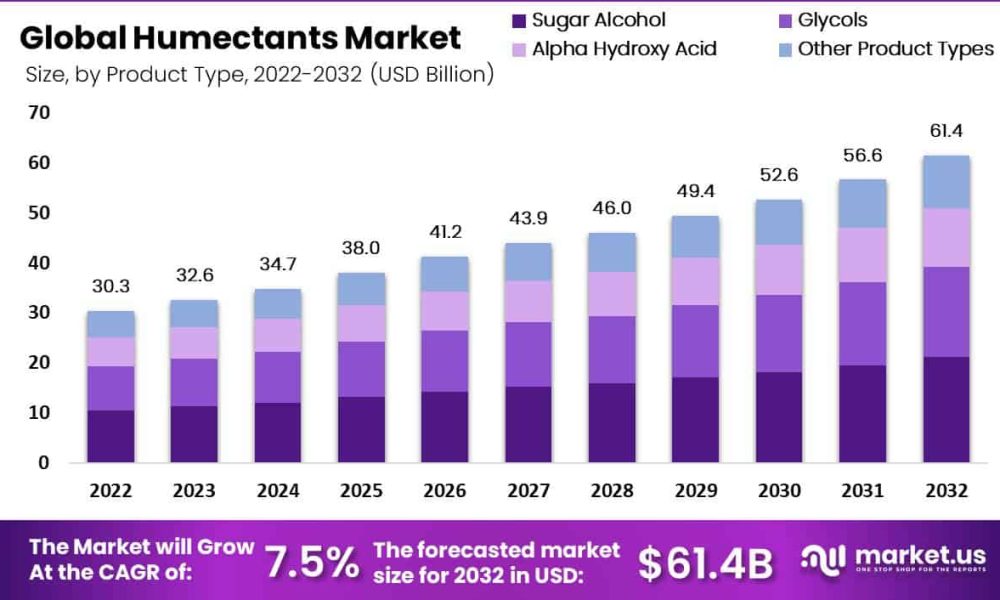
According to market.us, the global humectants market was valued at USD 30.3 billion in 2023 and is projected to reach USD 61.4 billion by 2032, expanding at a CAGR of 7.5% during the forecast period. Humectants, widely used in personal care and food applications, are known for their ability to retain moisture by drawing water from the air or deeper skin layers.
These compounds are commonly found in lotions, shampoos, and other skincare and cosmetic products, where they are often blended with emollients, preservatives, and antioxidants to enhance absorption and hydration.
Market growth is significantly supported by changing consumer lifestyles, with rising demand for ready-to-eat products and longer shelf-life solutions. Humectants also play a crucial role in the food industry as additives, offering improved moisture retention, nutritional value, and better texture. The shift towards low-calorie diets has further boosted the use of polyol-based humectants in processed foods and beverages, as they help control water activity while offering reduced sugar content.
Additionally, increasing consumer preference for functional skincare, especially in urban areas, has driven strong demand from the cosmetic industry. As multifunctional ingredients, humectants are expected to see wider application across sectors, contributing to sustained market expansion through 2032.
Key Takeaways
- Market Growth: The global humectants market was valued at USD 30.3 billion in 2022 and is projected to reach USD 61.4 billion by 2032, representing a Compound Annual Growth Rate (CAGR) of 7.5% from 2023 to 2032.
- Application in Cosmetics: Humectants are used in cosmetics and personal care products in combination with other ingredients like emollients, occlusives, and antioxidants to provide moisture to the skin and aid in the absorption of active components.
- Anti-Aging Products: The global aging population has fueled demand for anti-aging skincare products, and humectants play a crucial role in these formulations.
- Leading Product Types: Sugar alcohol humectants, such as those used as sugar substitutes in low-calorie foods, have seen significant growth. Glycols, especially propylene glycol, are also widely used in skincare and cosmetic products.
- Natural vs. Synthetic: Natural humectants, sourced from ingredients like glycerin and aloe vera, are preferred due to their mildness and safety for the skin. Synthetic humectants, like glycerin and urea, are chosen for their cost-effectiveness and longer shelf life.
- Application Sectors: The food and beverage sector is the largest consumer of humectants, driven by their ability to extend product shelf life. Oral and personal care products also utilize humectants to retain moisture, improve gloss, and enhance skin health.
- Regional Analysis: North America The region holds a 35% share of the market due to high growth in the beauty and pharmaceutical industries and increasing demand for ready-to-eat food. Asia Pacific Changing consumer lifestyles, rising disposable income, and a focus on health and nutrition in countries like India and China contribute to high growth.
Access a Complimentary Sample of This Premium Report: https://market.us/report/humectants-market/request-sample/
Factors Affecting the Growth of the Humectants Market
Rising Demand for Moisturizing and Anti-Aging Products: An increasing focus on skincare, particularly products that offer hydration and anti-aging benefits, is driving demand for humectants. Consumers are becoming more aware of skin health and are actively seeking products with ingredients that help retain moisture and improve texture.
Expansion of the Processed Food and Beverage Sector: The widespread use of humectants in processed foods, bakery items, and confectionery products to retain moisture and improve shelf life is a key driver. As convenience foods become more popular, the demand for humectants in food applications continues to grow.
Shift Towards Low-Calorie and Sugar-Free Alternatives: With growing health consciousness, consumers are opting for low-sugar diets, leading to increased use of sugar alcohols such as sorbitol and xylitol, which function as humectants in foods and beverages.
Growth in the Personal Care and Cosmetic Industry: The personal care sector, particularly skincare and haircare, increasingly relies on humectants to enhance product performance. Their ability to support ingredient delivery and maintain product consistency makes them vital in formulations.
Technological Advancements in Ingredient Development: Ongoing innovation in the synthesis of bio-based and multifunctional humectants has broadened their application. New product development is enabling better performance, stability, and compatibility with clean-label and natural formulations.
Key Market Segmentation
By Product Type Analysis
Sugar alcohol humectants are experiencing notable growth, particularly in “no added sugar” and “sugar-free” food products. As consumer awareness of low-calorie diets rises globally, demand for these humectants is expected to increase significantly over the forecast period.
Meanwhile, the glycol segment is also projected to grow rapidly, driven by its extensive use in personal care products such as creams, lotions, shampoos, and serums. Propylene glycol, in particular, stands out as a widely used and safe humectant. Beyond cosmetics, it is also commonly found in frozen dairy items, packaged baked goods, beer, soda, and coffee, contributing to its rising market demand across both food and non-food sectors.
By Source Analysis
Natural humectants such as glycerin, honey, aloe vera, and lactic acid are widely used in soaps, moisturizers, and cosmetics. Their demand is increasing due to growing consumer interest in hydration, skincare, and the preference for natural and organic ingredients. This trend is expected to drive strong growth in the natural humectants segment during the forecast period. In parallel, synthetic humectants are also projected to grow at a high rate, owing to their moisture-retaining capabilities and chemical stability.
Compounds like ectoin and methyl gluceth are known for their multiple hydrogen-bonding sites, enhancing skin hydration. Additionally, glycols such as butylene glycol and propylene glycol aid in moisture retention by altering the structure of ceramides and have slower evaporation rates than water. Synthetic variants like urea, sodium lactate, sorbitol, and glycerin are favored in cosmetics due to their lower production costs and extended shelf life.
By Application Analysis
The demand for humectants in the food and beverage industry is rising due to their key benefits, such as extending shelf life and enhancing product performance. Innovations by manufacturers and ongoing research in food applications are further supporting this growth. Additionally, there is a growing shift toward using food-grade, consumer-safe ingredients, which is expected to strengthen the use of humectants in food products during the forecast period. The oral and personal care segment is also projected to witness substantial growth, driven by humectants’ strong moisture-retention properties.
These compounds are commonly used in toothpaste, mouthwash, and various personal care formulations. In the cosmetics sector, humectants are widely incorporated in creams, lotions, and serums due to their skin-soothing and hydrating effects. Their medical relevance is also notable, particularly in treating skin conditions like eczema and psoriasis.
Humectants Key Market Segments
By Product Type
- Sugar Alcohol
- Glycols
- Alpha Hydroxy Acid
- Other Product Types
By Source
- Natural
- Synthetic
By Application
- Food & Beverage
- Oral & Personal Care
- Pharmaceuticals
- Other Applications
Regional Analysis
North America is expected to dominate the humectants market, holding the largest share of approximately 35% during the forecast period. This dominance is driven by the region’s strong pharmaceutical and beauty industries, alongside rising demand for ready-to-eat food in the U.S. and Canada, which boosts the use of humectants in food applications.
In contrast, the Asia Pacific region is projected to witness the highest growth, fueled by shifting consumer lifestyles, increasing disposable incomes, and growing demand for functional and nutritious food, especially in China and India. Additionally, greater consumer awareness regarding food additives is expected to support regional market expansion.
In Europe, the preference for natural ingredients over synthetic ones is prominent due to stricter regulations and higher safety standards in cosmetic formulations. European consumers often associate natural components with lower health risks, leading manufacturers to avoid synthetic humectants and opt for safer, naturally derived alternatives.
Top Key Players in the Market
- BASF SE
- Archer Daniel Midland Company
- Cargill Incorporated
- Du Pont De Nemours and Company
- Ashland Global Holdings Inc.
- The DOW Chemical Company
- Barentz
- Ingredion
- Brenntag AG
- Roquette Freres
- Other Key Players
Get in Touch with Us:
Market.us (Powered By Prudour Pvt. Ltd.)
Address: 420 Lexington Avenue, Suite 300 New York City, NY 10170, United States
Send Email: [email protected]
Refer to More Related Reports:



