
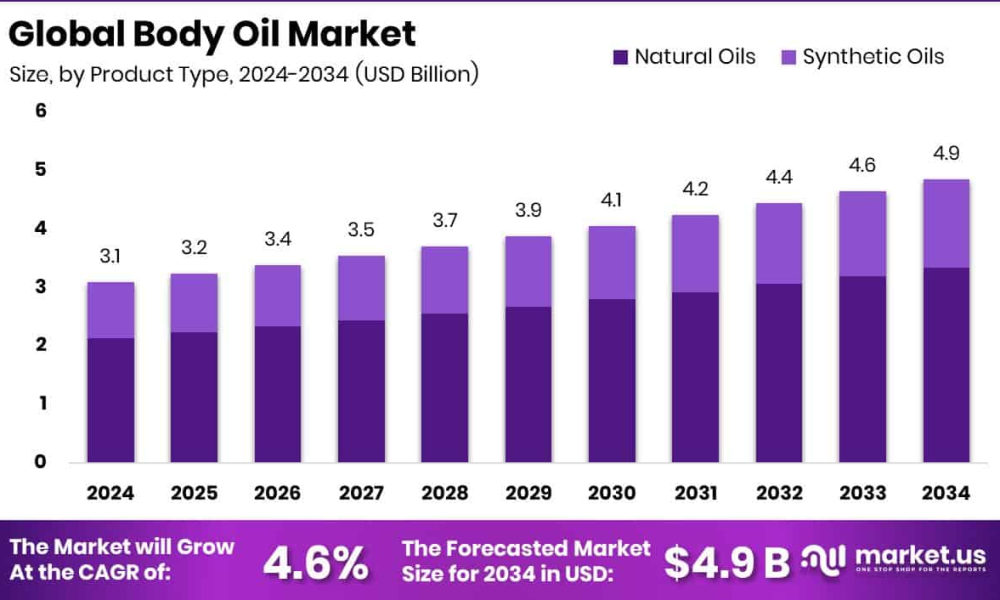
According to market.us, The global body oil market is projected to reach a value of approximately USD 4.9 billion by 2034, rising from USD 3.1 billion in 2024, with a steady compound annual growth rate (CAGR) of 4.6% from 2025 to 2034. North America plays a significant role in this expansion, driven by increasing wellness awareness, and accounted for a substantial 41.8% market share in 2024. Body oil, a skincare product made primarily from plant-based or natural oils, is designed to deeply hydrate and nourish the skin.
Unlike lotions, which typically contain water, body oils are more concentrated and penetrate the skin more effectively, offering long-lasting moisturization. These products are often enriched with essential oils or skin-friendly vitamins, providing additional benefits such as improved skin tone, reduced dryness, and enhanced elasticity. They are commonly applied after bathing or used in massages, contributing to their popularity in both personal care and therapeutic wellness routines.
The global body oil market encompasses the manufacturing, distribution, and retail of various formulations intended for skincare. This includes a broad range of products—from organic and herbal blends to premium oils tailored for specific skin concerns—serving a diverse consumer base across genders and age groups. The market is seeing growing traction in the personal care, spa, and wellness sectors as consumers increasingly gravitate toward natural and minimalist skincare solutions.
The clean beauty trend has significantly influenced buying behavior, with more individuals moving away from synthetic lotions in favor of body oils derived from ingredients like almond, jojoba, and argan oils. These naturally sourced options are particularly appealing to consumers with sensitive or allergy-prone skin, encouraging brands to innovate with cold-pressed, organic, and chemical-free formulations that offer higher levels of trust, safety, and consumer loyalty.
Key Takeaways
- Global Body Oil Market is expected to be worth around USD 4.9 billion by 2034, up from USD 3.1 billion in 2024, and grow at a CAGR of 4.6% from 2025 to 2034.
- In 2024, Natural Oils held a 68.9% share in the Body Oil Market by Product Type.
- Liquid form dominated the Body Oil Market with a 72.7% share in the Product Form segment.
- Spa and Wellness Centers accounted for 56.4% application share in the Body Oil Market.
- Supermarkets/Hypermarkets led distribution with a 44.8% market share in the Body Oil segment.
- North America generated USD 1.2 Bn in body oil sales during 2024.
Access a Complimentary Sample of This Premium Report: https://market.us/report/global-body-oil-market/free-sample/
Factors Affecting the Growth of the Body Oil Market
- Rising Demand for Natural and Organic Products: A significant driver of market growth is the increasing consumer shift toward clean beauty and chemical-free skincare products. Body oils made from natural ingredients such as almond, jojoba, coconut, or argan oil are gaining popularity due to their perceived purity and skin compatibility. Consumers, especially those with sensitive or allergy-prone skin, are actively avoiding synthetic additives and preservatives, leading to higher demand for organic and cold-pressed oils.
- Growth in Wellness and Self-Care Trends: The global focus on wellness, particularly post-pandemic, has led to a heightened interest in self-care routines that include nourishing body oils. Used for hydration, relaxation, and massage therapy, body oils are being increasingly integrated into daily wellness practices. This shift is particularly strong in North America and Europe, where wellness spending is high and consumers prioritize holistic health approaches.
- Expanding Spa and Personal Care Industry: The expansion of the spa, aromatherapy, and premium personal care industries has positively impacted the body oil market. Body oils are widely used in professional spa treatments and massage therapies due to their moisturizing properties and ability to deliver essential oils effectively. The rise of boutique wellness centers and luxury skincare brands has further boosted demand for high-quality, scented, and therapeutic oils.
- Increasing Awareness of Skin Health: Consumers are becoming more knowledgeable about skincare ingredients and are actively seeking products that offer both cosmetic and therapeutic benefits. Body oils are valued not just for hydration, but also for their ability to improve skin elasticity, reduce stretch marks, and enhance skin tone. This awareness is expanding the consumer base, particularly among aging populations and individuals with dry or sensitive skin.
- Influence of E-Commerce and Digital Marketing: The rise of digital platforms and e-commerce has broadened consumer access to body oil products worldwide. Online beauty retailers, direct-to-consumer brands, and influencer-driven marketing strategies have helped niche body oil brands reach targeted audiences, especially younger, internet-savvy consumers who prefer convenience and personalized shopping experiences.
Report Segmentation
By Product Type Analysis: In 2024, natural oils dominated the body oil market’s product type segment, accounting for a significant 68.9% share. This reflects a strong consumer shift toward plant-based and organic skincare products that offer clean, nourishing, and chemical-free solutions. Oils derived from sources such as almond, coconut, and jojoba are favored for their antioxidant-rich properties and deep hydration benefits. The preference for natural formulations is closely linked to rising consumer awareness around ingredient transparency and the broader wellness movement. Additionally, the popularity of Ayurvedic and cold-pressed oils in culturally rooted regions further supports the segment’s growth. As sustainability and skin safety remain key concerns, natural oils continue to lead the market over synthetic alternatives.
By Product Form Analysis: Liquid body oils held a dominant 72.7% share in the product form segment of the body oil market in 2024. Their popularity stems from their ease of application, fast absorption, and smooth texture, making them highly suitable for daily use and professional therapies. Liquid forms offer excellent compatibility with essential oils, enhancing their role in aromatherapy and customized skincare routines. Their packaging—often in pump bottles or droppers—adds convenience and hygiene, which resonates with modern consumer preferences. Moreover, brands are increasingly enhancing liquid body oils with botanical extracts, vitamins, and natural fragrances, further boosting their appeal across personal and wellness care settings.
By Application Analysis: Spa and wellness centers emerged as the leading application segment for body oils in 2024, contributing 56.4% to the market. This dominant share highlights the central role of body oils in massage therapies, skincare treatments, and holistic wellness experiences. Spas rely on high-quality aromatic oils for their therapeutic properties, sensory benefits, and ability to improve skin texture. The segment has been further strengthened by the post-pandemic surge in self-care and relaxation services, driving demand for premium oil-based treatments. Luxury hotel spas and wellness tourism destinations have also played a part in this growth, often incorporating specialized oil therapies into their offerings, making spa and wellness centers a key driver in the body oil market.
By Distribution Channel Analysis: In 2024, supermarkets and hypermarkets led the distribution channel segment of the body oil market with a 44.8% share. Their dominance is attributed to wide product availability, convenience, and the ability for consumers to physically evaluate skincare items. These retail environments offer a range of body oils across various price points, from budget-friendly to premium, thus appealing to a broad demographic. High foot traffic, in-store promotions, and competitive pricing strategies make supermarkets and hypermarkets a preferred choice for both planned and impulse purchases. Their extensive reach across urban and semi-urban locations ensures accessibility, reinforcing their position as the most influential distribution channel for body oil products.
To Purchase this Premium Report@ https://market.us/purchase-report/?report_id=147737
Key Market Segments
By Product Type
- Natural Oils
- Synthetic Oils
By Product Form
- Spray
- Liquid
By Application
- Spa and Wellness Centers
- Medical Therapeutics
- Others
By Distribution Channels
- Supermarkets/Hypermarkets
- Brand Stores
- Pharmacy Stores
- Online Platforms
- Other Distribution Channels
Regional Analysis
In 2024, North America emerged as the leading region in the global body oil market, capturing a substantial 41.8% share and generating approximately USD 1.2 billion in revenue. This regional dominance is driven by heightened consumer awareness surrounding skincare, a well-established retail network, and the growing integration of body oils into wellness routines. The popularity of natural and therapeutic oil-based products has contributed significantly to market strength across the United States and Canada.
Europe followed closely, with steady demand supported by the increasing adoption of premium body oils and a strong shift toward organic and sustainable skincare options, particularly in countries such as Germany and France. In the Asia Pacific region, market growth is accelerating due to rising disposable incomes and a growing inclination toward personal care and grooming products among younger consumers.
The Middle East and Africa are also witnessing gradual expansion in the body oil market, particularly as oil-based products become more prominent within traditional beauty rituals and spa treatments in key wellness tourism destinations. Meanwhile, Latin America is showing promising potential, bolstered by the development of local manufacturing capabilities and a cultural affinity for natural, oil-based skincare solutions. Collectively, these regional dynamics are shaping a diverse and growing global landscape for body oils.
Market Key Players
- Unilever plc
- The Procter & Gamble Company
- Avon Products, Inc.
- L’Occitane Groupe S.A.
- Aveda Corporation
- Clarins
- KAO USA Inc.
- Desert Essence
- Chanel Limited
- MOROCCANOIL, INC.
- Forte Organics Ltd
- Other Key Players
Refer More Related Reports:
Get in Touch with Us:
Market.us (Powered By Prudour Pvt. Ltd.)
Address: 420 Lexington Avenue, Suite 300, New York City, NY 10170, United States.
Contact No: +1 718 874 1545 (International), +91 78878 22626 (Asia).
Email: [email protected]



