

Overview
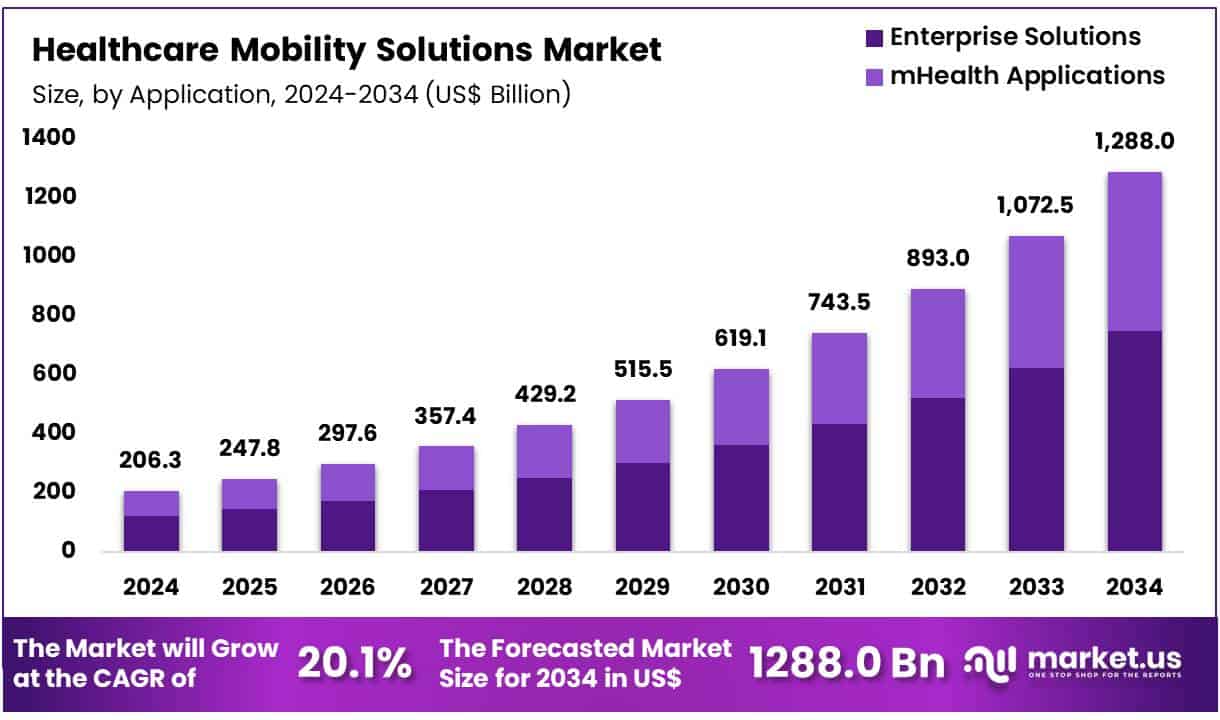
The Global Healthcare Mobility Solutions Market size is expected to be worth around US$ 1288.0 Billion by 2034 from US$ 206.3 Billion in 2024, growing at a CAGR of 20.1% during the forecast period 2025 to 2034. In 2024, North America led the market, achieving over 43.2% share with a revenue of US$ 89.1 Billion.
The global healthcare mobility solutions market is experiencing substantial growth, driven by the rising adoption of mobile devices, increasing demand for patient-centric care, and growing pressure to improve healthcare efficiency and accessibility. Healthcare mobility solutions encompass a wide range of mobile applications, devices, and services designed to streamline clinical workflows, improve communication between providers, and enhance patient outcomes.
Mobile health (mHealth) apps, remote monitoring tools, and mobile EHR access are increasingly being integrated into hospital systems, supporting real-time data access and decision-making. According to the World Health Organization (WHO), mobile health is playing a vital role in extending care to remote and underserved populations, particularly in low- and middle-income countries.
Hospitals, home healthcare agencies, and diagnostic laboratories are among the key adopters of mobility solutions. The increasing prevalence of chronic conditions such as diabetes and cardiovascular diseases is further fueling the need for continuous patient monitoring via mobile platforms. Additionally, government initiatives like the U.S. HITECH Act and Europe’s Digital Health Strategy are catalyzing healthcare digitalization, creating a favorable environment for market expansion.
North America currently leads the market due to robust digital infrastructure, while Asia-Pacific is projected to witness the fastest growth over the forecast period. As digital innovation continues to reshape healthcare delivery, mobility solutions are becoming essential in creating more responsive, connected, and efficient health systems.
Click here to get a Sample report copy@ https://market.us/report/global-healthcare-mobility-solutions-market/free-sample/
Key Takeaways
- In 2024, the global healthcare mobility solutions market generated revenue of USD 3 billion, and is projected to reach USD 1,288.0 billion by 2033, growing at a CAGR of 20.1% during the forecast period.
- Based on product type, the market is categorized into enterprise mobility platforms, mobile applications, and mobile devices. Among these, mobile devices led the segment in 2023, accounting for 47.5% of the total market share.
- In terms of application, the market is segmented into enterprise solutions and mHealth applications. Enterprise solutions emerged as the leading segment, holding a significant 58.3% share.
- By end-user, the market is divided into healthcare providers, healthcare payers, and patients. Healthcare providers dominated this segment with a 54.6% revenue share, reflecting their central role in care delivery and digital adoption.
- Regionally, North America held the largest market share at 43.2% in 2023, driven by advanced healthcare infrastructure and high adoption of mobile health technologies.
Segmentation Analysis
- Product Type Analysis: The mobile devices segment held a 47.5% market share, driven by the widespread use of smartphones, tablets, and wearables in clinical settings. These devices enable healthcare professionals to access patient records, monitor vitals, and communicate efficiently, improving workflow. Enhanced security features and device interoperability support broader adoption across facilities. Mobile health apps designed for these devices also contribute to demand. Their role in remote monitoring and telemedicine is expanding, making mobile devices essential to scalable healthcare mobility solutions.
- Application Analysis: Enterprise solutions accounted for 58.3% of the market, reflecting growing demand for integrated platforms that streamline clinical operations. These solutions facilitate secure data exchange, support coordinated workflows, and comply with privacy regulations. As healthcare systems shift toward value-based care, scalable mobility platforms become critical for optimizing outcomes. Integration with mHealth apps enhances their effectiveness. Healthcare organizations increasingly invest in customizable enterprise solutions that improve operational efficiency and support large-scale digital transformation initiatives.
- End-user Analysis: Healthcare providers captured 54.6% of the revenue share due to their essential role in delivering care and managing patient data. Providers utilize mobility solutions for real-time access to health records, remote consultations, and streamlined documentation. The rise in chronic conditions and aging populations increases the need for efficient care delivery tools. Digital health investments and telehealth expansion further boost adoption. As care delivery becomes more patient-centric, providers remain the leading adopters of healthcare mobility technologies.
Market Segments
Product Type
- Enterprise Mobility Platforms
- Mobile Applications
- Mobile Devices
- Barcode Scanners
- Mobile Computers
- RFID Scanners
- Other Mobile Devices
Application
- Enterprise Solutions
- Patient Care Management
- Case Management
- Dietary And Nutrition
- Infectious Disease Monitoring/Field Data Collection
- Medication Administration
- Patient Id (PPID)/Patient Tracking
- Patient Monitoring
- Specimen Collection And Tracking
- Other Patient Care Management Solutions
- Operation Management
- Asset And Facilities Management
- Claims Processing
- Materials Management
- Patient Admissions/Discharge
- Revenue Management/Billing
- Other Operation Management Solutions
- Work Force Management
- Scheduling
- Time And Attendance Management
- Other Workforce Management Solutions
- mHealth Applications
- Chronic Care Management
- Exercise
- Medication Management
- Sleep Monitoring
- Weight Loss
- Women’s Health
- Other mHealth Applications
End-user
- Healthcare Payers
- Healthcare Providers
- Hospitals
- Laboratories
- Other Healthcare Providers
- Patients
To Purchase this Premium Report @ https://market.us/purchase-report/?report_id=149149
Regional Analysis
North America Leads the Healthcare Mobility Solutions Market
North America accounted for the largest share of the global healthcare mobility solutions market, contributing approximately 43.2% of total revenue. This dominance can be attributed to the widespread use of smartphones and tablets by healthcare professionals and the high adoption of electronic health records (EHRs).
According to the Office of the National Coordinator for Health Information Technology (ONC), a significant percentage of U.S. hospitals have integrated EHR systems, creating a strong need for mobile access tools. In 2024, Eli Lilly and Company introduced LillyDirect, a mobile platform designed to support chronic disease management, highlighting the region’s growing shift toward mobile-driven care delivery. This increasing reliance on digital tools is aimed at improving clinical efficiency, patient engagement, and accessibility.
Asia-Pacific to Witness the Fastest Growth Rate
The Asia-Pacific region is projected to record the highest compound annual growth rate (CAGR) during the forecast period. By the end of 2022, mobile subscriptions in the region reached 1.73 billion, with continued expansion anticipated due to rising smartphone affordability and internet penetration.
Government initiatives such as India’s National Digital Health Mission (NDHM), launched in 2022, are expected to accelerate the deployment of healthcare mobility solutions by building a robust digital health ecosystem. These advancements are enabling broader adoption of mHealth services, remote consultations, and digital record systems across emerging economies.
Key Players Analysis
Leading players in the healthcare mobility solutions market are driving growth through the integration of advanced technologies such as artificial intelligence (AI) and cloud computing. These companies are strengthening their market position by engaging in strategic partnerships and acquisitions aimed at enhancing their technological capabilities and expanding their geographic reach.
A key focus lies in the development of scalable mobile platforms that enable real-time patient monitoring, secure data sharing, and streamlined clinical workflows. Ensuring data security and compliance with healthcare regulations remains a top priority to promote trust and facilitate widespread adoption across healthcare systems. Continuous investment in research and development enables companies to stay competitive and adapt to rapid technological advancements.
A prominent example is Oracle Health, formerly known as Cerner Corporation. Established in 1979, Oracle Health is recognized for its expertise in health information technology, particularly in providing electronic health record (EHR) systems and interoperability solutions globally. In 2022, Oracle Corporation acquired Cerner for USD 28.3 billion, incorporating its offerings into the broader Oracle Health ecosystem.
Oracle Health delivers a suite of services including mobile health apps, clinical decision support tools, and data analytics platforms, all designed to improve patient outcomes and healthcare efficiency. The company continues to advance innovation by focusing on AI-powered solutions and system-wide integration within the digital health landscape.
Market Key Players
- Wipro
- Oracle
- OMRON Healthcare
- Microsoft
- IBM Corporation
- GE HealthCare
- GCX
- Apple Inc
Market Dynamics
- Market Driver: The primary driver for the healthcare mobility solutions market is the increasing adoption of mobile devices and digital tools in clinical settings. Healthcare professionals are using smartphones, tablets, and wearable technologies to access electronic health records (EHRs), communicate with care teams, and monitor patients in real time. This shift toward mobility enhances workflow efficiency, supports faster clinical decisions, and improves patient engagement. The demand for remote care and real-time data access continues to fuel market expansion globally.
- Market Trend: A key emerging trend is the integration of artificial intelligence (AI) and cloud computing into healthcare mobility platforms. These technologies enable predictive analytics, automated workflows, and scalable data storage, significantly enhancing clinical decision-making and operational efficiency. AI-driven applications support functions such as remote diagnostics, patient triage, and personalized treatment planning. The trend toward digitized, data-driven healthcare is prompting providers to adopt advanced mobile platforms that support seamless interoperability, real-time monitoring, and improved care coordination across diverse healthcare environments.
- Market Opportunity: A major opportunity lies in the expansion of healthcare mobility solutions across emerging markets, particularly in Asia-Pacific and Africa. With rising mobile penetration, increasing affordability of smartphones, and growing government investment in digital health infrastructure, these regions are well-positioned for adoption. National initiatives such as India’s NDHM support large-scale implementation of mobile health platforms. This creates a favorable environment for vendors to introduce scalable, cost-effective solutions tailored to underserved populations, driving growth and improving access to care.
Conclusion
The global healthcare mobility solutions market is poised for transformative growth, driven by technological advancements, increased mobile adoption, and a rising focus on patient-centric care. With a projected CAGR of 20.1% through 2034 and strong contributions from North America and emerging Asia-Pacific markets, mobility solutions are redefining healthcare delivery.
Key players are accelerating innovation through AI, cloud integration, and strategic collaborations. As digital infrastructure strengthens globally, the demand for scalable, secure, and efficient mobile platforms will continue to grow, offering significant opportunities to enhance clinical outcomes, operational efficiency, and healthcare accessibility across all regions.
View More Reports:
Healthcare Predictive Analytics Market Set for 24.1% CAGR Growth
Healthcare Predictive Analytics Market Set for 24.1% CAGR Growth
Bioanalytical Testing Services Market Eyes USD 11.5 Bn Milestone
Bioanalytical Testing Services Market Eyes USD 11.5 Bn Milestone
Healthcare Interoperability Solutions Market to Hit USD 14.7 Billion by 2034
Healthcare Interoperability Solutions Market to Hit USD 14.7 Billion by 2034



