
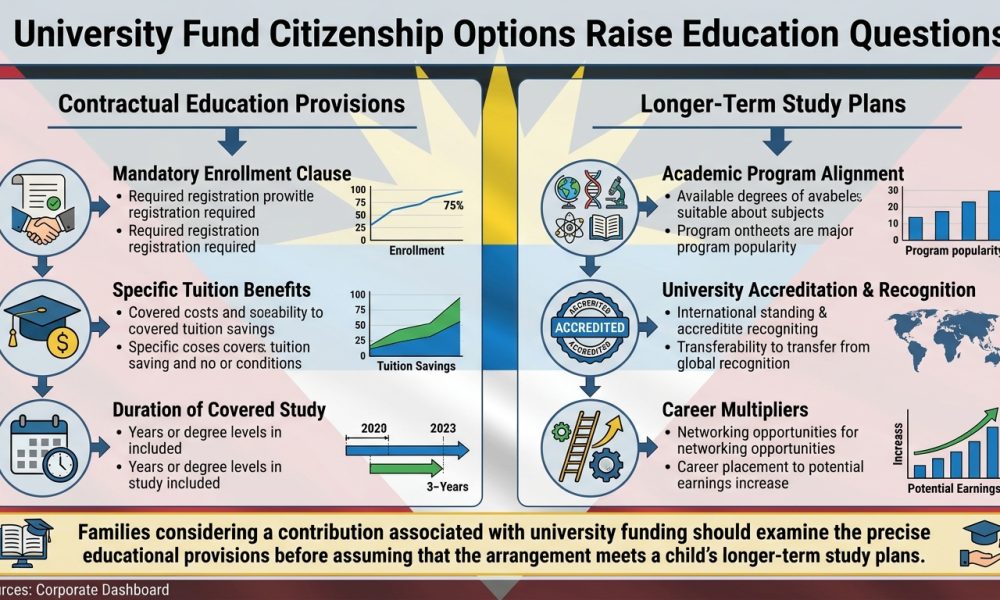
An education-linked citizenship contribution may help finance university development while offering a limited tuition benefit. Still, families must examine eligibility, admissions, living expenses, and separate government rules before treating the arrangement as a complete study plan.
WASHINGTON, DC, November 6, 2026 — Antigua and Barbuda’s University of the West Indies Fund attracts families comparing second citizenship with educational opportunities, yet its advertised scholarship has a narrower scope than a complete university education or guaranteed admission to a preferred degree program.
The government describes a contribution pathway available to qualifying families of at least six people, with an accompanying one-year tuition-only scholarship for one family member rather than unlimited educational funding for everyone included in the citizenship application.
Understanding that difference is essential when parents calculate whether the arrangement serves a child’s longer-term study plans, especially when course availability, academic admission, accommodation, and expenses beyond tuition remain independent considerations for families making irreversible financial commitments.
The University Fund Combines Citizenship and Public Education Funding
Antigua and Barbuda established the university funding option within its citizenship-by-investment framework to channel qualifying contributions toward the University of the West Indies Five Islands Campus, linking an immigration program with broader national educational development objectives.
The route differs from an ordinary education savings account because the family pays a nonrefundable contribution toward a government-recognized funding mechanism rather than depositing money into an individual account reserved for a child’s future tuition.
Applicants therefore need to assess the primary nationality objective separately from the secondary educational benefit, since the citizenship decision and a student’s academic progression follow different rules and administrative processes.
Six Qualifying Family Members Are Required
Official Citizenship by Investment Unit guidance sets the University of the West Indies Fund contribution at US$260,000 for an application involving at least six qualifying people, with government processing fees included for that initial group.
For a family including a seventh or subsequent qualifying dependent, the published schedule identifies an additional US$10,000 processing charge per person, before applicable individual screening, passport, and professional expenses are considered under the rules currently applicable to each applicant.
A household with only four or five eligible applicants cannot simply pay the larger sum and claim the university route, because the minimum family-size requirement is a substantive condition of this particular option.
The Scholarship Covers One Person and One Year
The government’s official description provides that participation entitles one family member to a one-year scholarship covering tuition only at the University of the West Indies, rather than four years of tuition for several children.
This distinction can dramatically affect educational budgeting when parents expect a multiyear undergraduate program, since additional academic years and charges outside tuition remain expenses that the family may need to finance independently when assessing future household financial obligations.
The benefit also does not guarantee university admission or placement in a particular degree, and applicants should confirm the University’s current scholarship administration and academic admission conditions before assuming eligibility for their preferred course.
A Tuition Scholarship Is Not a Full Cost-of-Attendance Award
University attendance can generate housing, food, books, computers, local transportation, health coverage, and travel expenses, none of which should be assumed to be covered by a provision described expressly as tuition only, even when admission is ultimately approved.
A child relocating from North America may also face setup costs, visa or residence documentation questions, and differences in personal living expenses that vary according to where the student studies and whether accommodation is available.
Families should prepare a multiyear cost model that treats the scholarship as a possible limited tuition benefit, rather than subtracting the entire projected university budget from the original citizenship contribution, particularly when several relatives are included together.
Program Availability Does Not Guarantee Academic Admission
University admissions generally depend on recognized qualifications, program prerequisites, application deadlines, language competency where relevant, and available places, making the student’s academic record important regardless of the family’s citizenship route during the household’s wider educational planning process.
Parents should investigate whether their child’s preferred qualification is offered at Five Islands or another university campus, since participation in the citizenship fund should not be mistaken for access to every academic program.
Course structures, professional accreditation, internship access, and postgraduate opportunities deserve attention before a family makes a substantial, irreversible contribution on the assumption that future educational needs are secured, particularly before signing contracts with professional representatives.
Recent Campus Expansion Adds Important Context
A March 30, 2026, Antigua News report on regional funding for the Five Islands Campus described commitments by Jamaica, Grenada, Saint Kitts and Nevis, and Saint Vincent and the Grenadines to support the University’s development.
The report described a broader regional funding arrangement rather than a change to the citizenship scholarship, showing why institutional expansion and an individual applicant’s contractual education entitlement must be evaluated separately, particularly where students plan to study overseas.
Antigua and Barbuda’s 2026 budget also described planned campus expansion and new academic offerings. Still, construction ambitions and prospective courses should not be represented as guaranteed placements for a specific investor family when comparing the offer with other citizenship pathways.
Separate Public Tuition Policies Should Not Be Confused
In June 2026, Antigua and Barbuda’s Cabinet approved a policy direction for free tuition at Five Islands for eligible students undertaking their first undergraduate degree, subject to further implementation and eligibility conditions under the relevant government and university requirements.
That wider education initiative has different beneficiaries and administrative considerations from the one-year citizenship fund scholarship, meaning parents should not combine the two descriptions into an assumed multiyear entitlement without written confirmation from the responsible authorities.
A student may qualify under one policy but not another, depending on residency, citizenship, program choice, and the implementation rules in effect when the university application is considered, especially when academic circumstances change unexpectedly.
Dependent Eligibility Must Be Checked Before Counting Six
A six-person household is not necessarily a qualifying six-person application, because the citizenship program defines eligible dependents through prescribed family relationships and may impose conditions involving age, dependency, and marital status before the family commits substantial financial resources.
Adult children and older relatives deserve particular attention, since the evidence required to include them may differ from the documents submitted for a spouse or a younger dependent child, particularly during government and university administrative reviews.
Before comparing the university fund against other financial routes, families should ask an authorized representative to confirm each proposed applicant’s eligibility under the regulations currently in force, especially when making irreversible financial commitments.
The Total Family Budget Exceeds the Contribution
The published US$260,000 amount includes processing for six qualifying applicants. Still, government due diligence, passport fees, translations, official certificates, and other professional services may increase the actual sum spent under the rules currently applicable to each applicant.
Current published screening fees are US$8,500 for a principal applicant, US$5,000 for a spouse, US$2,000 for dependents aged twelve through seventeen, and US$4,000 for qualifying adult dependents, which you must consider when assessing future household financial obligations.
The official passport fee is US$300 per approved person, so parents should evaluate the ages of all participating relatives rather than relying on a generic advertisement describing one all-inclusive family citizenship price without independently verifying every applicable payment.
A Fund Contribution Is Not a Recoverable Education Investment
Unlike an educational trust or investment account, the University of the West Indies Fund contribution is not structured to repay principal to the applicant when a child graduates or decides not to attend University.
The financial objective is government consideration of a citizenship application, accompanied by a specifically limited educational provision, not the ownership of a marketable asset generating income or an account earmarked for future fees.
If the intended student changes academic interests, attends another institution, or never uses the scholarship, the family should not assume that the citizenship contribution becomes refundable or transferable into ordinary cash benefits, particularly when several relatives are included together.
Government Approval Comes Before Citizenship Documentation
Applications go through licensed agents and government assessment, with the Citizenship by Investment Unit retaining authority to evaluate identity, background, financial information, and compliance with the governing nationality rules during the household’s broader educational planning process.
The official university fund guidance describes due diligence fees at submission and the principal contribution and passport fees following approval, with the contribution ordinarily due within thirty days of the government’s approval letter.
Preliminary approval differs from a citizenship certificate or completed passport, and family education plans should allow for uncertainty when government review takes longer than expected, particularly before signing contracts with professional representatives.
Education Timelines May Not Match Citizenship Timelines
School completion, university admissions, examination results, and academic-year start dates follow fixed schedules that may not align with the government’s citizenship application and passport issuance sequence for each family member, particularly where students plan to study overseas.
Parents hoping to use a scholarship for an imminent academic year should verify whether the applicant can meet institutional deadlines independently of the progress of the family’s nationality file when comparing the offer with other citizenship pathways.
It is more prudent to preserve other education financing and admission options than to assume citizenship approval, scholarship confirmation, and student enrollment will all occur within the same short period under the relevant government and university requirements.
American Dual Nationals Retain Existing Obligations
The U.S. Department of State’s guidance on dual nationality explains that American citizens with another nationality generally retain obligations associated with U.S. citizenship and must use American passports for entry and departure, an important consideration for families making substantial financial commitments.
Another citizenship does not automatically eliminate tax requirements, provide a separate financial identity, or change the rules governing financial aid and tuition classifications at universities outside the issuing country under the rules currently applicable to each applicant.
Families maintaining retirement accounts, businesses, or property abroad should evaluate the citizenship contribution alongside relevant tax and financial planning, without presuming an education-linked donation creates special exemptions when assessing future household financial obligations.
Passport Technology Cannot Establish Scholarship Eligibility.
A biometric passport may include an electronic chip and security features that compatible readers can examine, but a successful technical scan cannot establish which University benefits the holder is entitled to receive or confirm academic admission.
Amicus International Consulting’s guide on scanning a passport’s NFC chip and understanding the results explains the distinction between electronic document authentication and legal or administrative status determined by government authorities, particularly when multiple relatives are included.
Even after citizenship documents are issued, scholarship eligibility and academic admission remain separate questions that require confirmation through the responsible program and university offices, not a travel-document inspection during the household’s broader educational planning process.
Families Should Ask for the Written Scholarship Terms
Before paying, applicants should seek written clarification on the eligible student, applicable university campuses, covered tuition period, activation conditions, admission prerequisites, and any deadlines governing use of the education benefit, especially before signing contracts with professional representatives.
A general reference to a one-year tuition award should not be interpreted as permission for several relatives to divide the benefit, automatically extend it, or apply it to a degree outside the institution’s approved arrangements.
Where a child is several years from University, parents should also check whether the entitlement can be deferred and what happens if a preferred course is unavailable when the student applies, particularly where students plan to study overseas.
The National Development Fund Offers a Different Comparison
Antigua and Barbuda’s National Development Fund has a US$230,000 starting contribution, with processing charges assessed separately. In contrast, the university option begins at US$260,000, inclusive of processing, for six qualifying relatives.
A family of six may find the university pathway relevant because of its fee structure and educational provision. Still, a smaller household cannot qualify simply by paying the higher contribution under the relevant government and university requirements.
The comparison should include each person’s screening expenses, the expected use of the tuition benefit, and the likelihood that the household will rely on the country for future residence, rather than relying exclusively on promotional summaries.
Education Planning Should Extend Beyond the First Year
A four-year degree may require several periods of tuition, accommodation, books, transport, and unforeseen expenses, while the fund’s published scholarship concerns only one family member and one year of tuition, especially for families making irreversible financial commitments.
Parents can use that limited benefit in their estimates while separately budgeting remaining years and preserving flexibility if the student changes subjects, postpones enrollment, or studies elsewhere under the rules currently applicable to each applicant.
The most reliable comparison examines the citizenship cost and the child’s educational interests as related but separate decisions, supported by official rules rather than broad promotional assurances when assessing future household financial obligations.
The Value Depends on the Household’s Actual Objectives
For a qualifying large family seeking lawful second citizenship, the university fund can combine a defined contribution category with a limited education opportunity and a broader purpose of supporting regional higher education without assuming that admission or approval is guaranteed.
For another household, the scholarship may have little practical value because the children are too young, already enrolled elsewhere, or intend to pursue programs that do not match the available university offerings, particularly when several relatives are included together.
Ultimately, university fund citizenship options raise education questions because a one-year tuition-only entitlement is a specific, limited benefit. At the same time, academic success depends on courses, financial preparation, and independent student choices.




