
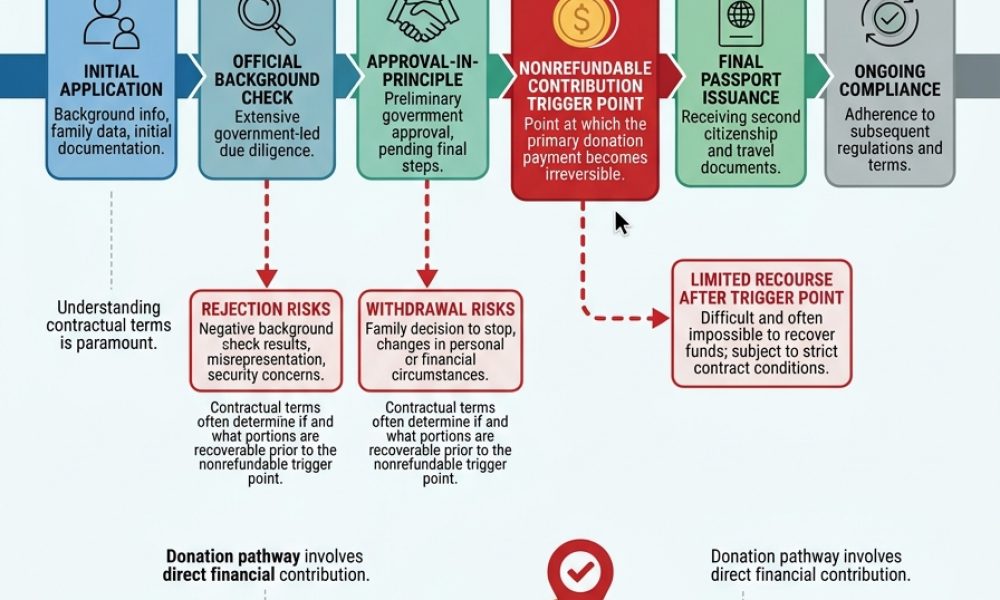
Citizenship-by-donation programs require applicants to distinguish nonrefundable government contributions from preliminary processing fees and to examine payment milestones, rejection procedures, withdrawal conditions, family eligibility, and the financial consequences of changing circumstances before committing substantial capital.
WASHINGTON, DC, November 6, 2026 — Families considering citizenship through government contributions face a financial decision that extends beyond the advertised minimum, because payment timing, contractual obligations, and the potential inability to recover funds can determine whether a program fits their circumstances.
A nonrefundable contribution represents a fundamentally different commitment from a conventional investment, particularly when applicants cannot recover the principal after completing a qualifying payment, even if their financial priorities or international relocation plans subsequently change.
Prospective applicants must therefore examine when each payment becomes due, which amounts are refundable, and how withdrawal, refusal, or administrative delays are addressed before interpreting a citizenship quotation as an affordable route to another passport.
Nonrefundable Citizenship Contributions Are Permanent Expenditures
Citizenship-by-donation programs generally require qualifying applicants to contribute to a designated government development fund, with the payment supporting national priorities rather than purchasing shares, creating a loan, or establishing a recoverable investment interest.
Once a qualifying contribution has been properly completed under a nonrefundable program, the applicant should ordinarily expect that money to remain with the government rather than become available for future withdrawal or repayment.
This distinction matters because the potential reward is lawful nationality and its associated rights, not an income-producing investment, meaning families must evaluate whether they can permanently surrender the contribution without undermining financial security.
Dominica Provides a Clear Example of the Financial Structure
Dominica’s official Citizenship by Investment Unit guidance on program costs and contributions identifies its Economic Diversification Fund as a nonrefundable route requiring a minimum US$200,000 contribution from one qualifying applicant.
A principal applicant with up to three qualifying dependents generally faces a US$250,000 contribution, while additional relatives can increase the total according to eligibility categories and the applicable government fee schedule.
The minimum amount does not include every administrative expense, and families must separately account for due diligence, interviews, processing, documents, professional services, and passport applications when determining their full financial exposure.
The Payment Sequence Creates an Important Distinction
Under Dominica’s published procedures, applicants submit through an authorized agent, and the government assesses the application before instructing an approved applicant to make the principal qualifying fund contribution.
That sequence reduces the risk of making the main contribution before preliminary approval. Still, it does not make earlier processing, professional, or screening payments automatically recoverable if an application is unsuccessful.
Applicants should distinguish the contribution itself from other payments required during the process, because fees charged for work already performed may remain payable even if the underlying citizenship application does not proceed.
Approval in Principle Is Not the Same as Citizenship
A government letter approving in principle ordinarily indicates that the applicant has reached a significant stage of assessment and may proceed with the required investment, subject to remaining conditions.
It does not establish that naturalization is complete, because the qualifying payment must still be made and any outstanding official requirements satisfied before a citizenship certificate can be issued.
Families should carefully examine the timing stated in approval correspondence, particularly when the payment deadline coincides with changing financial circumstances, international banking restrictions, or a reassessment of the household’s relocation plans.
Withdrawal Before Approval Requires Contractual Review
An applicant who withdraws before receiving government approval may avoid completing the main nonrefundable contribution, depending on the program’s payment sequence, but may have already incurred preliminary expenses.
Authorized agents, lawyers, translators, and other service providers may have performed substantial work, meaning contractual terms rather than the headline contribution policy can determine whether previously paid professional fees remain refundable.
Before signing an agreement, applicants should request written explanations addressing withdrawal at different stages, including before document submission, after government filing, during screening, and after receipt of approval in principle.
Application Refusal Does Not Mean Every Fee Is Returned
A government may refuse citizenship after reviewing background information, documentary evidence, financial history, or other eligibility considerations, and applicants should not assume screening fees will be returned simply because approval was denied.
Due diligence investigations, application processing, and professional document preparation represent services or administrative activities that may generate nonrefundable charges before the government reaches its final decision.
The key question is whether the qualifying contribution was already due and paid, which fees were incurred during review, and what the applicable government rules and signed agreements provide.
Changing Family Circumstances Can Alter Contribution Requirements
A family applying together may experience marriage, divorce, childbirth, or changes in dependency before completing the application, potentially affecting eligibility, screening charges, and the contribution category applicable to the household.
An adult child may no longer qualify under the same dependent provisions. At the same time, a newly added family member may require additional documentation and individual government review before citizenship can be granted.
Applicants should establish whether amendments are permitted, what additional fees apply, and how removing or adding a dependent affects payments already made under the original application.
Nonrefundable Fees and Contributions Must Be Distinguished
The term nonrefundable can describe several different payments, including government application charges, background investigation expenses, professional retainers, and the final contribution made to a public development fund.
Do not combine these amounts into one vague contractual category, because their payment dates, recipients, purposes, and refund conditions may differ substantially under government rules and individual agreements.
An itemized quotation should identify each charge separately and explain which circumstances allow a refund, credit, or adjustment without implying protections that the responsible government has never authorized.
International Policy Changes Add Financial Uncertainty
An October 29, 2026, Reuters investigation into European pressure on Caribbean citizenship programs described negotiations over potential program closures and the consequences for governments dependent on citizenship-related revenues.
European concerns focus partly on security and visa-free travel privileges, while Caribbean governments have emphasized the economic importance of these programs for public revenue, infrastructure, and development.
Applicants should recognize that a completed donation cannot necessarily be recovered because an unrelated government subsequently changes visa-waiver arrangements, making long-term travel benefits a separate consideration from payment obligations.
Contract Terms Should Address Program Changes
An agreement with a commercial representative should clarify what happens when an official program changes its contribution requirements, introduces additional screening, or suspends applications. Meanwhile, the applicant’s file remains under review.
The document should distinguish changes occurring before submission from those arising after approval, including whether additional government payments would require the applicant’s written authorization before the representative proceeds.
Where possible, contracts should also identify the applicable refund provisions and dispute-resolution procedures, although private agreements cannot guarantee that a government will return a legally nonrefundable contribution.
Payment Instructions Require Independent Verification
Large international transfers carry risks of incorrect account details, intermediary charges, unauthorized payment requests, and confusion about whether money is going to a government fund or a private representative.
Applicants should verify the official payment procedure through authorized sources and retain reliable transaction records, particularly when final contribution instructions arrive after months of correspondence and preliminary investigation.
The recipient, currency, amount, transfer deadline, and responsibility for banking charges should be clear before funds move, because a successful transfer does not automatically establish that citizenship has been granted.
Changing Financial Circumstances Require Early Decisions
An applicant may experience business losses, unexpected medical expenses, family emergencies, or investment setbacks while waiting for government approval, leaving the household less financially comfortable with a previously affordable contribution.
The appropriate response is to evaluate the signed obligations and applicable deadlines before making a final payment, rather than assuming that an earlier expression of interest creates an unavoidable commitment.
Families should maintain sufficient liquidity for existing responsibilities and future settlement expenses, recognizing that another nationality may be valuable without justifying financial decisions that endanger essential household reserves.
Property Investments Create Different Recovery Questions
An approved real estate route may provide an ownership interest that can eventually be sold, unlike a completed government donation. Still, recovery depends on holding restrictions, market conditions, and contractual rights.
Property buyers may face maintenance charges, management expenses, construction problems, or weak resale demand, so the chance of recovering capital differs from a government guarantee of repayment.
The comparison should therefore distinguish a certain nonrecoverable contribution from an investment carrying uncertain future proceeds, rather than treating either arrangement as universally preferable for every applicant.
Passport Issuance Follows Official Citizenship Recognition
After the government confirms completion of the qualifying contribution and remaining requirements, a successful applicant may receive a certificate of naturalization before submitting a separate passport application.
That sequence matters when a family has already paid substantial sums but still awaits government documentation, because payment confirmation alone is not a valid travel document.
Applicants should budget for the final administrative stages and avoid relying on anticipated passport delivery when arranging nonrefundable travel, particularly where several relatives require separate documents.
Passport Authentication Does Not Establish Payment Rights
Modern biometric passports contain electronic security features that compatible inspection systems can examine. Still, technical authentication cannot determine whether a citizenship contribution was refundable or whether contractual obligations were properly fulfilled.
Amicus International Consulting explains related verification limits in its guide on how to scan a passport’s NFC chip and understand the results, distinguishing electronic security checks from broader government decisions.
Even a successfully authenticated passport cannot establish the value of a previous investment, the enforceability of a refund clause, or the applicant’s rights against an intermediary.
Independent Review Can Protect the Household Budget
Families considering a substantial nonrefundable contribution should seek appropriate legal and financial advice before signing agreements, especially when multiple representatives or payment recipients are involved.
A useful review examines the program’s current authority, the applicant’s eligibility, government fee schedules, refund provisions, family circumstances, and how much capital remains after completing the contribution.
This preparation cannot eliminate every commercial or regulatory uncertainty, but it can identify obligations that might otherwise become apparent only after the applicant has paid substantial nonrecoverable expenses.
Financial Certainty Depends on Knowing When Obligations Become Final
Citizenship-by-donation programs can offer lawful nationality opportunities, but you should assess your ability to complete a qualifying contribution alongside government approval, family eligibility, and the possibility of future changes in circumstances.
The essential questions concern when money becomes nonrecoverable, which preliminary expenses remain payable after withdrawal or rejection, and whether contractual terms accurately describe the rights available at each application stage.
Ultimately, nonrefundable contributions change the citizenship cost equation because applicants are committing capital for potential nationality benefits rather than purchasing a recoverable asset, making timing, transparent agreements, and government verification indispensable to responsible financial planning.




