
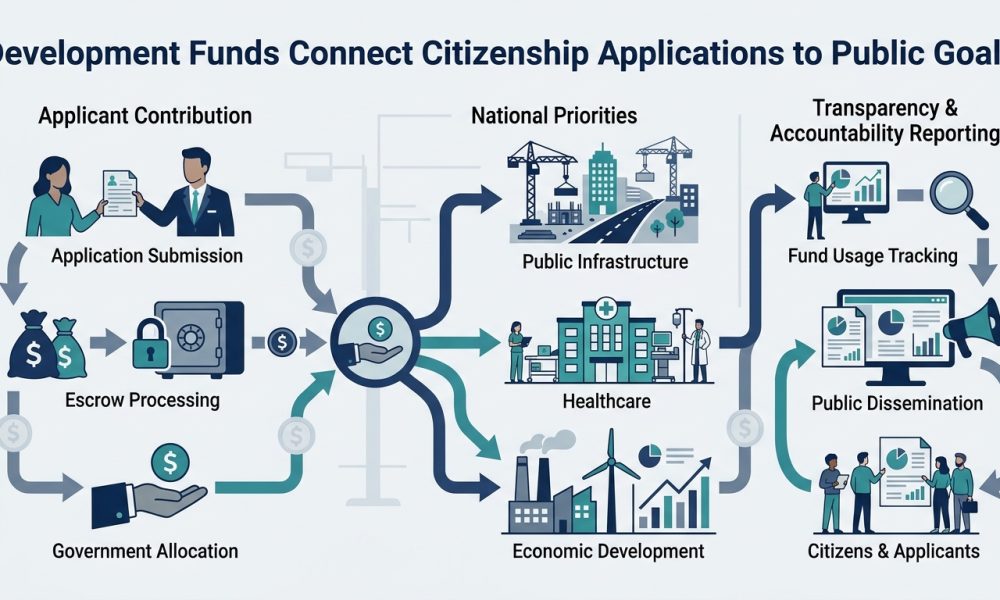
Citizenship-by-donation programs link private contributions to public development priorities, including infrastructure, healthcare, education, and climate resilience, while raising important questions about government accountability, financial oversight, investment migration, and the long-term economic benefits delivered to citizens.
WASHINGTON, DC, November 6, 2026 — Citizenship-by-investment programs are attracting renewed attention as Caribbean governments show how contributions from foreign applicants can support national development, creating an important link between private citizenship applications and public spending priorities.
For applicants considering a second passport through a government development fund, the transaction involves more than a financial contribution, because the proceeds may become part of a country’s broader strategy for financing infrastructure, healthcare, education, and economic diversification.
The arrangement also creates responsibilities for participating governments, which must balance the economic benefits of incoming funds against effective financial management, transparent reporting, national security screening, and the expectations of citizens whose communities are intended to benefit.
Citizenship Contributions Serve a Broader Public Purpose
Donation-based citizenship programs allow qualifying foreign nationals to make nonrefundable contributions to designated government funds, with the financial proceeds intended to support economic development and other public initiatives identified under the issuing country’s legislation.
Unlike conventional commercial investments, these contributions generally do not give applicants ownership interests or repayment rights, so their financial purpose is tied to government development objectives rather than future investment income or recoverable capital.
The distinction matters because governments frequently describe citizenship contributions as instruments of national development. At the same time, applicants evaluate whether the resulting nationality rights justify a permanent expenditure under the program’s current financial and legal requirements.
Dominica’s Economic Diversification Fund Provides an Example
Dominica’s Economic Diversification Fund forms part of the country’s established citizenship-by-investment framework, allowing qualifying applicants to contribute money toward government-supported initiatives while completing the required nationality application and background investigation procedures.
According to the Citizenship by Investment Unit, the fund supports public- and private-sector projects in education, healthcare, infrastructure, tourism, information technology, agriculture, and other activities intended to strengthen economic development.
The government currently identifies a minimum contribution of US$200,000 for an individual applicant, while qualifying family applications require different amounts and additional administrative expenses depending on the number and circumstances of participating relatives.
Education Can Be a Major Beneficiary of Development Funding
Educational infrastructure represents one of the public priorities identified by Dominica’s citizenship authorities, including school construction and improvements intended to support learning environments and expand opportunities for students across the country.
For small island economies, financing educational facilities can create benefits extending beyond individual construction projects, particularly when improved school infrastructure supports workforce development, community resilience, and the long-term economic prospects of younger generations.
However, a government’s statement that citizenship revenue supports education should be distinguished from independently verified project expenditures, since meaningful accountability requires evidence of which initiatives received funding and what outcomes they delivered.
Healthcare Projects Connect Funding to Public Services
Dominica’s citizenship authorities also identify hospital renovations and healthcare improvements among the development activities supported through program revenues, reflecting the importance of medical infrastructure in geographically dispersed island communities.
Investment in hospitals and health centers can strengthen access to essential care. Still, actual benefits depend on staffing, equipment, maintenance, operational financing, and whether completed facilities remain able to serve residents over time.
Governments can improve public understanding by distinguishing announcements of planned healthcare expenditures from completed projects, published financial allocations, and measurable improvements in the delivery of medical services to local populations.
Infrastructure Development Can Shape National Economic Capacity
Roads, airports, public facilities, and utilities can influence tourism, commercial activity, emergency preparedness, and regional connectivity, making infrastructure financing an important consideration when governments explain how citizenship contributions advance national development objectives.
Dominica has publicly linked citizenship-related financing to major infrastructure and reconstruction initiatives, including projects intended to improve transportation capacity and strengthen resilience after destructive tropical storms that have affected the island.
The financial significance of these projects creates a corresponding need for transparent procurement, realistic construction budgets, independent oversight, and regular reporting that allows the public to evaluate progress against government commitments.
Climate Resilience Creates Particular Challenges for Island States
Caribbean governments face substantial costs from hurricanes, coastal exposure, infrastructure damage, and changing environmental conditions, making reliable financing for disaster preparedness a key part of long-term national development.
Revenue from citizenship programs can fund resilience initiatives, but reliance on unpredictable applicant demand may complicate planning when expensive projects require sustained funding over several years.
Authorities should therefore distinguish temporary revenue opportunities from dependable long-term financing, especially when public infrastructure and disaster Protection measures create financial obligations that continue after construction is complete.
Tourism and Agriculture Can Receive Development Support
Dominica identifies tourism and agriculture among the sectors associated with its Economic Diversification Fund, reflecting an effort to strengthen economic activity beyond the direct administrative revenue generated by nationality applications.
Support for tourism infrastructure and agricultural capacity can potentially encourage employment and domestic business development. Still, project selection should be based on economic feasibility rather than the assumption that every funded initiative will succeed.
For prospective citizenship applicants, these objectives provide context for the government’s contribution requirement without transforming the payment into a conventional investment that produces personal ownership or contractual financial returns.
Development Funding Can Create Opportunities for Local Businesses
Government spending supported by citizenship contributions may generate construction contracts, procurement activity, professional service demand, and opportunities for local suppliers, creating economic effects beyond the initial transfer of funds.
Those benefits depend on the structure of public expenditure and whether domestic businesses can compete effectively for contracts, meaning the distribution of opportunities deserves attention alongside the total amount of citizenship revenue collected.
Transparent procurement procedures and public reporting can help citizens evaluate whether development spending supports a broad range of local enterprises or becomes concentrated among a relatively limited group of beneficiaries.
The Financial Scale Has Attracted International Attention
An October 29, 2026, Reuters investigation into European pressure on Caribbean citizenship programs described how investment migration revenues have become economically significant for several Eastern Caribbean governments.
The report identified European concerns involving security and visa-free travel privileges, while also explaining that ending the programs could affect government budgets and the financing arrangements supporting national development initiatives.
This tension illustrates the competing considerations facing participating states, which must weigh the economic value of citizenship revenues against international concerns about identity screening, financial integrity, and immigration controls.
Revenue Dependence Creates a Public Finance Challenge
Citizenship contribution receipts can strengthen government finances during periods of sustained international demand. Still, reliance on those payments creates exposure when applications decline, or foreign policy changes affect the attractiveness of a country’s passport.
The International Monetary Fund has examined these risks across the Eastern Caribbean, emphasizing the need for stronger revenue management, greater transparency, and realistic planning for when citizenship-related income falls.
Governments relying on these funds for recurring expenditure must consider how essential services would continue if application volumes declined sharply, particularly when budget commitments extend beyond the period of strong program demand.
Public Reporting Helps Distinguish Revenue From Results
The amount collected from citizenship applicants is only one measure of program activity, because development outcomes depend on how funds are allocated, whether authorized expenditures occur, and whether completed projects provide lasting benefits.
Government reporting can identify contribution receipts, administrative costs, approved projects, expenditure categories, and outstanding commitments, allowing citizens to understand the relationship between nationality programs and public financial management.
Independent audits and project-level assessments can build confidence by examining whether reported spending matches actual work, particularly when large construction programs involve multiple contractors and long delivery schedules.
Clear Accounting Supports Public Confidence
A transparent development fund should make it possible to distinguish gross contributions from the amounts available after accounting for operating expenses, screening costs, contractual obligations, and other program-related financial commitments.
This distinction matters especially when promotional descriptions cite substantial citizenship revenues without explaining how much funding ultimately reaches schools, hospitals, transport systems, or other intended public beneficiaries.
Publicly accessible financial statements and consistent reporting standards can support informed scrutiny without assuming that every contribution produces identical economic benefits or that all government development claims are independently verified.
Citizenship Approval Remains Separate From Development Spending
An applicant’s contribution may support national development. Still, the government’s willingness to accept funding does not eliminate requirements governing personal eligibility, background screening, identity verification, or the formal recognition of citizenship.
Dominica’s application process includes review through authorized representatives and government authorities, with mandatory interviews for applicants aged sixteen and older and due diligence designed to evaluate relevant personal and financial information.
These procedures demonstrate that citizenship donations should not be represented as unrestricted passport purchases, because sovereign approval remains essential regardless of the public objectives supported by the contribution.
Financial Screening Protects the Integrity of Contributions
Authorities may examine an applicant’s source of wealth and source of funds before approving citizenship, seeking evidence that the proposed government contribution originates from legitimate activities and properly documented financial arrangements.
That assessment can involve employment records, business ownership, investment proceeds, inheritance documents, and other information appropriate to the applicant’s circumstances, with additional investigation where the submitted evidence leaves material questions unresolved.
Effective screening supports both immigration integrity and confidence in public development funding, since governments have an interest in ensuring that revenue supporting national projects is not associated with prohibited financial activity.
Family Applications Change the Contribution Calculation
A principal applicant may include qualifying relatives under a citizenship program, but the government’s financial requirements can vary according to family composition, dependency categories, and individual screening obligations.
Dominica currently identifies a US$250,000 Economic Diversification Fund contribution for a principal applicant and up to three qualifying dependents, with additional amounts potentially applying to larger eligible households.
Families should therefore evaluate the complete contribution and administrative budget before applying, rather than assuming that a single advertised amount covers every relative or guarantees approval for all participating individuals.
Nonrefundable Donations Require Careful Financial Planning
Once a qualifying development fund contribution becomes nonrefundable under the applicable government rules, applicants generally cannot treat the money as capital available for withdrawal, repayment, or another future investment.
The financial benefit sought is the acquisition of lawful nationality and its associated rights, making the decision fundamentally different from purchasing an income-producing property or acquiring a security with an expectation of financial returns.
Applicants should preserve sufficient resources for family obligations, international relocation, and unexpected expenses after completing the contribution, particularly when the intended benefit involves establishing residence or maintaining a long-term contingency option.
A Second Passport Does Not Guarantee Every Travel Privilege
Citizenship can provide domestic residence and employment rights. Still, visa-free access to other countries depends on external immigration policies that may change through diplomatic negotiations, security assessments, or revised entry requirements.
European scrutiny of Caribbean citizenship programs illustrates why an issuing government cannot permanently guarantee visitor privileges granted by another jurisdiction, even when nationality was lawfully acquired under its domestic legislation.
Applicants should therefore distinguish the enduring legal status of citizenship from international travel benefits that remain subject to decisions by destination governments and transportation authorities.
American Applicants Retain Separate Nationality Responsibilities
The U.S. Department of State’s official guidance on dual nationality explains that Americans can hold another citizenship while remaining subject to applicable United States laws and passport requirements.
Another nationality does not automatically eliminate federal tax obligations, create a separate financial identity, or exempt individuals from Identification requirements imposed by regulated banks and immigration authorities.
Prospective applicants maintaining international assets or business interests should obtain qualified advice before assuming that contributing to a foreign development fund independently creates tax advantages, asset Protection, or unrestricted financial privacy.
Passport Authentication Cannot Verify Development Spending.
Modern biometric passports include electronic security features that compatible readers can examine. Still, successful technical authentication does not show how a citizenship contribution was allocated or whether a government development project met its stated objectives.
Amicus International Consulting explains the limits of electronic verification in its guide on scanning a passport’s NFC chip and interpreting the results, distinguishing document security from broader administrative and legal questions.
Applicants should therefore evaluate passport authenticity, government nationality recognition, and public financial accountability as separate matters, each requiring evidence appropriate to the specific question.
Citizenship Planning Should Include Public Accountability Questions
Families exploring second passport and citizenship planning through Amicus International Consulting should review the issuing country’s legal framework, current fees, screening procedures, and published information on the public development purposes tied to qualifying contributions.
Professional assistance can help organize documents and explain application requirements, but government authorities remain responsible for granting nationality and accounting for revenues collected through officially authorized development funds.
An informed applicant should understand both sides of the arrangement, including the personal financial commitment and the government’s stated public objectives, without assuming that commercial representatives can independently verify every claimed development outcome.
Development Funds Must Balance Revenue and Long-Term Sustainability
For participating governments, citizenship contributions can provide meaningful resources for infrastructure, healthcare, education, and economic diversification, but the lasting public benefit depends on responsible expenditure and credible financial oversight.
A program that generates substantial receipts during favorable market conditions still requires contingency planning, because international demand and diplomatic arrangements may change. At the same time,e public infrastructure and essential services continue to create financial obligations.
Ultimately, development funds link citizenship applications to public goals by turning private contributions into potential national resources, making transparent accounting, responsible government approval, and measurable community benefits central to evaluating the broader value of citizenship-by-donation programs.




