
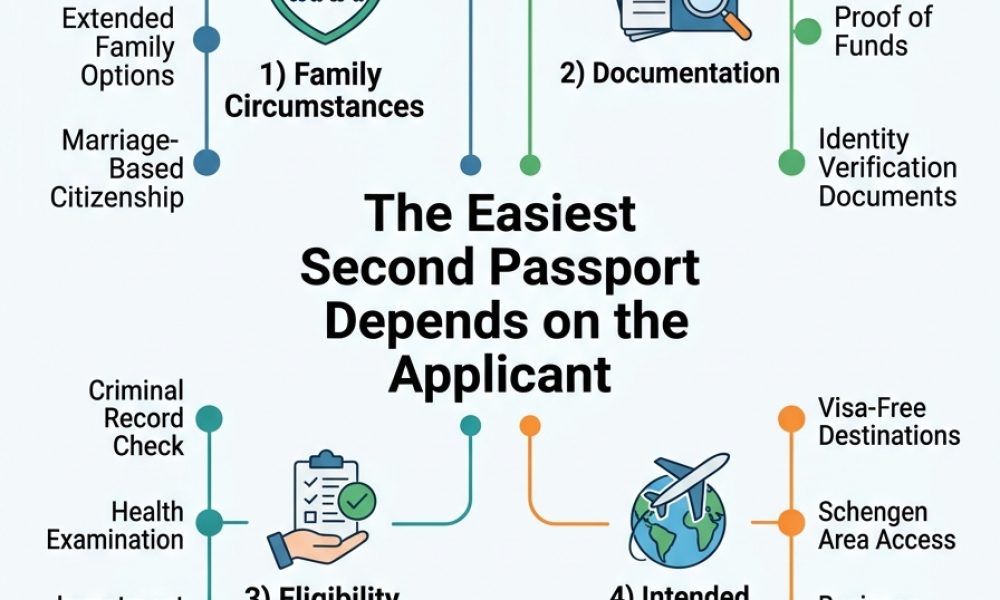
Claims about simple citizenship routes require individualized assessment because ancestral eligibility, investment costs, residency obligations, family circumstances, government screening, and intended travel destinations can make one pathway considerably more practical than another.
WASHINGTON, DC, November 6, 2026 — The search for the easiest second passport is becoming increasingly complicated as prospective applicants compare citizenship by descent, government-authorized investment programs, and residence-based naturalization without always considering the legal and personal circumstances that determine eligibility.
For an American with a qualifying Irish grandparent, ancestral citizenship may provide a relatively direct legal pathway. Meanwhile, another applicant without relevant family connections may need years of lawful residence or a substantial financial contribution.
The most suitable route therefore depends less on commercial rankings promising fast approvals and more on whether an individual satisfies the applicable nationality law, possesses authentic supporting records, and can meet the government’s financial and administrative requirements.
There Is No Universally Easiest Second Passport
Citizenship laws differ between countries: some recognize nationality through parents, others allow registration through grandparents, and certain jurisdictions offer naturalization after residence or contributions under specifically authorized government programs.
An applicant with citizenship through descent may only need to document that status. In contrast, someone pursuing investment citizenship must meet screening requirements before the government considers granting a new nationality.
These differences make promotional claims about the easiest passport inherently incomplete unless they identify the applicant type, relevant family history, financial circumstances, and the specific immigration or citizenship rights being sought.
Canadian Citizenship Reform Illustrates Individual Eligibility
A May 30, 2026, Reuters report on growing American interest in Canadian citizenship by descent described increased approvals following Canada’s December 2025 reforms, highlighting how changes in nationality law can create opportunities for previously excluded descendants.
The report cited 1,140 additional approvals in January, 1,255 in February, and 1,405 in March, showing strong demand among families exploring Canadian ancestry and future international residence opportunities.
However, the expanded legislation does not make every distant descendant Canadian, because relevant birth dates, parental nationality, historical legal restrictions, and substantial connection requirements for certain future births remain essential considerations.
Citizenship by Descent May Involve Existing Legal Rights
Citizenship by descent can be comparatively straightforward when an applicant already qualifies automatically through a parent, possesses complete civil records, and needs only an official certificate or passport documenting existing nationality.
The process becomes more complicated when the applicant must establish relationships across several generations, investigate historical naturalization events, or resolve inconsistencies involving surnames, adoption records, and birth registrations.
Families should therefore distinguish an uncomplicated first-passport application from a complex nationality recognition case, even when both applications ultimately rely on the same ancestral connection to a particular country.
Irish Ancestry Offers a Different Registration Pathway
Ireland recognizes citizenship automatically in certain circumstances involving an Irish-born parent, while individuals with Irish-born grandparents may become citizens by entering the country’s Foreign Births Register.
Applicants relying on foreign birth registration must provide the required genealogical and civil records, including documents connecting the relevant generations and explaining legally recognized name changes where necessary.
An Irish grandparent can therefore offer a meaningful pathway for one applicant. Still, another relative born under different circumstances may face additional requirements that affect when citizenship can be acquired and transmitted.
Historical Documents Can Determine How Difficult an Application Becomes
A strong ancestry claim can become administratively demanding when applicants must recover essential birth certificates, marriage registrations, or naturalization records from archives in several countries.
Official authorities may require certified documents, evidence connecting changed names, and records issued by original custodians rather than relying solely on privately prepared family trees or ancestry websites.
Applicants who begin with complete, consistent records may experience a substantially simpler process than relatives whose documents contain historical errors, even when their underlying nationality eligibility appears similar.
Investment Citizenship Offers a Different Type of Opportunity
Government-authorized citizenship-by-investment programs can provide an alternative for applicants without qualifying ancestry, but they ordinarily require substantial financial commitments, detailed documentation, background investigations, and official approval.
Dominica’s Citizenship by Investment Unit currently identifies a minimum US$200,000 contribution through its Economic Diversification Fund, alongside separate government charges for due diligence, interviews, processing, and nationality documentation.
The financial requirements may appear more predictable than researching several generations of ancestry. Still, payment cannot eliminate screening or guarantee that an applicant will meet the government’s citizenship criteria.
Mandatory Interviews Challenge Simplified Marketing Claims
Dominica requires citizenship-by-investment applicants aged sixteen and older to participate in mandatory interviews, which can be conducted virtually through authorized arrangements rather than requiring every applicant to travel internationally.
Applicants must also undergo background investigations examining identity, financial circumstances, source of wealth, source of investment funds, and other matters relevant to the government’s assessment.
A program advertised as requiring no physical residence or international travel should therefore not be confused with an interview-free or scrutiny-free application, particularly when promotional materials predate current screening requirements.
Citizenship by Donation Has a Distinct Financial Structure
A government-funded contribution generally represents a permanent, nonrefundable expenditure after completion, making it fundamentally different from acquiring an investment property or another financial asset that might eventually be sold.
Families considering contribution-based citizenship should calculate government payments, professional fees, dependent applications, screening expenses, and passport issuance before assuming the advertised minimum reflects the full household commitment.
An applicant with sufficient financial resources may accept that expenditure for legitimate nationality benefits, while another family may reasonably prefer an ancestry or residence pathway involving different expenses and obligations.
Real Estate Investment Is Not Automatically Simpler
Approved property investments can provide a qualifying route under certain citizenship programs, but they introduce ownership agreements, holding periods, transaction charges, maintenance expenses, and uncertainty about future market value.
A government-approved property category establishes eligibility within a particular program, not a commercial guarantee that the underlying asset will appreciate or generate reliable income.
Applicants should separate citizenship approval from property performance and obtain appropriate contractual review before treating real estate as a straightforward substitute for a nonrefundable government contribution.
Naturalization Through Residence Requires Long-Term Commitment
Residence-based naturalization can provide a lawful route for individuals willing to establish their lives in another country, often involving minimum residence periods, language qualifications, integration requirements, and background screening.
Unlike an ancestry claim based on existing family history, ordinary naturalization may require the applicant to relocate, maintain qualifying residence, and demonstrate continuing compliance over several years.
For someone already planning permanent settlement, these obligations may fit naturally into broader life plans, while an applicant seeking immediate mobility without relocating may find them considerably less practical.
Family Composition Can Change the Preferred Route
A passport pathway that works for one adult may become less attractive when a spouse, adult child, or older dependent cannot qualify under the same citizenship or immigration provisions.
Some nationality laws allow children to inherit citizenship automatically, while others require registration, proof of parental residence, or compliance with rules limiting transmission through successive generations born abroad.
Households should therefore evaluate each participating member’s eligibility before choosing a program, because the principal applicant’s approval does not necessarily establish permanent relocation rights for the entire family.
Marriage Does Not Automatically Create Foreign Citizenship
Spouses of newly recognized citizens often remain foreign nationals who must qualify for residence through sponsorship, partnership, employment, or another category established under the destination country’s immigration legislation.
That separate process may require financial evidence, relationship documentation, government fees, and additional waiting periods, potentially affecting the household’s ability to relocate together on a preferred date.
An applicant comparing nationalities should examine family reunification provisions alongside personal citizenship eligibility, especially when the intended destination must support two working adults or dependent relatives.
Passport Rankings Can Obscure More Important Rights
Commercial rankings emphasize visa-free destinations, but short-term visitor access does not automatically authorize employment, permanent residence, or unrestricted access to public healthcare in the countries listed.
A highly ranked passport might offer little additional travel convenience to an American who already visits most preferred destinations without conventional visas, while another nationality could create meaningful residence rights.
Families should therefore compare the countries where they actually intend to live, work, study, or retire rather than treating the largest destination count as the decisive measure of citizenship value.
Dual Citizenship Creates Continuing Legal Responsibilities
The U.S. Department of State’s official dual nationality guidance explains that Americans can hold another nationality while remaining subject to applicable United States legal obligations, including passport requirements governing American entry and departure.
Another passport does not automatically terminate United States citizenship, eliminate tax reporting responsibilities, or exempt the individual from the laws of the country granting additional nationality.
Applicants should assess these ongoing obligations before choosing a pathway, especially when overseas residence, substantial financial assets, professional licensing, or family responsibilities could create additional legal considerations.
Processing Time Depends on Application Complexity
Government processing estimates may describe ordinary applications with complete evidence, while files involving missing documents, inconsistent personal information, additional investigations, or unusual family circumstances can require substantially longer review.
A program advertised as fast should therefore be evaluated according to its current official procedures, rather than treating an intermediary’s previous successful application as a guaranteed timetable for a different person.
Prospective applicants should also distinguish approval in principle, formal citizenship recognition, and passport issuance, since those milestones may require separate administrative steps before the person can actually travel.
Current Government Authority Matters More Than Commercial Promises
A legitimate citizenship program must operate under the issuing country’s legal framework, with responsible government authorities determining who qualifies and which documents establish nationality after approval.
Professional advisers can assist with application preparation, genealogical research, document certification, and coordination, but they cannot independently grant citizenship or waive mandatory screening requirements through private contractual arrangements.
Consumers should be cautious when advertisements promise guaranteed passports, invented family histories, or exemption from legal requirements without identifying the statutory basis and responsible government decision-maker.
Privacy Benefits Must Be Understood Realistically
Second citizenship may provide valuable international flexibility, but it does not establish an unrelated personal identity, remove existing financial records, or eliminate Identification requirements imposed by border authorities and regulated institutions.
Amicus International Consulting explains technical identity-document verification in its guide on scanning a passport’s NFC chip and understanding the results, distinguishing electronic passport authentication from nationality recognition and administrative validity.
Applicants seeking privacy should prioritize lawful document handling, secure communications, and accurate personal records rather than relying on promises that a new passport can conceal legally relevant historical information.
Professional Planning Should Begin With the Applicant’s Objectives
People considering second passport planning through Amicus International Consulting should begin by identifying their actual purpose, whether it involves international business travel, family relocation, ancestral citizenship recognition, retirement, or preserving future residence options.
A structured assessment can compare available legal pathways, documentary requirements, expected expenses, processing uncertainty, and the status of accompanying relatives without assuming that one country offers the easiest solution for everyone.
This approach also helps separate citizenship from ordinary residence permits, because a family may meet its immediate relocation objectives through a lawful immigration program without first acquiring another nationality.
The Most Practical Citizenship Route Is an Individual Decision
An applicant with documented Irish ancestry may find registration more suitable than investment citizenship. Meanwhile, someone with no qualifying family connection may need to consider residence-based naturalization or an authorized contribution program.
Neither option is universally easiest, because legal eligibility, financial commitments, family composition, administrative requirements, and intended destination determine how manageable the process becomes for each individual.
Ultimately, the easiest second passport depends on the applicant because specific national laws govern citizenship, and the most practical pathway lawfully matches personal eligibility, household needs, available resources, and long-term international objectives.




