
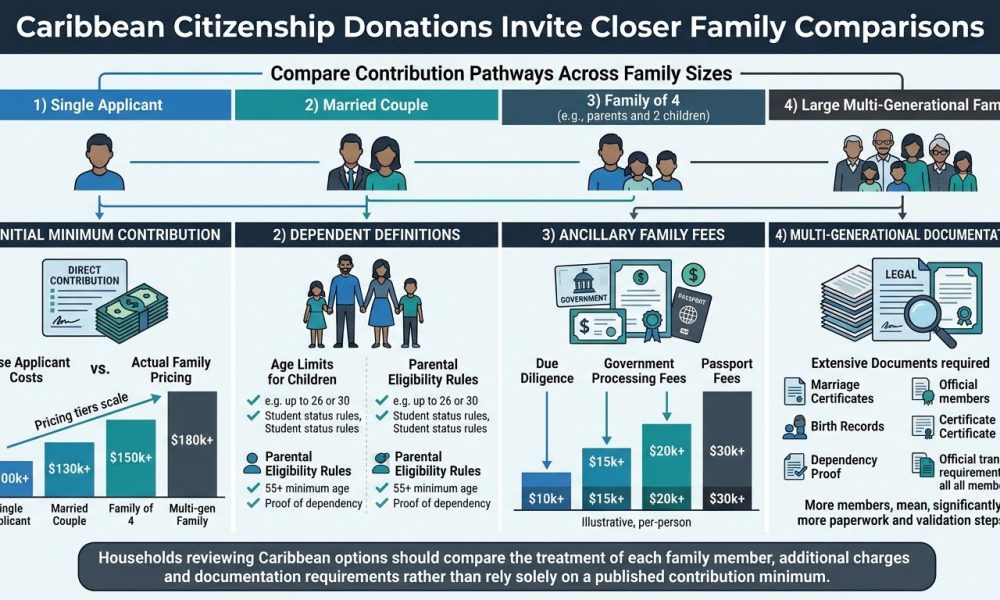
Families evaluating Caribbean citizenship-by-investment programs must compare more than the advertised contribution, because dependent eligibility, age-related screening charges, government processing fees, documentary requirements, and future family additions can substantially change the total cost of acquiring another nationality.
WASHINGTON, DC, November 6, 2026 — Caribbean citizenship-by-investment programs continue attracting international families seeking additional residence and travel opportunities, but comparing the available donation routes requires a detailed assessment of household composition, government charges, and the legal requirements applying to individual relatives.
A contribution advertised for a family of four may appear financially attractive. Yet, eligibility can change when the household includes adult children, aging parents, grandparents, or other dependents whose circumstances differ from the program’s standard family categories.
For applicants considering Dominica, Grenada, Saint Lucia, Antigua and Barbuda, or Saint Kitts and Nevis, the most useful comparison therefore involves identifying who qualifies, which payments apply to each individual, and what government approval actually provides.
Family Composition Matters More Than the Headline Price
Citizenship donation programs generally establish a minimum qualifying contribution. Still, that amount does not necessarily represent the complete cost of obtaining nationality for a spouse, children, and other eligible family members.
Governments may apply different contribution brackets, background investigation charges, interview requirements, and processing fees according to age or dependency, meaning two households with identical membership numbers can face substantially different financial commitments.
An applicant with a spouse and two young children may fall under one fee structure, while another applicant supporting elderly parents or financially dependent adult children may qualify under additional provisions with higher charges.
Dominica Establishes a Clear Family Contribution Framework
Dominica’s Economic Diversification Fund currently requires US$200,000 from a single principal applicant, while the published contribution for the principal applicant and up to three qualifying dependents is US$250,000.
The country’s official schedule also identifies an additional US$25,000 contribution for each qualifying dependent younger than eighteen and US$40,000 for each additional dependent aged eighteen or older beyond the relevant family category.
These amounts establish the principal government contribution, but applicants must additionally account for processing, background checks, interviews, naturalization certificates, professional assistance, and the costs of obtaining acceptable documents from foreign authorities.
Saint Lucia Uses a Different Family Funding Structure
Saint Lucia’s National Economic Fund currently lists a US$240,000 contribution for a principal applicant accompanied by up to three qualifying dependents, creating a different starting point than Dominica’s published household contribution.
For additional qualifying dependents, the program lists US$10,000 for each person younger than eighteen and US$20,000 for each person older than eighteen under the applicable contribution schedule.
The apparent price difference should not determine the decision independently, because Saint Lucia applies its own processing and due diligence charges, while qualifying family relationships and the government’s screening requirements must still be established.
Grenada Introduces Another Contribution Calculation
Grenada’s National Transformation Fund identifies a US$235,000 contribution covering a principal applicant and up to three qualifying dependents, subject to exclusions affecting particular dependent categories and supplementary charges.
The government distinguishes certain relatives, including specified parents, grandparents, and siblings, whose inclusion can create additional contribution requirements that are not captured by the standard family-of-four amount.
Applicants should therefore examine Grenada’s dependency definitions alongside its published application, processing, interview, and due diligence charges rather than treating the minimum fund contribution as an all-inclusive family quotation.
Antigua and Barbuda Separates Contributions From Processing Fees
Antigua and Barbuda currently identifies a US$230,000 minimum contribution to its National Development Fund, which can cover a qualifying family application but does not automatically eliminate other government charges.
The program publishes processing fees of US$10,000 for a single applicant and US$20,000 for a family of up to four, with additional charges applying when more qualifying dependents participate.
This structure shows why comparing the fund contribution alone can lead to misleading conclusions, particularly when family members also incur due diligence and passport fees that must be paid separately.
Recent International Pressure Complicates the Comparison
An October 29, 2026, Reuters investigation into European pressure on Caribbean investor citizenship programs described negotiations affecting five Eastern Caribbean countries whose citizenship revenues contribute significantly to national development and government finances.
The reporting examined European concerns involving security and visa-free Schengen access, while regional governments emphasized the importance of program revenues for infrastructure, economic activity, and public spending.
For families comparing citizenship opportunities, these developments reinforce the importance of reviewing current government authorization and travel privileges without assuming every existing program will keep the same conditions indefinitely.
Dependent Definitions Can Change Eligibility
A dependent is not necessarily anyone who receives financial assistance from the principal applicant, because each citizenship program establishes its own rules governing qualifying relationships, age limits, and evidence of support.
Certain programs accommodate financially dependent adult children or parents under defined conditions, while others distinguish siblings, grandparents, and relatives with particular care needs through additional eligibility provisions.
Families should confirm whether each proposed member qualifies before calculating the contribution, because excluding a relative can require an entirely separate immigration strategy rather than a simple additional payment.
Adult Children Require Individual Attention
Adult children present particular planning challenges because some programs recognize qualifying dependency during education or other specified circumstances, whereas financial independence or changes in personal circumstances can affect eligibility.
Parents should review documentation requirements for education, financial support, marital status, and the dependent’s age before assuming a child approaching adulthood will qualify under the same category as younger siblings.
An application submitted near an eligibility threshold may warrant professional review of the precise governing rules, particularly where changes during processing could affect whether the family member remains eligible.
Parents and Grandparents May Increase Total Costs
Including elderly parents or grandparents can be an important objective for families seeking intergenerational security, but programs differ in qualifying ages, dependency criteria, and government charges for older relatives.
The principal applicant may need to provide evidence of financial support and legally recognized family relationships, while the older relative may be required to complete medical, background, or identity checks.
A family comparison should therefore include the practical interests of older dependents alongside the financial quotation, particularly when healthcare access and suitable living arrangements are central to the intended relocation.
Government Screening Fees Change Household Budgets
Dominica’s official schedule identifies a US$7,500 due diligence charge for the principal applicant and US$4,000 for each dependent aged sixteen or older, alongside other application expenses.
Saint Lucia and Grenada maintain their own screening structures, so the number and ages of participating relatives matter when calculating the household’s total mandatory government payments.
Even when one jurisdiction advertises a lower contribution, additional due diligence and processing expenses can narrow the apparent difference, especially when several adults or older teenagers apply.
Mandatory Interviews Can Affect Teenagers
Dominica requires applicants aged sixteen and older to participate in mandatory interviews, generally conducted through authorized virtual arrangements, as part of the government’s identity and background examination process.
The requirement applies to eligible teenagers and adults, meaning a household with older children may face additional interview charges and scheduling responsibilities than a family with only young children.
Applicants should verify the issuing government’s current interview rules rather than relying on promotional descriptions prepared before regional screening standards were strengthened or revised.
Authentic Family Records Are Essential
Citizenship authorities may require birth certificates, marriage documents, adoption records, police certificates, medical information, and other evidence establishing both the identities and legally recognized relationships of participating family members.
Where relatives were born in different countries, documentary preparation may involve translations, apostilles, legalization, or formal corrections of inconsistent names and dates appearing in historical civil records.
These requirements can create expenses and delays independent of the qualifying contribution, making early document collection especially important for households involving several generations or complicated family histories.
Application Timing Must Include Every Relative
A principal applicant may complete their documentation before accompanying relatives, but the government’s review can depend on receiving complete information for every person included within the intended family application.
Additional verification involving one family member may affect the administrative timetable, particularly when a background investigation requires clarification or an official document must be obtained from an overseas authority.
Families should therefore avoid assuming that an advertised processing estimate guarantees simultaneous passport issuance, especially when relocation plans involve school admissions, employment changes, or nonrefundable travel arrangements.
Adding Family Members Later Has Separate Consequences
Some Caribbean programs permit qualifying dependents to be added after the principal applicant acquires citizenship, but the financial and procedural requirements may differ substantially from including them initially.
Saint Lucia, for example, publishes separate contribution categories for adding a spouse, newborn child, or other qualifying dependent after the original applicant becomes a citizen.
Do not assume a later addition is available without verification, because age, dependency, family relationships, screening requirements, and current program regulations may determine whether that option exists.
Application Approval Remains a Government Decision
A family contribution cannot independently create citizenship for every relative because each applicant must meet the responsible government’s eligibility and screening requirements before it can issue official nationality documentation.
Authorized representatives can coordinate records, submit applications, and explain financial requirements, but they cannot grant citizenship or exempt family members from mandatory government investigations.
Applicants should distinguish approval in principle from completed naturalization and subsequent passport issuance, ensuring that contractual promises accurately reflect the government’s actual decision-making process.
Citizenship Is Different From Permission to Relocate Elsewhere
An approved Caribbean nationality may establish the right to reside in its issuing country. Still, it does not automatically authorize permanent residence or employment in unrelated destinations that allow short-term visa-free visits.
Families seeking a second passport primarily for relocation should assess housing, healthcare, education, employment, and the rights of accompanying relatives rather than focusing exclusively on international passport rankings.
The practical value of citizenship depends on whether the country’s legal benefits support the household’s actual objectives, especially when multiple generations expect to establish their lives abroad.
American Families Retain Separate Legal Obligations
The U.S. Department of State’s official guidance on dual nationality explains that American dual nationals generally remain subject to applicable United States laws, including passport requirements governing American entry and departure.
Another nationality does not automatically eliminate existing tax obligations, financial reporting responsibilities, or lawful Identification requirements imposed by government authorities and regulated financial institutions.
Families maintaining American businesses, retirement accounts, property, or trusts should examine those responsibilities with qualified professionals before assuming that acquiring Caribbean citizenship independently changes their financial or legal position.
Passport Verification Does Not Replace Citizenship Approval
Modern biometric passports incorporate electronic identity information and cryptographic protections that compatible inspection systems can examine. Still, successful technical authentication does not independently establish the legality of an underlying citizenship application.
Amicus International Consulting explains these distinctions in its guide on scanning a passport’s NFC chip and understanding the results, separating electronic document verification from official nationality recognition.
A technically authentic passport may still be expired, canceled, or unsuitable for a particular journey, demonstrating why applicants should rely on current government documentation and applicable border requirements.
Professional Advice Should Address the Complete Family
Families exploring lawful second passport planning through Amicus International Consulting should start by identifying every proposed applicant and reviewing the legal eligibility, documentation, and financial commitments tied to each available government pathway.
A comprehensive assessment should distinguish qualifying contributions, screening fees, professional charges, interview expenses, passport costs, and future dependent additions before the household makes substantial nonrefundable commitments.
Professional coordination can help organize applications, but the responsible citizenship authority retains final decision-making power, and no private adviser can guarantee approval or waive statutory eligibility requirements.
A Complete Comparison Must Include Financial Reserves
Families making a substantial nonrefundable contribution should preserve sufficient funds for housing, medical care, education, transportation, and unexpected expenses rather than treating the passport application as their only international planning cost.
The expense becomes particularly significant when several relatives relocate together, because maintaining household stability abroad may require resources beyond those committed to obtaining citizenship.
A realistic budget therefore separates nationality acquisition costs from later settlement expenses, ensuring a successful passport application does not leave the family financially unprepared for its intended move.
Regulatory Changes Require Current Verification
Government investment thresholds, eligible dependent categories, screening charges, and international visitor privileges can change, making older promotional quotations unreliable when evaluating a family application under current legislation.
Recent European scrutiny of Caribbean programs reinforces the importance of verifying official requirements before payment, especially when a household expects nationality to support long-term mobility across several jurisdictions.
Applicants should obtain current government fee schedules and written explanations from authorized representatives, rather than assuming another family’s earlier approval applies to their own application.
Family Eligibility Determines the Real Citizenship Cost
Caribbean citizenship donations can provide lawful nationality opportunities for qualifying households, but the financial comparison becomes meaningful only after assessing each relative’s eligibility, documentation, and additional government charges.
A seemingly inexpensive contribution may become substantially more costly when several dependents require separate screening. At the same time, a higher advertised minimum may cover a household composition that better matches the applicant’s circumstances.
Ultimately, Caribbean citizenship donations invite closer family comparisons because the value and affordability of another nationality depend on individual eligibility, complete government fees, authentic documentation, and the practical benefits available to every participating family member.




