
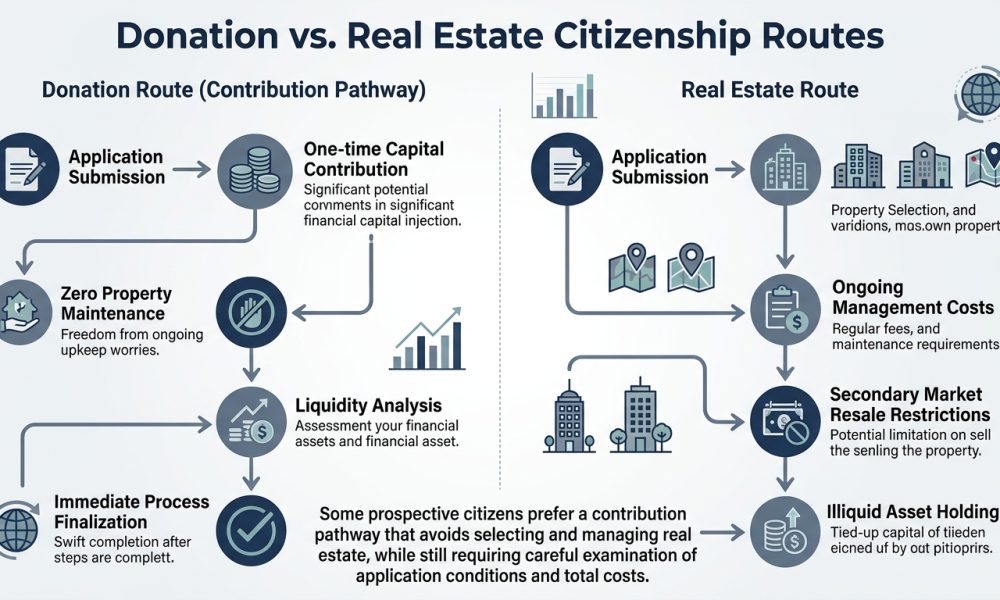
Government contribution programs offer an alternative to purchasing qualifying real estate, attracting applicants who prefer defined financial commitments without property ownership or management, while nonrefundable payments, background investigations, family eligibility, and changing international travel privileges remain essential considerations.
WASHINGTON, DC, November 6, 2026 — Citizenship-by-donation programs are attracting attention from international applicants who want a lawful second nationality without buying resort property, managing rental investments, or accepting the commercial uncertainties of government-approved real estate developments.
For families considering Caribbean citizenship, a nonrefundable contribution can provide a more straightforward financial arrangement. Still, the apparent simplicity of the transaction does not remove government screening, additional fees, or the possibility of application refusal.
The central question is whether surrendering a defined amount of capital in exchange for consideration under an authorized citizenship program better serves the applicant’s objectives than acquiring property that may eventually be sold.
Donation-Based Citizenship Offers a Different Financial Structure
A citizenship donation generally involves contributing money to a designated government development fund under legislation that permits qualifying foreign nationals to apply for naturalization after meeting prescribed eligibility and due diligence requirements.
Unlike purchasing real estate, the contribution ordinarily does not create an ownership interest, rental income entitlement, or contractual expectation that the applicant will recover the money after citizenship is granted.
This distinction can appeal to individuals who primarily seek nationality and international mobility rather than another investment property requiring ongoing attention, particularly when their existing portfolios already include substantial real estate holdings.
Dominica Provides a Clear Comparison of Both Routes
Dominica currently offers two main citizenship-by-investment pathways: a contribution to its Economic Diversification Fund and the purchase of an interest in a government-approved real estate development.
Under the official Dominica Citizenship by Investment Unit’s published investment requirements, both routes begin at US$200,000 for a principal applicant. However, additional government charges and financial obligations make their total costs substantially different.
The Economic Diversification Fund contribution is nonrefundable, while qualifying real estate must generally be retained for at least three years, or five years when subsequently sold to another applicant seeking program qualification.
Avoiding Property Ownership Can Reduce Administrative Complexity
Applicants choosing a government contribution generally avoid selecting a development, negotiating property contracts, assessing construction schedules, and arranging ongoing management services that may become necessary when qualifying citizenship through real estate.
Those avoided responsibilities can be particularly relevant for internationally mobile business owners and retirees who already maintain homes in several countries and do not want additional administrative obligations attached to another property.
However, avoiding property management should not be confused with avoiding financial risk altogether, because a completed donation permanently transfers capital rather than leaving an asset available for future sale.
Recent European Pressure Adds Uncertainty to Caribbean Programs
An October 29, 2026, Reuters investigation into European Union pressure on Caribbean citizenship programs described negotiations involving several Eastern Caribbean countries whose investor citizenship revenues support public finances and development projects.
The reporting identified European concerns about security and visa-free Schengen access, alongside the financial implications for governments that have become dependent on contributions and investment-related economic activity.
These developments do not mean that every existing nationality has been canceled. Still, they make it important for applicants to distinguish current government approval procedures from international visitor privileges that could change.
A Nonrefundable Contribution Requires a Different Financial Assessment
A household making a qualifying donation should generally treat that payment as money permanently spent, rather than as part of a portfolio expected to provide future income, appreciation, or capital repayment.
The benefit received after successful approval is citizenship itself, which may provide lawful residence, employment opportunities, and certain international travel privileges, depending on the issuing country’s laws and external agreements.
Applicants should therefore assess affordability using available capital after the donation, ensuring that their retirement plans, business operations, emergency reserves, and family responsibilities remain financially sustainable without recovering the contributed funds.
Property Investment Introduces Separate Commercial Risks
A qualifying property purchase may offer the possibility of capital recovery through a later sale. Still, the amount ultimately recovered depends on contractual rights, market conditions, investor demand, and the development’s financial performance.
Resort investments can involve maintenance charges, operating expenses, occupancy uncertainty, construction delays, and transfer restrictions, so an officially approved project is not necessarily a profitable commercial investment.
Prospective buyers should distinguish government authorization for citizenship purposes from independent financial analysis, because approval of a development under a nationality program does not guarantee rental distributions or capital preservation.
Starting Prices Do Not Reveal the Complete Cost
Dominica’s published contribution schedule identifies US$200,000 for one principal applicant and US$250,000 for a principal applicant with up to three qualifying dependents, before applicable supplementary screening and administrative charges.
The government also publishes a US$1,000 processing fee, a US$7,500 due diligence fee for the principal applicant, and separate charges for qualifying dependents, interviews, and certificates of naturalization.
These additional payments demonstrate why a donation advertised at US$200,000 cannot accurately be described as an all-inclusive passport price, especially when professional fees and document preparation expenses are considered.
Real Estate Routes Can Carry Higher Government Charges
Dominica’s approved real estate pathway currently requires a qualifying property investment of at least US$200,000, alongside government fees beginning at US$75,000 for an individual applicant after the relevant approval.
For a principal applicant and up to three qualifying dependents, the published government fee rises to US$100,000, before other applicable processing, investigation, documentation, and professional charges.
These differences can make the contribution route financially attractive to applicants who place little value on holding another property. However, comparisons should still consider the potential resale value of a qualifying asset.
Government Screening Remains Mandatory Under Both Routes
Choosing a donation instead of property does not eliminate the requirement to establish personal eligibility, disclose relevant background information, and demonstrate that the funds used for the application originate from legitimate sources.
Dominica’s published procedures involve authorized representatives, independent due diligence investigations, government review, and mandatory interviews for applicants aged sixteen and older before the responsible authorities determine whether to approve citizenship.
Applicants should question advertisements that describe contribution citizenship as automatic or free from meaningful screening, especially when a private intermediary suggests a large payment can replace statutory eligibility requirements.
The Source of Funds Matters Before Payment
Citizenship authorities may request documents demonstrating how applicants accumulated their wealth and where the specific money intended for the contribution originated, even when the applicant maintains substantial assets with regulated banks.
Supporting evidence can include employment income, company ownership, investment statements, inheritance documents, or proceeds from legitimate property sales, depending on the circumstances and the program’s current documentary requirements.
A donation may therefore avoid commercial property due diligence while still requiring extensive personal financial verification, making accurate records and professional preparation important before the application is formally submitted.
Family Composition Can Change the Preferred Funding Route
An individual applicant may find a government’s contribution structure straightforward. Still, the financial calculation can change considerably when a proposed citizenship application includes spouses, children, dependent parents, or grandparents.
Additional relatives may increase qualifying contributions, require separate background investigations, and add interview expenses and passport fees, while certain family members may not qualify under the relevant dependency provisions.
Families should therefore confirm the eligibility and total cost for each intended beneficiary before selecting a funding option, rather than assuming one contribution automatically provides citizenship to an unrestricted household.
Authorized Agents Coordinate the Application Process
Dominica requires citizenship-by-investment applications to proceed through government-authorized agents, whose responsibilities include coordinating documents, explaining procedures, and communicating with the citizenship authority during the government’s review.
An agent may provide valuable professional assistance, but the representative cannot independently grant nationality, guarantee an outcome, or exempt an applicant from screening requirements established under the issuing country’s legislation.
Prospective applicants should confirm an intermediary’s authorization, obtain a written fee agreement, and distinguish government payments from professional charges before transferring substantial funds or signing investment commitments.
Approval in Principle Is Not Final Citizenship
Under Dominica’s published application sequence, government review and background investigations generally precede instructions to complete the qualifying donation or approved real estate investment after approval in principle.
The preliminary approval indicates that the applicant may proceed to satisfy the remaining requirements, but it should not be mistaken for completed naturalization or an immediately usable government passport.
Only after the required conditions are satisfied can the issuing authority complete citizenship documentation, and applicants must then follow a separate administrative process to obtain appropriate travel documents.
A Second Passport Has Benefits Beyond Tourist Travel
A lawfully granted nationality can provide an enduring connection to its issuing country, including domestic residence and employment rights that differ substantially from temporary visitor permission granted by unrelated foreign governments.
For internationally mobile families, those rights may support retirement planning, future relocation, business activities, or an additional place of residence when personal or economic circumstances change.
Nevertheless, applicants should evaluate whether the issuing country actually fits their plans, because obtaining another passport does not automatically authorize permanent residence or employment in every destination offering visa-free short visits.
External Visa Privileges Are Subject to Change
The attractiveness of Caribbean nationality often includes access to foreign destinations without conventional advance visas. Still, those privileges depend on decisions by other governments, not permanent guarantees from the citizenship-issuing country.
Recent European discussions on investor citizenship show that a passport’s visitor benefits can become the subject of international policy negotiations, even when a person’s underlying nationality remains legally recognized.
Applicants should therefore value actual residence opportunities and intended travel destinations rather than assuming current passport rankings will guarantee the same international access in future decades.
Tax Residence and Citizenship Require Separate Analysis
Obtaining another nationality through a government contribution does not automatically eliminate existing tax obligations, create a new financial identity, or change the reporting responsibilities imposed by banks and other regulated institutions.
American applicants may still face United States taxation and financial reporting obligations after acquiring another passport. At the same time, relocating to the issuing country can raise additional questions about tax residence and foreign income.
Families with international businesses, investment accounts, trusts, or substantial property holdings should obtain qualified cross-border advice before assuming that a contribution-based citizenship program independently provides asset Protection or financial anonymity.
Passport Verification Does Not Replace Legal Recognition
Modern biometric passports incorporate contactless electronic chips and cryptographic security features that compatible inspection systems can examine. Still, successful technical authentication does not independently establish the legal validity of an original citizenship application.
Amicus International Consulting explains these distinctions in its guide on scanning a passport’s NFC chip and understanding the results, emphasizing the difference between electronic document checks and official nationality determinations.
An authentic passport may still be expired, canceled, or unsuitable for a particular journey, meaning applicants should rely on current government-issued records and applicable travel rules rather than commercial claims about electronic scanning results.
A Donation Route Should Match the Applicant’s Objectives
For individuals focused on acquiring another nationality without additional property management, a government contribution may offer a clearer financial commitment than purchasing a resort interest subject to holding requirements.
Other applicants may prefer an approved asset because they value the possibility of eventual capital recovery, even though that possibility introduces commercial uncertainty and continuing obligations that require independent assessment.
Neither route offers a universally suitable answer, so household finances, family composition, planned residence, and tolerance for investment risk matter more than a simple comparison of advertised minimum amounts.
Professional Advice Can Clarify the Complete Decision
Families comparing lawful second passport and citizenship planning options through Amicus International Consulting should consider the legal pathway, government eligibility requirements, financial commitments, and documentary responsibilities associated with each proposed program.
Professional coordination can help applicants organize records and understand the process, but government approval remains outside private consultants’ authority, and investment performance must be evaluated independently of citizenship eligibility.
A transparent proposal should explain the qualifying contribution, screening costs, family fees, professional services, payment stages, and potential consequences of refusal before the applicant makes an irreversible financial commitment.
Long-Term Relocation Costs Remain Separate From Citizenship Fees
A family intending to settle abroad may need substantial funds for housing, transportation, healthcare, schooling, insurance, and local financial arrangements after acquiring nationality, regardless of the contribution pathway selected.
These expenses can become especially significant when several relatives relocate together or when employment, professional licensing, and access to local services require additional preparation following citizenship approval.
The household should therefore preserve sufficient resources for settlement rather than directing every available dollar toward the qualifying contribution, especially when the original objective is to establish a secure and sustainable life overseas.
Regulatory Changes Require Continuing Verification
Citizenship program thresholds, dependent definitions, screening charges, and approved investment categories can change, meaning commercial brochures prepared under earlier regulations may not accurately describe the opportunities currently available.
Applicants should confirm official program status and fees immediately before proceeding, particularly while Caribbean governments and European authorities continue discussing the future of investor citizenship and associated visa-free access.
Older successful applications can provide useful background, but they cannot guarantee that a new applicant will face identical conditions, expenses, processing timelines, or international mobility benefits under the rules now in force.
Donation Routes Offer Simplicity Without Eliminating Responsibility
The main appeal of a contribution-based citizenship pathway is the ability to avoid selecting, owning, and eventually disposing of qualifying real estate while making a defined payment to an authorized national development fund.
That administrative simplicity does not remove the consequences of a nonrefundable contribution or the requirements for government screening, accurate financial disclosures, family eligibility assessment, and formal nationality approval.
Ultimately, donation routes appeal to applicants who want to avoid property purchases because they separate citizenship financing from commercial real estate ownership. At the same time, successful planning still depends on understanding the full costs, legal requirements, and the practical value of another nationality.




